
Endometriosis vs Adenomyosis: Understanding the Difference in Symptoms, Diagnosis and Treatment
By Dr. Pallavi Kulkarni, MBBS, DGO, DNB (OB-GYN), DFP, MRCOG (UK), Fellowship in IVF · Medically reviewed by Dr. Pallavi Kulkarni ·
Quick answer: In both endometriosis and adenomyosis, tissue like the lining of the womb grows where it should not. In endometriosis it grows outside the uterus, on the ovaries and the lining of the pelvis, and the main problem is pain: very painful periods, pain during sex, and pain passing stool or urine during periods. In adenomyosis it grows inside the muscle wall of the uterus, which becomes bulky, and the main problem is heavy, painful periods.
An ultrasound usually finds adenomyosis. Endometriosis can be diagnosed from your symptoms, an examination and a scan, but a normal scan does not rule it out (ACOG 2026, WHO). Many women have both. Neither is cancer, and both are treatable, usually with medicines or a hormone coil rather than surgery. See the side-by-side table.
Holding a scan report? See what “bulky uterus” and other report words mean. Worried about your daughter? Read about endometriosis in teenagers.
Go to the nearest hospital emergency department if you have sudden, severe pain in the lower belly, or very heavy bleeding with dizziness or fainting. See all warning signs.
Two women can come to our clinic in Kandivali East with almost the same complaint, painful periods, and leave with different diagnoses. One has endometriosis. The other has adenomyosis. Quite often, a woman has both. The names sound alike and some treatments overlap, but the two conditions behave differently, and knowing which one you have changes what to expect from scans, medicines, surgery and pregnancy.
This guide puts endometriosis and adenomyosis side by side: where each one grows, how the symptoms differ, how each is found, every treatment option, what the studies say about pregnancy, and when to see a gynaecologist.
Endometriosis vs adenomyosis: the difference at a glance
If you are scanning rather than reading, start here. Each row is explained further down.
| Endometriosis | Adenomyosis | |
|---|---|---|
| Where the tissue grows | Outside the uterus: ovaries, tubes, the lining of the pelvis, sometimes the bowel or bladder | Inside the muscle wall of the uterus |
| Main problem | Pain | Heavy bleeding with pain |
| Periods | Very painful. Bleeding is not always heavy | Heavy, long and painful, often with clots |
| Other common signs | Pain during sex. Pain passing stool or urine during periods. Difficulty getting pregnant | A large, tender uterus. Tiredness from low iron (anaemia) |
| Size of the uterus | Usually normal | Often enlarged (“bulky”) |
| Usual age when found | Often in the 20s and 30s. Symptoms can start in the teens | Most often in the late 30s and 40s. Can also be found in younger women |
| Main tests | Your symptoms, an examination and an ultrasound. MRI for deeper disease | Ultrasound. MRI if the scan is not clear |
| Is keyhole surgery (laparoscopy) needed to find it? | Sometimes, not always | No. The camera cannot see inside the wall of the uterus |
| Common first treatments | Pain medicines and hormonal medicines | The hormone coil (LNG-IUS). Tranexamic acid on heavy days or hormonal tablets as alternatives |
| Does removing the uterus cure it? | Not necessarily, because the disease is outside the uterus | Yes, but it is the last option, for women whose family is complete and whom other treatments have not helped |
What is the difference between endometriosis and adenomyosis?
The difference is where the tissue grows. The uterus (womb) has a soft inner lining, the endometrium. Every month this lining thickens and then sheds as your period. In both conditions, tissue that looks like this lining grows in the wrong place.
- Endometriosis: the tissue grows outside the uterus. It is most often found on the ovaries, the fallopian tubes and the thin lining that covers the inside of the pelvis. Sometimes it is on the bowel or the bladder.
- Adenomyosis: the tissue grows inside the muscle wall of the uterus. The wall thickens, and the uterus often becomes larger and tender. Scan reports may call this a “bulky uterus”.
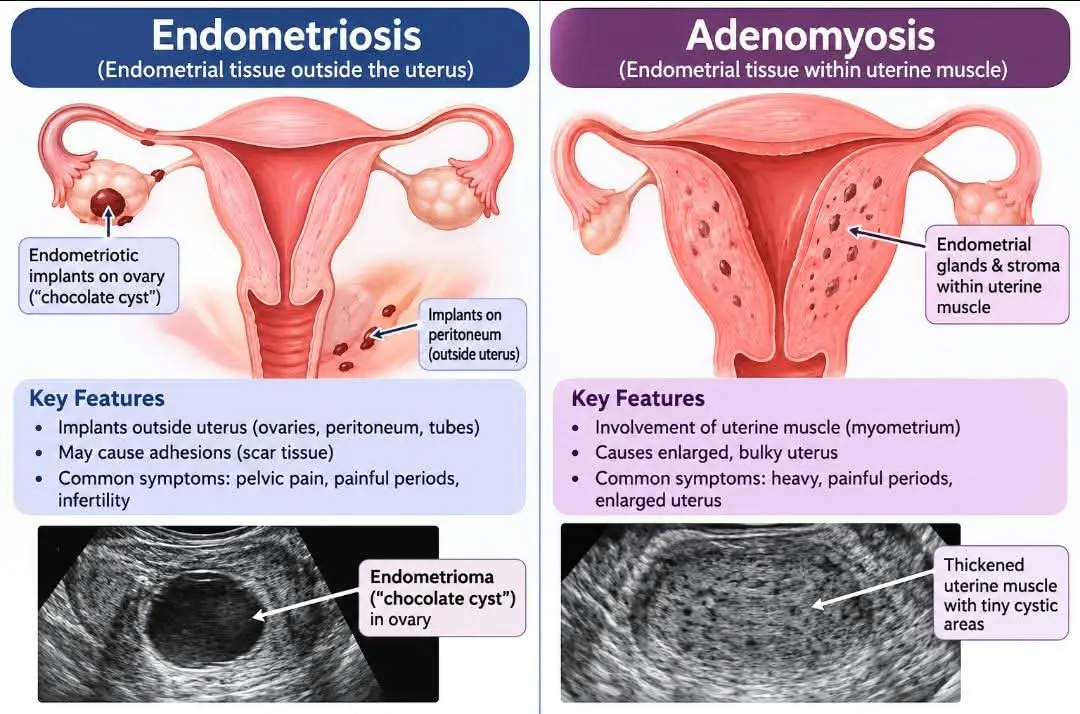
Wherever it is, this tissue responds to your monthly hormones, just as the normal lining does. It swells and bleeds, but the blood has no easy way out. That causes inflammation, pain and, over time, scarring. In endometriosis the scarring can stick organs together (adhesions). In adenomyosis the muscle wall becomes thick and tender and bleeds more each month.
Why does it happen?
Doctors do not know the exact cause of either condition. For endometriosis, one widely held idea is that some period blood flows backwards through the tubes into the pelvis. Many women have this and never develop endometriosis, so the immune system and genes also play a part. Having a mother or sister with endometriosis raises the chance. Adenomyosis is seen more often in women who have had pregnancies or surgery on the uterus, though the link is not fully proven.
Three things are true of both. Neither is an infection. Neither is cancer. And neither is caused by anything you did or did not do.
Endometriosis vs adenomyosis symptoms: how each one usually feels
Endometriosis usually shows up as pain: very painful periods, pain during sex, and pain passing stool or urine during periods. Adenomyosis usually shows up as heavy, long, painful periods, often with clots. Some period pain is common, but pain that keeps you away from work, college or school, or keeps you in bed, is not normal. It deserves a check-up.
Endometriosis: pain is the main sign
- Very painful periods. The pain often starts a day or two before the bleeding and gets worse over the years.
- Deep pain during or after sex.
- Pain when passing stool or urine, mainly during periods.
- Pain in the lower belly or pelvis on days when you do not have your period.
- Difficulty getting pregnant. For some women this is the only sign.
- Tiredness and low mood, often from living with pain for a long time.
The amount of pain does not always match the amount of disease. A woman with a few small patches can have severe pain, and a woman with a large chocolate cyst can have very little. Bowel symptoms during periods are sometimes mistaken for a stomach problem such as irritable bowel syndrome (IBS).
Endometriosis affects about 1 in 10 women of reproductive age worldwide (WHO).
“The question I ask is not only how bad the pain is, but what it stops you from doing. If you take leave every month, avoid sex because it hurts, or plan travel around your period, that pain deserves to be looked into, whatever anyone has told you about period pain being normal.”
- Dr. Pallavi Kulkarni, MBBS, DGO, DNB (OB-GYN), DFP, MRCOG (UK), Fellowship in IVF
Adenomyosis: heavy bleeding is the main sign
- Heavy periods. You may pass clots, soak through pads quickly, or bleed for more than 7 days.
- Painful, cramping periods that slowly get worse over the years.
- A feeling of pressure or heaviness in the lower belly.
- Pain during sex.
- Tiredness, weakness, breathlessness or hair fall. These can be signs of anaemia (low iron) from losing blood every month.
- Sometimes, difficulty getting pregnant.
Not every woman with adenomyosis has symptoms. Older studies of women who had a hysterectomy reported that about a third had none, though newer research suggests the true figure may be lower (Upson and Missmer, 2020). If it is found by chance on a scan and you have no symptoms, it needs an explanation, not fear, and usually no treatment.
Nobody knows exactly how common adenomyosis is, because it was long diagnosed only after a hysterectomy. In one London study, about 1 in 5 women attending a general gynaecology clinic had signs of adenomyosis on ultrasound. These were women who already had symptoms, so the figure for all women is likely lower. Heavy periods from adenomyosis are one reason anaemia is so common in Indian women; our guide to heavy bleeding during periods covers the bleeding side in detail.
Can you have endometriosis and adenomyosis at the same time?
Yes. Many women have both, and fibroids (non-cancerous lumps of muscle in the uterus) can be present as well. This is why symptoms alone cannot tell you which condition you have. For example:
- A woman treated for endometriosis may still have heavy periods, because she also has adenomyosis.
- A woman treated for adenomyosis may still have pain during sex or pain passing stool, because she also has endometriosis.
The name matters less than finding everything that is present. A careful history, an examination and a good scan do this.
Is adenomyosis the same as fibroids?
No, though they are often confused and often found together. A fibroid is a separate, rounded lump of muscle with a clear edge, and a surgeon can usually shell it out. Adenomyosis spreads through the wall of the uterus without a clear edge, which is why it is much harder to remove on its own. Our guide to uterine fibroids explains fibroids in detail.
Painful periods, heavy periods or both? A consultation can work out which condition is present, often with just an examination and an ultrasound, and set out treatment that fits your plans for pregnancy.
How are endometriosis and adenomyosis diagnosed?
Both conditions are diagnosed from your history, an examination and an ultrasound scan. A normal scan does not rule out endometriosis, and keyhole surgery cannot see adenomyosis. The first steps are the same for both:
- Your story. Your gynaecologist asks about your periods, the pattern of pain, bleeding, pain during sex, bowel and bladder symptoms, and any difficulty getting pregnant.
- An examination, if you are comfortable with it. The doctor checks for tenderness, a large or tender uterus, and swellings near the ovaries.
- An ultrasound scan (sonography). This is the first scan for both conditions. It is usually done through the vagina (transvaginal), because this gives the clearest picture. If you have never been sexually active, the scan is done through the abdomen (tummy) instead.
After this, the two conditions part ways.
Finding endometriosis
- Doctors can now diagnose endometriosis from your symptoms, examination and scan, and start treatment without surgery first (ACOG 2026, WHO).
- Ultrasound shows a chocolate cyst (endometrioma) on the ovary well. This is a cyst filled with old, thick, dark blood.
- Ultrasound often cannot see small patches on the lining of the pelvis. So a normal scan does not rule out endometriosis (NICE NG73, ESHRE 2022).
- An MRI scan may be advised if deeper disease, for example on the bowel or bladder, is suspected.
- Laparoscopy (keyhole surgery with a small camera) is kept for selected cases: for example, when treatment has not helped, when surgery is planned anyway, or as part of tests for infertility.
- No blood test can diagnose endometriosis. That includes the CA-125 test (NICE NG73, ESHRE 2022).
Many women wait years for this diagnosis. Across studies from many countries, the average wait from first symptoms to diagnosis was about 6.8 years (a review of 23 studies). A common reason is that the pain is treated as “normal”.
“A normal ultrasound report is reassuring, but it does not end the conversation. If your story fits endometriosis, I usually start treatment and see how you respond, rather than sending you for an operation just to put a name to it.”
- Dr. Pallavi Kulkarni, MBBS, DGO, DNB (OB-GYN), DFP, MRCOG (UK), Fellowship in IVF
Finding adenomyosis
- A transvaginal ultrasound is usually enough. Doctors now use internationally agreed signs to recognise adenomyosis on a scan (MUSA consensus, 2022).
- An MRI scan helps when the ultrasound is not clear, or when fibroids are also present.
- Laparoscopy does not help. The camera sees the outside of the uterus, and adenomyosis is inside the wall.
- The result depends on the experience of the person doing the scan. If your report says “normal” or “fibroids” but your symptoms continue, ask your gynaecologist to review it.
Words you may see on your scan report
Scan reports describe adenomyosis with words such as myometrial cysts, asymmetrical myometrial thickening and an irregular junctional zone, and describe endometriosis on the ovary as a chocolate cyst (endometrioma). Here is what each word means, so a report read alone at home is less frightening.
| Word on the report | What it means |
|---|---|
| Bulky uterus or globular uterus | The uterus is larger and rounder than usual. Adenomyosis is a common cause, but fibroids and a recent pregnancy can also do this, so the word alone is not a diagnosis. |
| Asymmetrical myometrial thickening | The front and back walls of the uterus (the myometrium is the muscle wall) are of unequal thickness. This points towards adenomyosis. |
| Myometrial cysts | Tiny pockets of fluid inside the muscle wall. One of the direct signs of adenomyosis. |
| Hyperechogenic islands | Small bright spots inside the muscle wall. Another direct sign of adenomyosis. |
| Fan-shaped shadowing | Thin dark stripes fanning out across the wall. An indirect sign of adenomyosis. |
| Irregular or interrupted junctional zone | The border between the lining and the muscle wall is uneven or broken. An indirect sign of adenomyosis. |
| Translesional vascularity | On a colour Doppler scan, blood vessels run straight through the abnormal area. This helps tell adenomyosis apart from a fibroid. |
| Endometrioma or chocolate cyst | A cyst on the ovary filled with old, thick blood. It points strongly towards endometriosis. |
The adenomyosis terms and their direct and indirect grouping follow the revised MUSA consensus (Harmsen et al, 2022). One sign on its own does not make the diagnosis. Your gynaecologist reads the report together with your symptoms and examination.
Treatment options for endometriosis and adenomyosis
There is no single best treatment. The right plan depends on three things: how much the symptoms trouble you, your age, and whether you want a pregnancy now or later.
For both conditions, medicines control the disease. They do not remove it, and symptoms often return when the medicine is stopped. That is not a failure of treatment. It is how these conditions behave, and it is why the plan is long-term.
Because both conditions depend on oestrogen, symptoms usually ease after menopause, which is one reason a woman in her late 40s may be advised to manage her symptoms rather than have surgery.
Treatments used for both
- Pain medicines such as ibuprofen or mefenamic acid, taken regularly on painful days rather than only when the pain is severe.
- Hormonal medicines. These include the combined pill, progestogen tablets such as dienogest, and the hormone coil (LNG-IUS, levonorgestrel intrauterine system). They work by quietening the monthly hormone cycle that feeds the tissue.
Some of these medicines are also used for family planning. Here they are given as treatment for the disease. Tell your doctor if you are trying to get pregnant, because the plan will be different.
Treatment for endometriosis
- Pain relief, such as paracetamol or an anti-inflammatory painkiller, and hormonal treatment are the first steps (NICE NG73).
- If these do not help, stronger hormone medicines (GnRH medicines, which switch off the ovaries for a while) can be used for a limited time under specialist care, because of side effects such as hot flushes and bone thinning.
- Keyhole surgery (laparoscopy) can remove endometriosis patches and chocolate cysts. It can reduce pain, and in some women it improves the chance of a natural pregnancy. Dr. Pallavi performs this keyhole surgery at hospitals near the clinic, listed below. Ovarian cyst surgery is described on our gynaecology procedures page.
- Endometriosis can come back after surgery. In a review of 17 studies, women who took hormonal treatment after surgery had less than half the risk of it coming back, compared with women who did not.
- Removing the uterus does not necessarily cure endometriosis, because the disease is outside the uterus (ESHRE 2022).
Treatment for adenomyosis
- The hormone coil (LNG-IUS) is a small device placed inside the uterus. It makes periods much lighter and less painful for most women, and it also prevents pregnancy while it is in place. At our clinic it is fitted in the operation theatre as a day-care procedure under short sedation, so you go home the same day. In a three-year study of 94 women with painful periods from adenomyosis, about 7 in 10 were satisfied with the coil at the end of three years. The most common side effects were weight gain and harmless (simple) ovarian cysts. NICE suggests considering it as the first treatment for heavy periods when adenomyosis is suspected or diagnosed (NICE NG88).
- Tranexamic acid is a non-hormonal tablet taken only on heavy days. It reduces bleeding, and is an option if the coil is not suitable for you or while tests are being arranged.
- Hormonal tablets such as dienogest are another option.
- Iron treatment if you are anaemic. Treating the bleeding and treating low iron go together.
- Uterine artery embolisation blocks the small blood vessels that feed the adenomyosis. No cut on the abdomen is needed. Across studies of 1,049 women, symptoms improved in about 8 in 10. It saves the uterus, but this is not the same as protecting fertility. Discuss this first if you want a pregnancy.
- Surgery to remove the affected part is possible only when adenomyosis is in one area of the wall rather than spread through it.
- Removing the uterus (hysterectomy) is the only complete cure for adenomyosis. It ends the chance of pregnancy, so it is for women whose family is complete and whose symptoms remain severe. It does not treat endometriosis if you have both.
From Dr. Pallavi’s own research. In her study of the hormone coil in 70 Mumbai women with abnormal bleeding, published under her maiden name, Dr. P. C. Dhamangaonkar (Journal of Mid-life Health, 2015), 26 women had adenomyosis on their ultrasound. In that group:
- By 1 year, none of the 22 women still being followed up had heavy periods. Half had only spotting and half had no periods at all.
- By 2 years, all 14 women still coming for follow-up had stopped bleeding.
This was a small study without a comparison group, and not every woman stayed in follow-up, so it cannot promise the same result for everyone. The full study is described in our heavy periods guide.
“Many women with adenomyosis come to me believing a hysterectomy is the only answer. For a woman who wants to keep her uterus, the hormone coil is usually where I start, and many never need the operation.”
- Dr. Pallavi Kulkarni, MBBS, DGO, DNB (OB-GYN), DFP, MRCOG (UK), Fellowship in IVF
Diet, yoga and home remedies
There is no good evidence that any diet, supplement, Ayurvedic, herbal or homeopathic product cures or shrinks endometriosis or adenomyosis. Regular exercise, good sleep and gentle yoga can help you cope with pain and feel better in general, and our guide to yoga for endometriosis and pelvic pain covers what the studies show. They work alongside medical treatment, not in place of it. If you take any herbal product, tell your gynaecologist.
Medicines, the hormone coil and surgery each suit different women. A consultation sets out the options that fit your symptoms, your age and your plans for pregnancy, so you can decide with all the facts.
Endometriosis, adenomyosis and pregnancy: what do the studies say?
Both conditions can make it harder to get pregnant. Neither one means you cannot have a baby.
Endometriosis. Up to half of women who have difficulty getting pregnant turn out to have endometriosis (ESHRE 2022). Looked at the other way, an often-quoted review (Bulletti et al, 2010) estimates that 30 to 50 in every 100 women with endometriosis have difficulty getting pregnant. Most women with endometriosis do have children, many without treatment. Large reviews link endometriosis with a somewhat higher chance of miscarriage, early (preterm) birth and caesarean delivery (Zullo et al, 2017). Most pregnancies still go well; your doctor may simply watch your pregnancy more closely.
Adenomyosis. Most of the research is on women having IVF. In these studies, women with adenomyosis had, on average, a lower chance of a live birth and a higher chance of miscarriage (Cozzolino et al, 2022). These are averages across groups of women. They show a link, not a proven cause, and they do not decide what will happen for you. Many women with adenomyosis do take a baby home.
Three more points:
- Pregnancy is not a cure. Symptoms often become quieter during pregnancy and breastfeeding, and commonly return afterwards. Plan a pregnancy because you want a child, not as a treatment.
- Do not wait too long. See a doctor if you have been trying for 12 months without success, or 6 months if you are over 35. If you are over 40, come as soon as you start trying. If you already know you have either condition, come as soon as you start trying, at any age (ACOG).
- Tell your doctor before starting hormonal treatment if you want a pregnancy soon, because most hormonal treatments also prevent pregnancy while you take them.
Our fertility and reproductive medicine page explains how a couple is evaluated, and Why Am I Not Getting Pregnant? covers the other common causes.
Trying to conceive with endometriosis or adenomyosis? Book a consultation to plan tests and treatment around your pregnancy plans, or call +91 91366 33062.
When should you see a gynaecologist?
See a gynaecologist if period pain or heavy bleeding keeps disturbing your life, month after month. Use the three boxes below to decide how soon.
Go to the nearest hospital emergency department if you have:
- Sudden, severe pain in the lower belly, especially with fever, vomiting or fainting
- Soaking through a pad every hour for more than two hours together, and you also feel dizzy, faint or breathless, or have chest pain. If you are bleeding that heavily and have even one of those symptoms, do not wait for the others. Get seen.
- Severe pain on one side of the lower belly, shoulder-tip pain or faintness when you could be pregnant
See your gynaecologist within a few days if:
- You have any bleeding after menopause
- You bleed between periods or after sex
- Your period pain has suddenly become much worse than usual
Call +91 91366 33062 or WhatsApp us (Monday to Saturday, 10:00 AM to 9:00 PM).
Book a routine appointment if:
- Period pain makes you miss work, college or school, or disturbs your sleep
- Pain medicines hardly help
- Your periods are very heavy: you pass large clots, change pads at night, or bleed for more than 7 days
- You have pain during or after sex
- You have pain when passing stool or urine during your periods
- You have had pain in the lower belly for more than 6 months
- You feel tired all the time, or you have been told you are anaemic
- You have been trying for a pregnancy for 12 months, or 6 months if you are over 35
- Your scan report mentions a “bulky uterus”, “adenomyosis” or a “chocolate cyst” and you want to understand it
- Your mother or sister has endometriosis and you have similar symptoms
This applies to teenagers too. Severe period pain in a young girl is not “growing pains”. Our guide to endometriosis in teenagers explains what to look for.
How to prepare for your visit
- Note the dates of your last 2 to 3 periods and how many days you bled.
- Count how many pads you use on your heaviest day, and whether you pass clots.
- Write down when the pain comes, how long it lasts, and what makes it better or worse.
- Bring your old scan reports, blood reports and a list of all your medicines, including Ayurvedic or homeopathic ones.
Severe period pain and very heavy bleeding are not something a woman must simply bear. Both conditions can be treated, and asking for help early gives you more options. For other symptoms worth a check-up, see When to Visit a Gynaecologist: 10 Signs You Must Know.
Endometriosis and adenomyosis care in Kandivali East, Mumbai
At Aarogya Women’s Clinic, Dr. Pallavi Kulkarni works out which condition is present, or whether both are, using your history, an examination and a careful ultrasound, and then talks through every option: medicines, the hormone coil, and surgery when it is genuinely needed. The plan is built around your symptoms, your age and your plans for pregnancy.
When surgery is the right choice, Dr. Pallavi performs keyhole surgery for endometriosis, hormone coil fitting and hysterectomy at hospitals near the clinic: Apollo Fertility, Borivali; Criticare Asia, Malad West; Surya Hospital, Santacruz; Phoenix Hospital, Borivali West; Seven Star Hospital, Kandivali East; Apex Hospital, Kandivali East; and Cloudnine Hospital, Malad West. More on hospital stay and recovery is on our gynaecology procedures page.
Women come to us from Thakur Village, Thakur Complex, Lokhandwala Township and Ashok Nagar in Kandivali East, and from Kandivali West, Borivali, Malad and Goregaon. If you are looking for a gynaecologist in Kandivali East for painful or heavy periods, you are welcome to call or message us.
Address: Aarogya Women’s Clinic, Shop no. 48, EMP-53, Evershine Halley, Thakur Village, Kandivali East, Mumbai 400101, next to Achija Restaurant.
Book a consultation at Aarogya Women’s Clinic, Kandivali East. Bring your period record and any earlier scan or blood reports.
Clinic hours: Monday to Saturday, 10:00 AM to 9:00 PM. Closed Sundays. Call +91 91366 33062 or +91 93245 97166.
References
- World Health Organization. Endometriosis (fact sheet), updated October 2025. https://www.who.int/news-room/fact-sheets/detail/endometriosis
- American College of Obstetricians and Gynecologists. Clinical Practice Guideline No. 11: Diagnosis of Endometriosis. Obstet Gynecol, March 2026. https://www.acog.org/clinical/guidance/clinical-practice-guideline/2026/03/diagnosis-of-endometriosis/
- National Institute for Health and Care Excellence. Endometriosis: diagnosis and management (NG73). https://www.nice.org.uk/guidance/ng73/chapter/Recommendations
- ESHRE Endometriosis Guideline Group. ESHRE guideline: endometriosis. Hum Reprod Open, 2022. PMID 35350465. https://pmc.ncbi.nlm.nih.gov/articles/PMC8951218/
- National Institute for Health and Care Excellence. Heavy menstrual bleeding: assessment and management (NG88). https://www.nice.org.uk/guidance/ng88/chapter/Recommendations
- Harmsen MJ et al. Consensus on revised definitions of Morphological Uterus Sonographic Assessment (MUSA) features of adenomyosis. Ultrasound Obstet Gynecol, 2022. PMID 34587658. https://pubmed.ncbi.nlm.nih.gov/34587658/
- Naftalin J et al. How common is adenomyosis? A prospective study of prevalence using transvaginal ultrasound in a gynaecology clinic. Hum Reprod, 2012. PMID 23001775. https://pubmed.ncbi.nlm.nih.gov/23001775/
- Upson K, Missmer SA. Epidemiology of adenomyosis. Semin Reprod Med, 2020. PMID 33105509. https://pmc.ncbi.nlm.nih.gov/articles/PMC7927213/
- Fryer J et al. Understanding diagnostic delay for endometriosis: a scoping review using the social-ecological framework. Health Care Women Int, 2025. PMID 39418593. https://pubmed.ncbi.nlm.nih.gov/39418593/
- Zakhari A et al. Endometriosis recurrence following post-operative hormonal suppression: a systematic review and meta-analysis. Hum Reprod Update, 2021. PMID 33020832. https://pmc.ncbi.nlm.nih.gov/articles/PMC7781224/
- Sheng J et al. The LNG-IUS study on adenomyosis: a 3-year follow-up study. Contraception, 2009. PMID 19185671. https://pubmed.ncbi.nlm.nih.gov/19185671/
- Dhamangaonkar PC, Anuradha K, Saxena A. Levonorgestrel intrauterine system (Mirena): an emerging tool for conservative treatment of abnormal uterine bleeding. J Midlife Health, 2015. PMID 25861205. https://pmc.ncbi.nlm.nih.gov/articles/PMC4389381/
- de Bruijn AM et al. Uterine artery embolization for the treatment of adenomyosis: a systematic review and meta-analysis. J Vasc Interv Radiol, 2017. PMID 29032946. https://pubmed.ncbi.nlm.nih.gov/29032946/
- Bulletti C et al. Endometriosis and infertility. J Assist Reprod Genet, 2010. PMID 20574791. https://pmc.ncbi.nlm.nih.gov/articles/PMC2941592/
- Zullo F et al. Endometriosis and obstetrics complications: a systematic review and meta-analysis. Fertil Steril, 2017. PMID 28874260. https://pubmed.ncbi.nlm.nih.gov/28874260/
- Cozzolino M et al. The effect of uterine adenomyosis on IVF outcomes: a systematic review and meta-analysis. Reprod Sci, 2022. PMID 34981458. https://pubmed.ncbi.nlm.nih.gov/34981458/
- American College of Obstetricians and Gynecologists. Committee Opinion No. 781: Infertility Workup for the Women’s Health Specialist, 2019. PMID 31135764. https://pubmed.ncbi.nlm.nih.gov/31135764/
This page is reviewed periodically by Dr. Pallavi Kulkarni. Last reviewed . Treatment availability and costs vary, so please confirm details with your doctor and the treating hospital.
Related reads on our blog
- → Heavy Bleeding During Periods (Menorrhagia): Causes, Warning Signs and Treatment
- → Uterine Fibroids: Symptoms, Causes and Treatment Options
- → Pain During Sex: Causes and Treatment for Women
- → Painful Periods in Teenagers
- → Why Am I Not Getting Pregnant?
- → Yoga for Women’s Health
Medically reviewed by Dr. Pallavi Kulkarni, MBBS, DGO, DNB (OB-GYN), DFP, MRCOG (UK), Fellowship in IVF, November 2026. This article is for educational purposes and does not replace personal medical advice. For diagnosis and treatment, please consult a qualified gynaecologist.
Do you have any questions?
Request An AppointmentFrequently asked questions about endometriosis and adenomyosis
What is the main difference between endometriosis and adenomyosis?
The difference is where the tissue grows. In endometriosis, tissue like the lining of the womb grows outside the uterus, on the ovaries and the lining of the pelvis, and the main symptom is pain. In adenomyosis it grows inside the muscle wall of the uterus, which becomes bulky, and the main symptoms are heavy and painful periods.
Which is more serious, endometriosis or adenomyosis?
Neither is “worse”. They trouble women in different ways. Endometriosis mainly causes pain and difficulty getting pregnant. Adenomyosis mainly causes heavy bleeding and pain. How severe it is differs more from woman to woman than from one condition to the other.
Can you have endometriosis and adenomyosis at the same time?
Yes. Many women have both, and fibroids can be present as well. That is why a woman treated for one condition may still have symptoms from the other, and why a careful examination and a good scan matter more than the name.
Do I need surgery to know which one I have?
Usually not. Adenomyosis is found on an ultrasound or MRI scan. Endometriosis can often be diagnosed from your symptoms, an examination and a scan, and treatment can start without surgery. Keyhole surgery is needed only in selected cases.
My ultrasound is normal, but I still have pain. What now?
A normal scan does not rule out endometriosis, because small patches on the lining of the pelvis often do not show on ultrasound. If your symptoms continue, go back to your gynaecologist. Treatment can be started based on your symptoms.
My laparoscopy showed no endometriosis. Can I still have adenomyosis?
Yes. Laparoscopy looks at the outside of the uterus. Adenomyosis is inside the wall of the uterus, so it needs an ultrasound or MRI scan to find it.
What does “bulky uterus” mean on my scan report?
It means the uterus is larger and rounder than usual. Adenomyosis is a common cause, but fibroids and a recent pregnancy can do the same, so the word alone is not a diagnosis. Your gynaecologist will read it together with your symptoms and the rest of the report.
What is a chocolate cyst?
A chocolate cyst, or endometrioma, is a cyst on the ovary filled with old, thick, dark blood that looks like melted chocolate. It is a form of endometriosis. Small cysts can often be watched or treated with medicines; larger or painful ones may need keyhole surgery.
Is adenomyosis the same as fibroids?
No. A fibroid is a separate, rounded lump of muscle with a clear edge that can usually be removed on its own. Adenomyosis spreads through the wall of the uterus without a clear edge. The two are often found together.
Are endometriosis and adenomyosis cancer?
No. Neither is cancer. Endometriosis is linked with a slightly higher risk of some cancers, including ovarian cancer, but the actual increase in risk is low, and guidelines advise doctors to reassure women about it.
Is removing the uterus the only cure?
For endometriosis, removing the uterus does not necessarily cure it, because the disease is outside the uterus. For adenomyosis, it is a complete cure, but it is the last option. Many women get good relief from the hormone coil, tablets or other procedures and never need this surgery.
Why has my doctor given me a contraceptive pill or a hormone coil? I am not looking for family planning.
These medicines quieten the hormone cycle that makes the tissue swell and bleed. In these conditions they are used as treatment. Your doctor may ask you to take the pill without a break so that you skip periods. This is a planned and well-studied way to reduce pain.
Will getting pregnant cure endometriosis or adenomyosis?
No. Symptoms may become quieter during pregnancy and breastfeeding, but they often return later. A pregnancy should be planned because you want a child, not as a treatment.
Can diet, yoga, Ayurvedic or homeopathic medicines cure these conditions?
There is no good evidence that any diet, supplement, Ayurvedic, herbal or homeopathic product cures or shrinks endometriosis or adenomyosis. Healthy food, exercise and yoga can help you feel better in general, but they cannot replace medical treatment.
Will my daughter get endometriosis too?
Endometriosis is more likely in women whose mother or sister has it. This does not mean your daughter will get it. It does mean her severe period pain should be checked early and not ignored.
Endometriosis aur adenomyosis mein kya fark hai?
Dono mein womb ki lining jaisa tissue galat jagah par badhta hai. Endometriosis mein yeh uterus ke bahar badhta hai, jaise ovary aur pelvis ki lining par, aur sabse badi taklif dard hoti hai: periods mein bahut dard, sex ke time dard, aur periods ke dauran potty ya urine karte waqt dard. Adenomyosis mein yeh uterus ki muscle wall ke andar badhta hai, uterus bulky ho jaata hai, aur periods heavy aur dardnaak hote hain. Dono cancer nahi hain aur dono ka ilaaj hai. Agar periods ka dard aapko kaam, college ya school se rokta hai, toh gynaecologist ko zaroor dikhayein.
What Our Patients Say
Experienced Gynecologist in Kandivali East with a Patient-Centered Approach
Dr. Pallavi Kulkarni is a highly regarded Gynecologist in Kandivali East, praised for her calm, compassionate, and patient-centered care. Her supportive approach helps women feel heard, respected, and confident about their treatment decisions.