
Period Cycle Calculator
A gentle, private way to estimate your next period date, understand if your cycle is short, usual or long, and learn when it makes sense to talk to a gynaecologist. Nothing is stored or sent anywhere - everything runs in your browser.
Medically reviewed by Dr. Pallavi Kulkarni · Last reviewed 14 May 2026
Everything you enter - your last period date, cycle length, period duration, age group and any symptoms you select - stays on your device. The calculation runs entirely inside your browser, so nothing is sent to a server, nothing is logged, and there is nothing for us or anyone else to see. Close the tab and it is all gone.
Your result will appear here
Fill in the form and tap Calculate. Your next expected period date, bleeding window and a short interpretation will show up here.
Medical Disclaimer
This calculator gives an approximate date based on the information entered. Periods can vary due to stress, illness, travel, weight changes, hormonal changes, PCOS, thyroid issues, pregnancy, medicines and other reasons. This tool does not diagnose any condition and should not replace medical consultation.
For teenage users: in the first few years after periods start, cycles can be irregular. However, very heavy bleeding, severe pain, very frequent periods, long gaps or absent periods should be discussed with a doctor.
How to read your cycle
Whether you call it a period calculator, menstrual cycle calculator or monthly cycle tracker, the core idea is the same: count the gap between two periods. Tracking for three to four cycles gives you and your doctor a clearer pattern than a single month. Here are three orienting points.
How a cycle is counted
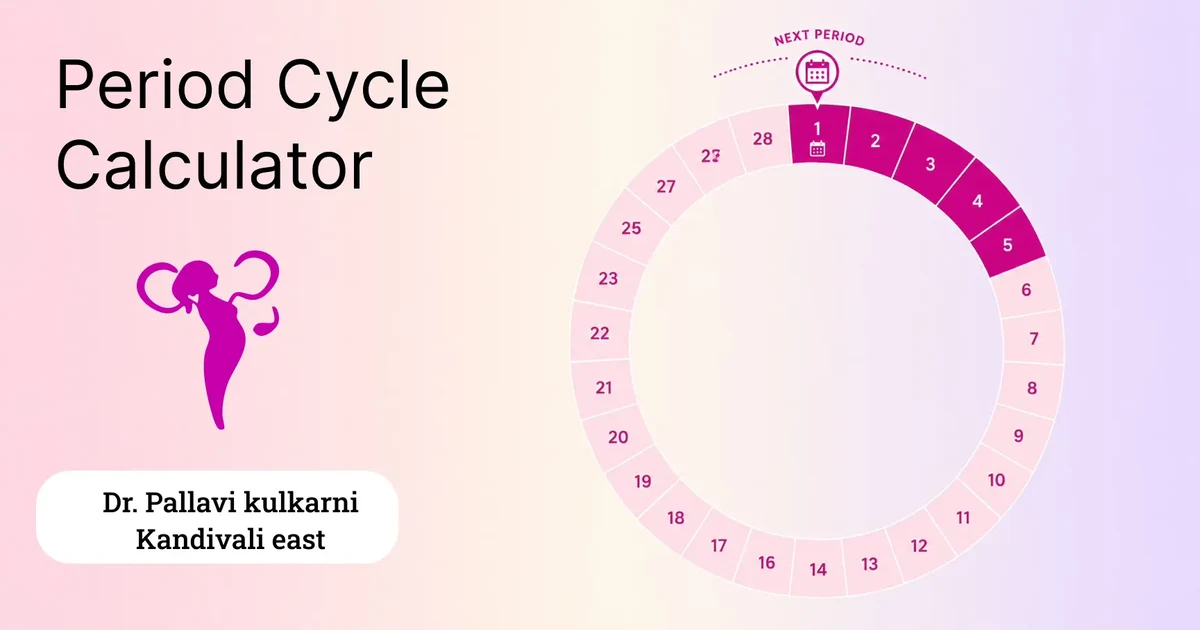
A menstrual cycle is counted from the first day of one period to the first day of the next period. It is not counted from when the previous period ended.
Typical adult cycle length is around 21 to 35 days. Teenage cycles can normally fall anywhere in 21 to 45 days in the first one to two years after the first period.
What can change your cycle
- Stress, exams, big life changes
- Illness, fever, recent infection
- Significant weight change or intense exercise
- Travel and time-zone changes
- Thyroid imbalance, PCOS (now PMOS)
- Pregnancy, hormonal contraception, certain medicines
When to see a gynaecologist
It is worth a consultation if you have any of the following:
- Cycles repeatedly under 21 or over 35 days (adults)
- Periods absent for 3 months or more (not pregnant)
- Bleeding longer than 7 days or very heavy flow
- Severe pain that disrupts school, work or sleep
- Bleeding between periods
Frequently asked questions
About the calculator and about period tracking in general.
What is a normal menstrual cycle length?
A typical adult menstrual cycle is around 21 to 35 days, counted from the first day of one period to the first day of the next. ACOG considers cycles between 21 and 45 days normal for teenagers in the first one to two years after the first period. Cycles shorter than 21 days or longer than 35 days in adults, especially if repeated month after month, are worth discussing with a gynaecologist.
How do I count or calculate my cycle?
Whether you call it a period cycle calculator, menstrual cycle calculator or next period date calculator, the method is the same. Count from the first day your period started (day 1, when actual bleeding begins, not spotting) to the day before your next period starts. So if your last period started on 1 May and your next one started on 29 May, your cycle is 28 days. Track three to four cycles in a row and take the average - this gives a more reliable number than a single month, especially if your cycles vary slightly. A paper diary, a phone calendar note or a free period-tracking app all work; the calculator above just needs the average.
Is my cycle 21, 28 or 30 days? How do I know?
All three can be normal. The often-quoted "28-day cycle" is the average, not the rule. Adult cycles anywhere between 21 and 35 days are considered normal (ACOG); teenage cycles can normally range from 21 to 45 days in the first one to two years after menarche. To know your own length: pick the first day of two consecutive periods and count the gap. Most women find their cycles vary by a day or two each month, which is also normal. What matters is the average over three to four cycles, and whether it stays roughly consistent. Repeated cycles under 21 days, over 35 days (adult) or over 45 days (teen) are worth a gynaecologist review.
What counts as an unhealthy cycle length?
For adults, repeatedly less than 21 days or more than 35 days is the threshold where evaluation is helpful. For teenagers, more than 45 days after the first one to two years post-menarche is the cut-off. Also flag-worthy: cycles that swing dramatically month to month (e.g., 25 days one cycle, 50 the next), or cycles that started regular and have become irregular. Causes range from PCOS (now renamed PMOS) and thyroid imbalance to significant stress, weight change, perimenopause and, in some cases, structural issues. The calculator's consultation prompts above flag many of these patterns - if you see them, please talk to a gynaecologist.
Is this period calculator accurate for irregular cycles?
If your cycles are very irregular, the predicted next period date is more of a rough average than a precise estimate. Tracking your cycle for three to four months and entering your average gives a better result. If your cycles repeatedly differ by more than 7 to 9 days, please consult a gynaecologist - irregular cycles can be a sign of PCOS, thyroid issues or other hormonal patterns worth evaluating.
Can this calculator be used for PCOS?
It can give an estimate, but PCOS (recently renamed PMOS) is characterised by irregular or long cycles, so the prediction will be less reliable. Use the calculator to track your average and let the consultation prompts flag when professional evaluation is helpful. For a clinical view on PCOS in Indian women, see our PCOS-is-now-PMOS guide.
I have not had a period for over three months. What should I do?
If you have not had a period for three months or more and you are not pregnant, please consult a gynaecologist. This is called secondary amenorrhea and can be caused by PCOS, thyroid imbalance, significant weight changes, hormonal contraception, very high stress or other reasons. NHS Inform similarly recommends a doctor's review for periods stopping for around 3 to 6 months.
Can I get pregnant 2 or 3 days after my period?
Yes, it is possible, though usually not very likely. Two factors matter: how short your cycle is, and how long sperm survive. Sperm can survive in the reproductive tract for up to 5 days. If you have a shorter cycle (say 21 to 24 days), ovulation can happen as early as day 7 to 10 - which means sperm from sex 2 to 3 days after your period ends could still be alive when ovulation happens. With a longer or more average cycle (28 to 32 days), the chance is much lower but not zero. This calculator does not predict ovulation; for that you would need a different tool that tracks cervical mucus, basal body temperature and luteal phase. If you are trying to avoid or achieve pregnancy, please see a gynaecologist for a personalised plan rather than relying on cycle-day estimates alone.
My period lasts more than 7 days, or I'm using a lot of pads. Is that normal?
Most periods last 3 to 7 days, with around 30 to 80 mL of blood loss across the cycle. Bleeding for more than 7 days or losing significantly more than that is called heavy menstrual bleeding (menorrhagia per RCOG and NHS guidance) and is worth evaluating. Practical thresholds patients can use at home: soaking through a regular pad or tampon every 1 to 2 hours, needing to use both a pad and a tampon together, waking at night to change protection, passing clots larger than a 2-rupee coin, or going through more than 6 fully-soaked pads on a heavy day. Repeated heavy or prolonged periods can lead to iron deficiency anaemia and have many treatable causes (fibroids, polyps, thyroid issues, hormonal patterns, IUDs, certain medicines). Please consult a gynaecologist - a basic workup (blood count, thyroid panel, pelvic ultrasound) usually clarifies the cause.
How many eggs are left at 35 or 37? Do shorter cycles mean lower ovarian reserve?
Egg numbers decline through a woman's life - from about 1 to 2 million at birth, to around 300,000 to 500,000 at the first period, to roughly 25,000 by the mid-30s, with the decline accelerating after 35 (ASRM and ACOG population data; individual variation is large). And yes, cycles that gradually shorten in your late 30s and 40s can be a sign of declining ovarian reserve - the follicular phase tends to compress as FSH rises and the ovaries respond faster. AMH and antral follicle count (AFC) give a more personal estimate than cycle length alone. None of this means pregnancy is impossible at 35 or 37, just that it can take longer and is worth discussing earlier rather than later if you are trying to conceive. See our Pregnancy After 35 guide and the female pregnancy doctor in Mumbai post for the practical picture.
How can I help my teenage daughter use this calculator?
The calculator works well for teenagers if you set Age Group to 13 to 19. Teenage cycles can normally vary between 21 and 45 days in the first one to two years after menarche. Repeated long gaps, very heavy bleeding or very painful periods are worth discussing with a doctor. See our Adolescent Gynecology Clinic page or our Irregular Periods in Teenage Girls guide for more.
Does this calculator predict ovulation or fertile days?
No - this calculator only estimates the next period date. If you want to estimate your ovulation day and fertile window, use our companion Ovulation and Fertile Window Calculator, which works back from the next-period date using the 14-day rule and shows the fertile window plus most fertile days. Note that any calculator-based ovulation estimate is approximate; it does not predict ovulation, fertile days or pregnancy chances with certainty - those need a different model that also accounts for cervical mucus, basal body temperature and luteal phase length. If you are trying to conceive, please consult a gynaecologist or fertility specialist for personalised guidance.
What Our Patients Say
Compassionate and Highly Recommended Gynecologist in Kandivali East
Dr. Pallavi Kulkarni is a trusted Gynecologist in Kandivali East, known for compassionate care, clear communication, and a patient-first approach. Women often feel comfortable, well-informed, and reassured throughout their consultation, treatment, and pregnancy journey.
Worried about your cycle?
Dr. Pallavi Kulkarni is a female gynaecologist in Kandivali East with consultations in English, Hindi and Marathi. If your cycle has been off for a while, an early consultation usually saves months of guesswork.
Book a consultation