
Pregnancy Due Date and Week Calculator
Estimate your expected delivery date, current pregnancy week, trimester and key pregnancy milestones. Calculate from the first day of your last period, conception date, IVF transfer date, or a due date you have already been given. Nothing is stored or sent anywhere; everything runs in your browser.
Medically reviewed by Dr. Pallavi Kulkarni · Last reviewed 14 May 2026
Everything you enter - your last period date, cycle length, period duration, age group and any symptoms you select - stays on your device. The calculation runs entirely inside your browser, so nothing is sent to a server, nothing is logged, and there is nothing for us or anyone else to see. Close the tab and it is all gone.
Your result will appear here
Choose a calculation method, enter the relevant date, and tap Calculate. Your estimated due date, current pregnancy week, trimester and key milestones will show up here.
Medical Disclaimer
This calculator gives an approximate estimate only. Pregnancy due dates can vary, and your doctor may confirm or revise your due date using an early pregnancy ultrasound (ideally before 14 weeks) and clinical history. ACOG considers a pregnancy that has not had ultrasound confirmation or revision before 22 weeks to be suboptimally dated. This tool does not replace medical consultation, antenatal care, ultrasound dating, or emergency medical advice.
If you are pregnant and have bleeding, severe abdominal or shoulder-tip pain, dizziness or fainting, fever, severe vomiting, or reduced baby movements later in pregnancy, please seek medical care urgently.
How a pregnancy due date is calculated
Whether you call it a due date calculator, pregnancy week calculator, or pregnancy due date and week calculator, the underlying maths is the same. Here are three quick orienting points.
The 280-day rule (LMP method)
The most common method adds 280 days (40 weeks) to the first day of your last menstrual period (LMP). This is sometimes called Naegele's rule. It assumes a 28-day cycle with ovulation around day 14. If your cycles are longer or shorter than 28 days, the estimate can be adjusted slightly using your average cycle length.
For an IVF pregnancy, dating starts from the embryo transfer date instead: Day 3 transfer + 263 days, or Day 5 blastocyst transfer + 261 days.
How pregnancy weeks are counted
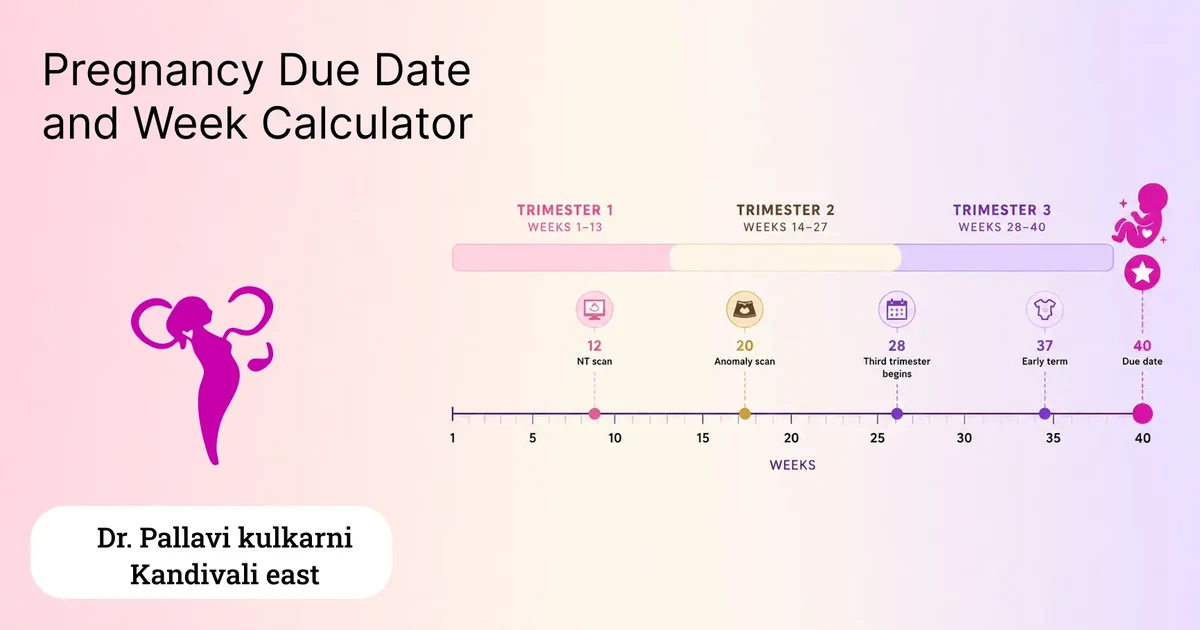
Pregnancy weeks are counted from the first day of the last menstrual period, not from conception. That means in the first 2 weeks of "pregnancy" you are not yet actually pregnant - conception happens around the end of week 2. By the time most women miss their period, they are already considered 4 weeks pregnant.
The full-term range is 37 to 42 weeks per NHS guidance. Only about 5 percent of babies are born on their exact due date.
Why your doctor may revise the date
An LMP-based estimate can be off if:
- Your cycles are irregular
- You do not remember the exact LMP date
- You ovulated earlier or later than day 14
- You have PCOS / PMOS or thyroid imbalance
- You recently stopped hormonal contraception
- You conceived through IVF (separate dating method)
An early ultrasound (ideally before 14 weeks) gives a more reliable date and is what your obstetrician will rely on for antenatal planning.
Frequently asked questions
About pregnancy due date, pregnancy weeks, IVF dating and ultrasound confirmation.
How do I calculate my pregnancy due date?
A common method is to add 280 days, or 40 weeks, to the first day of your last menstrual period (LMP). This assumes a 28-day cycle with ovulation around day 14. If your cycles are longer or shorter, the estimate is adjusted slightly. The calculator can also estimate your due date from a known conception or ovulation date (266 days after conception), from an IVF embryo transfer date (263 days after a Day 3 transfer, 261 days after a Day 5 blastocyst transfer), or work backwards from a due date you have already been given. In every case, the result is an estimate; your doctor may confirm or revise the due date after an early pregnancy ultrasound.
Can I calculate pregnancy weeks using my due date?
Yes. If you already know your due date, the calculator works backwards by estimating the pregnancy start date as 280 days (40 weeks) before the due date, then counts how many weeks and days have passed up to today. This is useful when your doctor has confirmed your due date by ultrasound and you want a quick way to know how many weeks pregnant you are.
Is the due date calculator accurate?
It gives an estimate, not a guarantee. NHS notes that pregnancy normally lasts 37 to 42 weeks from the first day of the last period, and most babies are born within two weeks either side of the estimated due date. An early pregnancy ultrasound (ideally before 14 weeks) is the most reliable way to date a pregnancy; ACOG considers a pregnancy that has not had ultrasound confirmation or revision before 22 weeks to be suboptimally dated.
Can I use this calculator if my periods are irregular?
Yes, but the result may be less accurate. If your periods are irregular, if you do not remember your last period date, or if you have PCOS / PMOS or thyroid issues, the LMP-based estimate can be off by days or even weeks. In these situations, an early pregnancy ultrasound is the better way to confirm gestational age, and your doctor will usually rely on the ultrasound date rather than the LMP date.
What if I conceived through IVF - can this calculator estimate my due date?
For IVF pregnancies, the due date is usually calculated from the embryo transfer date and the embryo age at transfer, not from the last menstrual period. The calculator supports both Day 3 embryo transfers (due date = transfer date + 263 days) and Day 5 blastocyst transfers (due date = transfer date + 261 days). Please follow the due date confirmed by your fertility specialist or obstetrician, especially if there are multiple embryos, donor eggs, frozen transfers or other treatment-specific details that affect dating.
Is the due date the exact birth date?
No. The due date is an estimated date - many babies are born before or after it. Only around 5 percent of babies are born on their actual due date. Babies born between 37 and 42 weeks are considered full-term. Your obstetrician will monitor pregnancy progress at antenatal visits and use ultrasound + clinical assessment to decide whether the pregnancy is progressing as expected.
What Our Patients Say
Compassionate and Highly Recommended Gynecologist in Kandivali East
Dr. Pallavi Kulkarni is a trusted Gynecologist in Kandivali East, known for compassionate care, clear communication, and a patient-first approach. Women often feel comfortable, well-informed, and reassured throughout their consultation, treatment, and pregnancy journey.
Pregnant? Book an early antenatal visit.
Dr. Pallavi Kulkarni is a female obstetrician and gynaecologist in Kandivali East, with consultations in English, Hindi and Marathi. An early ultrasound (ideally before 14 weeks) confirms the due date and gives the best foundation for the rest of your antenatal care.
Book a consultation