
Pain During Sex: Why It Happens to Women, What Causes It, and What You Can Do About It
By Dr. Pallavi Kulkarni, MBBS, DGO, DNB (OB-GYN), DFP, MRCOG (UK), Fellowship in IVF ·
She sat across from me, fidgeting with the strap of her bag. She had come for an unrelated complaint - some irregularity in her periods. But towards the end of the consultation, almost as an afterthought, she said: “Doctor, actually there is one more thing. But it is a bit embarrassing.”
I hear this almost every week. The “one more thing” that women tack on at the end of a visit, when they have finally worked up the courage. And more often than not, that one more thing is pain during sex.
If you are reading this, chances are you have been looking for answers online because you are not comfortable asking anyone in person. That is okay. Let me walk you through this the way I would in my clinic - plainly, without judgment, with actual medical information instead of vague reassurances.
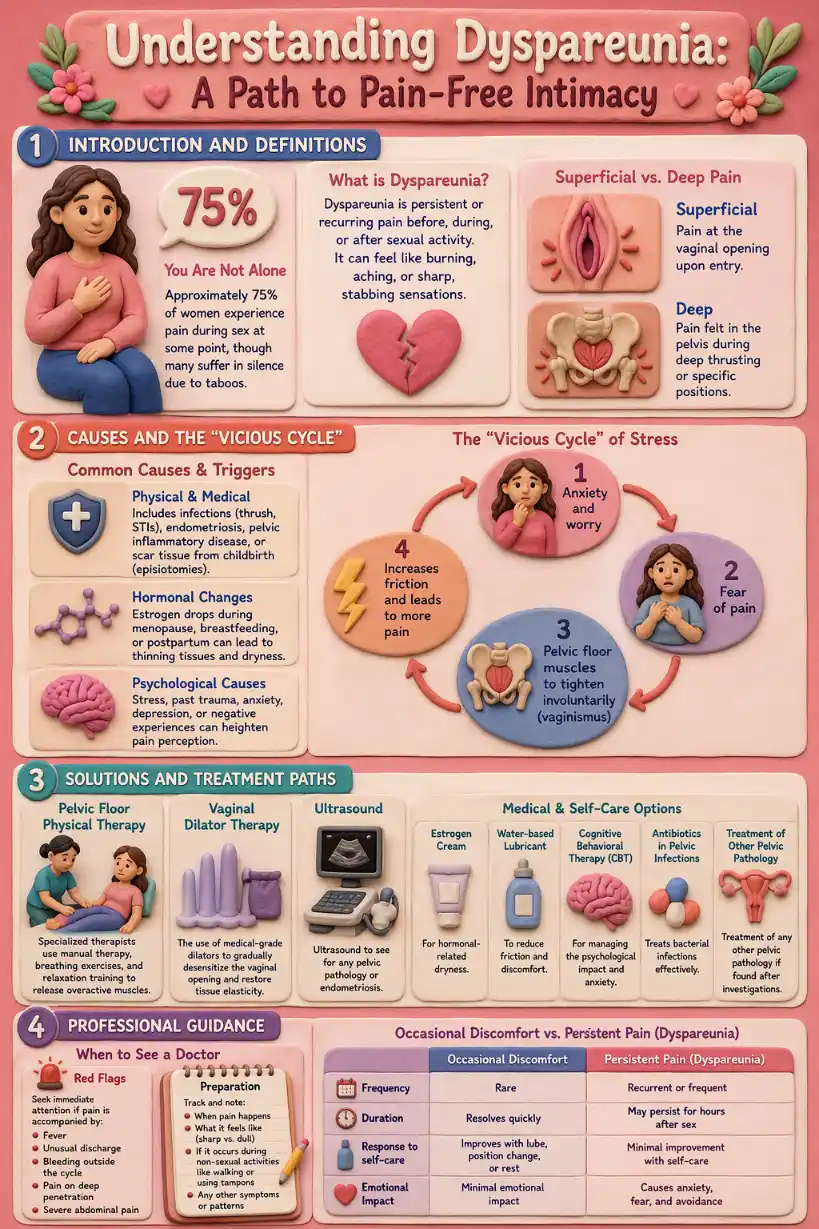
Pain During Sex for Women: Is It Normal?
Short answer: common, yes. Normal, no.
Globally, studies estimate that 10 to 28 percent of women experience painful intercourse at some point. In India, the numbers are harder to pin down because so few women report it. But a study from a leading Delhi hospital found that 56 percent of married women surveyed had at least one sexual dysfunction, and pain was among the most common complaints. A national study of over 84,000 Indian women published in The Journal of Sexual Medicine reported that roughly 1 in 8 women experienced pain during intercourse.
So if this is happening to you, you are far from alone. But “common” does not mean you should just accept it. Pain during sex is a symptom - it points to something specific. And that something is almost always treatable.
“In fifteen years of practice, I have seen hundreds of women with this problem. Not once has the answer been ‘just relax’ or ‘it will get better on its own.’ There is always a reason, and there is almost always a solution.”
- Dr. Pallavi Kulkarni
If you have been dealing with pain during sex and putting off getting it checked, even one visit can give you clarity. Most women feel relieved just knowing what the cause is.
Why Many Women in India Ignore Pain During Sex
Because nobody ever told them it was okay to talk about it.
In India, sexual health is wrapped in so many layers of silence that most women do not even have a vocabulary for what they are experiencing. You grow up hearing that sex is something you endure, not enjoy. That pain is expected. That asking questions about it means something is wrong with you rather than something is wrong medically.
That Delhi hospital study found that 64 percent of women with sexual health problems had never discussed them with anyone - not a friend, not a family member, and certainly not a doctor. They just carried it silently.
Then there is the misinformation. Google “pain during sex” in Hindi and you will find everything from dubious home remedies to spiritual explanations. Women try coconut oil, ashwagandha, “Kegel exercises for six months” - all before considering that a ten-minute conversation with a gynaecologist could actually tell them what is going on.
I am not blaming anyone for this. The healthcare system has not exactly made it easy. Many doctors themselves skip over sexual health in consultations. But the result is that women suffer in silence for years over something that could often be fixed in weeks.
What Causes Pain During Sex in Females?
I divide this into two categories because the treatment depends entirely on where the pain is.
Pain at the entrance (superficial dyspareunia)
Inadequate lubrication. This is the single most common cause I see. It can happen because of rushed foreplay, stress, certain medications (antidepressants are a frequent culprit), breastfeeding, or perimenopause and menopause. Hormonal changes after childbirth can also reduce natural lubrication significantly.
Vaginal infections. Yeast infections cause inflammation and rawness. Bacterial vaginosis changes the vaginal environment. Trichomoniasis causes irritation. All of these make sex painful. If you have noticed unusual vaginal discharge, itching, or a change in odour along with pain, an infection is very likely involved. Fungal infections in particular are extremely common and often go untreated for months because women mistake them for “normal discharge.” Understanding what is normal and what is not when it comes to discharge can help you catch infections earlier. Many of these fall under common gynaecological infections that we treat every day.
Vaginismus. This is involuntary tightening of the muscles around the vaginal opening. It can make penetration feel like hitting a wall. It is not something women do on purpose - it is a reflex. Often triggered by anxiety, past trauma, fear of pain, or simply because the body has learned to brace itself. A systematic review and meta-analysis found that 79 to 86 percent of women with vaginismus achieve successful penetrative intercourse after treatment, with pelvic floor physiotherapy and combined psychosexual approaches showing the highest success rates. It needs to be identified first, but it is one of the most treatable conditions we see.
Skin conditions. Lichen sclerosus, eczema, or contact dermatitis (from soaps, detergents, or synthetic underwear) can make the vulvar skin thin, cracked, or hypersensitive.
The hymen. Rarely the actual cause in adult women, despite what popular culture suggests. But in some cases, a thick or rigid hymen can cause pain. A minor procedure fixes this easily.
Pain deep inside (deep dyspareunia)
Endometriosis. According to published data, about 45 percent of women with dyspareunia have endometriosis as an underlying cause. The tissue that normally lines the uterus grows elsewhere - on the ovaries, behind the uterus, along the ligaments. Deep penetration hits these areas and causes sharp pain. If you also have very painful periods, heavy bleeding, or pain with bowel movements, endometriosis should be investigated.
Fibroids. Depending on where they sit, fibroids can cause deep pain during sex. Large ones pressing on the cervix or filling the uterine cavity are the usual culprits.
Ovarian cysts. Especially large cysts or ones in certain positions can be painful during sex.
Pelvic inflammatory disease (PID). Usually caused by untreated STIs, but can also follow other infections. Causes chronic deep pelvic pain that worsens during intercourse. PID is also a major cause of tubal damage, which is why ACOG guidelines recommend early evaluation if you have pelvic pain and are trying to conceive.
Pelvic adhesions. Scar tissue from previous surgeries, infections, or endometriosis can tether organs together and cause pain with movement during sex.
Retroverted uterus. A uterus tilted backwards is common and usually harmless. But in some women, it can make certain positions uncomfortable.
For women dealing with hormonal imbalance, the connection to painful sex is often indirect but real - hormonal shifts affect lubrication, tissue elasticity, and inflammation levels, all of which contribute to discomfort.
Not sure what is causing your pain? A proper evaluation can identify the specific cause. Most answers come from a simple examination and a few basic tests.
Pain During Sex First Time
This is one of the most searched queries I see, and it is surrounded by more myths than almost any other topic in women’s health.
Let me be direct: mild discomfort during the first time is common. It happens because of nervousness, muscle tension, and unfamiliarity - not because something is “supposed to break.” The idea that first-time sex must hurt or must cause bleeding is simply not true for many women.
The hymen is not a seal that needs to be torn. It is a thin, stretchy membrane that has an opening already. In many women, it stretches gradually over time from normal activity - exercise, tampon use, regular movement. Some women experience a little discomfort the first time, some do not notice anything at all.
What does cause first-time pain in most cases is anxiety. Your pelvic floor muscles tense up because you are nervous, which makes penetration harder and more painful. This is a completely normal response.
What is not normal: severe pain that makes penetration impossible, bleeding that does not stop, or pain that persists every single time beyond the first few attempts. If that is happening, see a doctor. It could be vaginismus, a thick hymen, or an infection that was already there.
Pain During Sex in Stomach or Lower Belly
When women say “it hurts inside” or “the pain goes to my stomach,” they are usually describing deep dyspareunia. This is different from pain at the entrance, and it points to different causes.
Deep pelvic or abdominal pain during sex is most commonly linked to endometriosis, fibroids, adenomyosis, ovarian cysts, or pelvic adhesions. It can also happen when the cervix is hit directly during deep penetration, which is uncomfortable even in women with no underlying condition.
If you experience deep pain consistently, especially if it is worse during certain times of your menstrual cycle, you need to be evaluated. Some warning signs that make this more urgent:
- Pain that gets worse over time rather than staying the same
- Pain accompanied by heavy or irregular periods
- Pain during bowel movements or urination
- Bloating or a feeling of pressure in the pelvis
- Pain that continues for hours after sex
- Bleeding after sex (not related to your period)
Postpartum pain during sex is also far more common than women realise. A meta-analysis published in 2021 found that about 35 percent of women experience pain during sex in the months following childbirth. Perineal tears, episiotomy scars, breastfeeding-related dryness, and pelvic floor changes all contribute. Women with high-risk pregnancies or complicated deliveries may be at even higher risk. If you had a baby and sex is now painful, it is not “just how things are now.” It is treatable.
How to Reduce Pain During Sex in Women
This depends entirely on the cause. But the good news is that treatment works. A multidisciplinary treatment study found that over half of women with chronic dyspareunia reported significant improvement, and for specific causes like vaginismus, success rates reach 79 to 86 percent. Here are the practical steps that help across most situations.
Use a water-based lubricant. This is the simplest first step. Many women feel embarrassed about needing lubricant, as if it means their body is not working properly. It does not. Lubrication varies with stress, sleep, hydration, hormones, and even the time of the month. A good water-based lubricant (avoid oil-based ones with condoms) reduces friction and makes a significant difference for many women.
Ensure adequate arousal before penetration. This is not just about foreplay as a concept - the body needs time to prepare physically. Blood flow to the pelvic area increases, the vaginal walls produce natural lubrication, and the cervix lifts. Rushing this process is one of the most common reasons sex is painful.
Treat active infections first. If you have a yeast infection, bacterial vaginosis, or any other gynaecological infection, sex is going to hurt. Treat it, wait for it to clear, and then try again.
Experiment with positions. Positions where the woman controls the depth and pace of penetration (such as being on top) tend to be less painful for women with deep dyspareunia. Avoid deep-thrust positions if deep pain is your issue.
Manage stress and fatigue. Chronic stress tightens pelvic floor muscles without you realising it. Poor sleep reduces arousal and lubrication. These are not “soft” causes - they have real physiological effects.
Pelvic floor physiotherapy. For vaginismus and muscle-related pain, this is one of the most effective treatments available. Research shows pelvic floor therapy achieves success rates of around 85 percent for vaginismus. A trained physiotherapist teaches you to identify, relax, and retrain the pelvic muscles. It is not a quick fix - it typically takes 8 to 12 weeks - but it works.
Address hormonal issues. If dryness is related to menopause, breastfeeding, or hormonal contraception, your doctor may recommend local oestrogen therapy or adjust your medication.
“The most common pattern I see is a woman who has been enduring painful sex for years, and her only strategy has been to avoid it. By the time she comes in, it has affected her relationship, her confidence, and sometimes her mental health. The fix is often surprisingly straightforward once we know the cause.”
- Dr. Pallavi Kulkarni
Watch: 4-Step Recovery Approach for Pain During Sex
Do Men Feel Pain During Sex Too?
Yes. Male dyspareunia exists and is more common than most people think. Tight foreskin (phimosis), infections, prostatitis, Peyronie’s disease, and even psychological factors can cause pain during sex in men. If your partner is also experiencing pain, he should see a urologist. Painful sex is not exclusively a women’s problem, even though it is far more commonly discussed in women.
What Happens at a Gynaecologist’s Consultation
I know this is the part that stops most women. The thought of describing something so personal to a doctor feels overwhelming. So let me tell you exactly what happens, step by step, so you know what to expect.
First, we talk. I will ask you when the pain started, where exactly it hurts, whether it happens every time or only sometimes, whether it has changed over time, and what other symptoms you have noticed. I may ask about your periods, about any changes in discharge, about your general health and medications. This conversation is private and confidential.
Then, if needed, a physical examination. This is always done with your consent, gently, and with explanation at each step. I am looking for signs of infection, inflammation, skin changes, muscle tightness, or tenderness in specific areas.
Depending on what I find, I may recommend an ultrasound, a vaginal swab for infection testing, or blood tests for hormones. Often, the cause is identified in the first visit itself.
Nobody is judging you. Whether you are married or unmarried, whether you have been sexually active for ten years or ten days, it makes no difference to me. I am a gynaecologist. My only concern is your health, not your personal life. Nobody is going to lecture you. And nobody is going to make you do anything you are not comfortable with. A good gynaecologist creates a space where you can speak freely, and that is exactly what we aim for.
“Sexual health is integral to overall health and well-being. Clinicians should routinely ask patients about sexual function and address sexual concerns as part of comprehensive health care.”
- American College of Obstetricians and Gynecologists (ACOG)
When Should You See a Doctor
- Pain during sex that happens regularly (not a one-off episode)
- Pain severe enough to make you avoid sex altogether
- Pain accompanied by abnormal discharge, odour, or itching
- Pain accompanied by irregular periods, heavy bleeding, or spotting after sex
- Deep pelvic pain or pain in the lower abdomen during or after sex
- Pain that is getting worse over time
- Pain that started after childbirth, surgery, or a new medication
- Inability to have penetrative sex at all (possible vaginismus)
- Pain that is affecting your relationship, your mental health, or your ability to conceive
Women from Kandivali East including Thakur Village, Kandivali West, Malad East, Malad West, Borivali East, Borivali West, Goregaon East and Goregaon West consult Dr. Pallavi Kulkarni for gynaecological care.
Ready to get this checked? Consult Dr. Pallavi Kulkarni at Aarogya Women’s Clinic in Thakur Village, Kandivali East. Call us at +91 91366 33062, WhatsApp us, or walk in.
A Final Note
Pain during sex is one of the most under-reported, under-discussed, and under-treated problems in women’s health - especially in India. But it does not have to stay that way.
You do not need to “just relax.” You do not need to endure it. You do not need to wait until it gets unbearable. You need a proper diagnosis and a treatment plan that actually addresses the cause.
If you have read this far, you already know something is not right. The next step is a conversation with someone who can help. That is all it takes to start.
You have read the information. If you are ready for a private, judgment-free consultation, Dr. Pallavi Kulkarni is available at Aarogya Women’s Clinic in Kandivali East.
Related reads on our blog
- → Vaginal Discharge: Causes, Symptoms & Treatment
- → Gynecological Infections Treatment in Kandivali East
- → Hormonal Imbalance in Women: Signs, Tests & Fixes
- → When to Visit a Gynecologist: 10 Signs You Must Know
- → Menopause Clinic in Kandivali East
- → Infertility Treatment in Kandivali East
Medically reviewed by Dr. Pallavi Kulkarni, MBBS, DGO, DNB (OB-GYN), DFP, MRCOG (UK), Fellowship in IVF, April 2026. This article is for educational purposes and does not replace personal medical advice. For diagnosis and treatment, please consult a qualified gynaecologist.
Do you have any questions?
Request An AppointmentQuestions I get asked
Do women feel pain during sex normally?
Some mild discomfort is common during the first few times. But ongoing, significant pain during sex is not normal. It is a medical symptom with treatable causes. You should not accept it as something you have to live with.
What causes pain during sex in females?
The most common causes are inadequate lubrication, vaginal infections (yeast or bacterial), vaginismus (involuntary muscle tightening), endometriosis, fibroids, ovarian cysts, pelvic inflammatory disease, and hormonal changes due to breastfeeding or menopause. A gynaecologist can identify the specific cause.
Why does it pain during sex in the stomach or lower belly?
Deep pelvic or abdominal pain during sex is usually caused by conditions like endometriosis, fibroids, adenomyosis, ovarian cysts, or pelvic adhesions. It can also happen if the cervix is directly hit during deep penetration. If this happens regularly, get evaluated.
How to reduce pain during sex in females?
Use a water-based lubricant, ensure adequate foreplay and arousal before penetration, treat any active infections, try positions that allow you to control the depth, manage stress and fatigue, and see a gynaecologist if pain continues. Pelvic floor physiotherapy is very effective for vaginismus.
How to prevent pain during sex?
Prevent pain by addressing the underlying cause. For lubrication issues, use a lubricant and allow more time for arousal. For infections, get treated before resuming intercourse. For vaginismus, pelvic floor therapy helps. For deeper causes like endometriosis, medical treatment can significantly reduce or eliminate the pain.
Is pain during sex the first time normal?
Mild discomfort is common due to nervousness and tension, not because something is supposed to break. Severe pain, bleeding that does not stop, or pain that continues beyond the first few times should be checked by a doctor.
Can pain during sex affect getting pregnant?
Indirectly, yes. If pain causes you to avoid sex or reduces frequency, it affects your chances. Some causes of painful sex, like endometriosis, PID, or fibroids, can independently affect fertility. Treating the pain often improves both comfort and your chances of conceiving.
Should I see a gynaecologist for pain during sex or try home remedies first?
If the pain is mild and only happens occasionally, trying a lubricant and more foreplay is a reasonable first step. But if it continues, if it is severe, or if it is accompanied by other symptoms like abnormal periods, discharge, or abdominal pain, see a gynaecologist. Do not rely on home remedies for persistent pain.
I feel too embarrassed to tell my doctor about pain during sex. Is that normal?
Completely normal. A study from a leading Delhi hospital found that 64 percent of women with sexual health problems had never discussed them with anyone, including their doctor. But gynaecologists deal with this topic every single day. There is nothing you can tell us that we have not heard before.
What Our Patients Say
Experienced Gynecologist in Kandivali East with a Patient-Centered Approach
Dr. Pallavi Kulkarni is a highly regarded Gynecologist in Kandivali East, praised for her calm, compassionate, and patient-centered care. Her supportive approach helps women feel heard, respected, and confident about their treatment decisions.