
Uterine Fibroids: Symptoms, Causes and Treatment Options (Do You Really Need Surgery?)
By Dr. Pallavi Kulkarni, MBBS, DGO, DNB (OB-GYN), DFP, MRCOG (UK), Fellowship in IVF ·
If your ultrasound report has just said “fibroid”, it is natural to feel worried. Many women who come to our clinic in Kandivali East have already been told, by a relative or by the internet, that the only answer is an operation. India’s own treatment guidance for doctors says otherwise: every option should be explained to you, including simply keeping an eye on things.
This guide explains what uterine fibroids are, what they feel like, how they are found, and every treatment option, from no treatment at all to surgery, so you can have a calm, informed conversation with your gynaecologist.

Uterine fibroids at a glance
If you are scanning rather than reading, start here. Each row is explained in more detail below.
| Topic | What to know |
|---|---|
| What they are | Non-cancerous growths of muscle and fibrous tissue in the wall of the womb. Doctors also call them leiomyomas or myomas. |
| How common | Very common, especially in the 30s and 40s. Most women who have them never know. |
| Common symptoms | Heavy or long periods, clots, tiredness from anaemia, pelvic pressure, passing urine often. Many women have none. |
| How they are found | A pelvic ultrasound, often a transvaginal scan, plus a blood count to check for anaemia. |
| Do they need surgery? | Not usually. Fibroids that cause no problems can simply be watched. |
| Treatment options | Watching, medicines for bleeding and pain, hormone treatment, myomectomy, embolisation, and hysterectomy for some women. |
| Cancer risk | Very low. Fibroids are benign. |
| Pregnancy | Many women with fibroids conceive and deliver normally. Fibroids inside the cavity matter most. |
| After menopause | They usually shrink. Any bleeding after menopause needs a check-up. |
What are fibroids?
Fibroids are lumps made of muscle and fibrous tissue that grow from the wall of the uterus. Doctors also call them leiomyomas or myomas. In Hindi they are often described as a gaanth (lump) in the bachchedani (womb). They can be as small as a seed or, less often, grow large enough to swell the lower tummy, and a woman can have one fibroid or several.
They are extremely common. India’s ICMR treatment guidance notes that about 8 in 10 women will have fibroids at some point in their lives. That estimate comes largely from research outside India, which found fibroids in most women by the age of 50. Most of these women never know, because their fibroids cause no problems.
Fibroids are benign, which means they are not cancer.
Types of fibroids: why location matters
If you have been looking for photos of fibroids, a diagram like the one below shows the different types far more clearly than a photograph can. Your ultrasound report usually says where the fibroid is. Doctors group fibroids by their position in the wall of the uterus, because position decides which symptoms a fibroid causes far more than its size does.
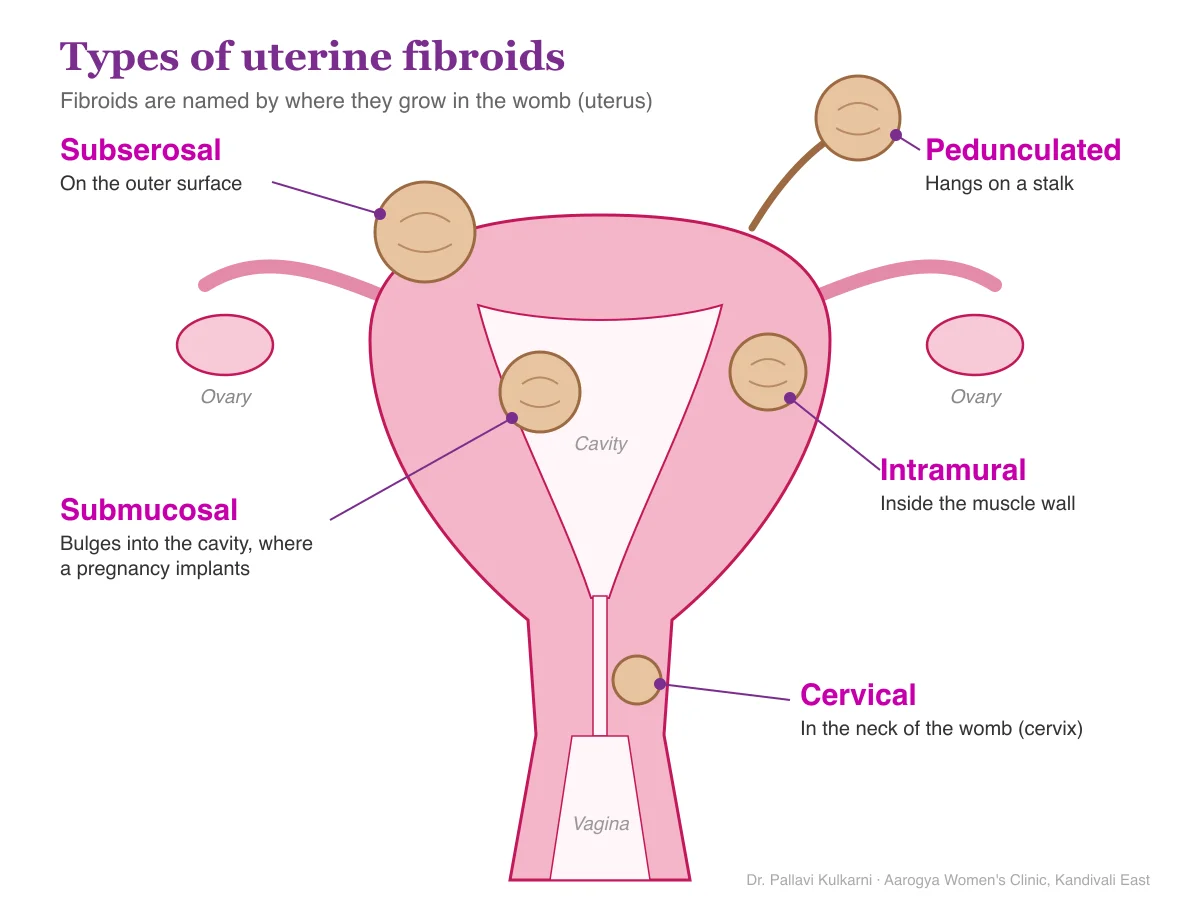
Fibroid types and what they tend to cause
| Type | Where it grows | What it tends to cause |
|---|---|---|
| Submucosal | Bulges into the inner cavity of the uterus | Heavy or prolonged periods. Can affect getting or staying pregnant, even when small. |
| Intramural | Within the muscular wall | Heavier periods, pain or pressure, depending on size and whether it presses on the cavity. |
| Subserosal | On the outer surface, sometimes on a stalk (pedunculated) | Pressure on the bladder or bowel. Usually little effect on periods or fertility. |
| Cervical | In the neck of the womb (cervix) | Depends on position. Can press on nearby organs. |
Sources: FIGO classification of fibroids (Munro et al, 2018), ICMR standard treatment workflow, Pritts et al, Fertility and Sterility, 2009.
This is why a small fibroid can sometimes cause more trouble than a large one. A 1.5 cm submucosal fibroid may cause heavy bleeding, while a 6 cm subserosal fibroid may cause nothing more than mild pressure. Your report may also use a numbered system, the FIGO types 0 to 8, which describes the same idea in more detail. You can ask your gynaecologist which type you have.
What are the symptoms of fibroids? (fibroids ke lakshan)
Many fibroids are found by chance on an ultrasound done for another reason, and cause no symptoms at all. When they do cause symptoms, the most common are:
- Heavy or prolonged periods, sometimes with large blood clots, or bleeding and spotting between periods
- Tiredness, breathlessness or a racing heartbeat, which can be signs of anaemia from losing blood every month
- Heaviness, pressure or pain in the lower abdomen, or painful periods
- Passing urine often, because the fibroid presses on the bladder
- Constipation or bloating, from pressure on the bowel
- Pain during sex
- A swollen lower tummy or a lump you can feel, with larger fibroids
- Difficulty getting pregnant or repeated miscarriage in some women (see the pregnancy section below)
Can you feel a fibroid? Signs you may notice yourself
You cannot confirm a fibroid at home, but some signs are worth a check-up: periods that are heavier than before or come with large clots, a firm swelling low in the tummy that you can feel when lying down, a feeling of heaviness or pressure, passing urine more often, or a lower tummy that looks bigger without weight gain elsewhere. These signs have other causes too, and many fibroids cause none of them. Only an ultrasound scan can tell you whether you have a fibroid.
Fibroids and anaemia
Heavy periods are one of the commonest causes of iron-deficiency anaemia in women, and anaemia is already widespread in India: more than half of Indian women are anaemic, according to NFHS-5. If you feel exhausted, get breathless climbing stairs, or your periods have become much heavier than before, ask your doctor for a blood test for haemoglobin and iron. Anaemia can be treated while you and your doctor decide what to do about the fibroid itself. Our guide to nutrient deficiency in Indian women explains iron in more detail, and our guide to irregular and heavy periods explains when heavy bleeding needs attention.
Do fibroids cause weight gain?
Fibroids do not cause general weight gain. A large fibroid can make the lower tummy look or feel bigger, though, and bloating can add to this.
What causes fibroids?
The exact cause is not fully understood. What doctors do know:
- Hormones play a part. Fibroids grow during the reproductive years, when the body makes oestrogen and progesterone, and usually shrink after menopause, when these hormones fall. Our guide to hormonal imbalance in women explains how these hormones work.
- They are most often found in the 30s and 40s. Among Indian women of reproductive age, new cases peak between 35 and 39.
- Family history may matter. Fibroids seem to run in some families.
Fibroids are not caused by anything you did or did not do, and they are not passed on through sex. There is also no proven way to prevent them, although a healthy weight and an active life are good for you in every other way.
Fibroids after menopause
Fibroids usually shrink after menopause as hormone levels fall, and symptoms often settle. The American College of Obstetricians and Gynecologists notes that fibroids in a woman nearing menopause often do not need treatment, so if you are close to menopause, waiting may be a reasonable plan. A fibroid that appears or grows after menopause, or any bleeding after menopause, should always be checked by a doctor. Our menopause clinic looks after women through this stage.
Are fibroids dangerous? Can they turn into cancer?
Fibroids are benign, meaning they are not cancer. ICMR’s treatment guidance for doctors notes that the risk of a fibroid being cancerous is very low.
Very rarely, a different kind of tumour of the uterus, called a sarcoma, can look like a fibroid on a scan. This is uncommon, and no scan or blood test can rule it out with complete certainty. That is why your doctor may want to re-check a fibroid that changes unexpectedly, for example one that grows quickly or appears after menopause. Quick growth needs a prompt check-up, but on its own it does not mean cancer.
When fibroids do cause harm, it is usually through heavy bleeding that leads to anaemia. Less often, a fibroid on a stalk can twist, or a fibroid can outgrow its blood supply (degeneration), and both can cause sudden, severe pain that needs prompt attention.
For most women, the real problems from fibroids are heavy bleeding, anaemia, pain and pressure, and all of these can be treated.
How are fibroids diagnosed?
You cannot reliably check for fibroids at home. Heavy periods or a swelling low in the tummy can have other causes, and many fibroids cause nothing you would notice. Diagnosis is usually simple and needs only:
- A conversation about your periods, pain, other symptoms and pregnancy plans
- An examination by your gynaecologist
- A blood count to check for anaemia. A thyroid test may be added, since thyroid problems can also affect periods.
- An ultrasound scan, often a transvaginal scan, which shows the number, size and position of the fibroids
An MRI or a hysteroscopy (a thin camera passed through the cervix to look inside the uterus) is added only when the picture is complex, for example before planning surgery or when a fibroid may be inside the cavity.
Reading your ultrasound report
The words on a scan report often sound more serious than they are. Here is what the common ones mean. None of them, on its own, means you need an operation; your doctor reads them alongside your symptoms.
| On your report | What it means |
|---|---|
| Bulky uterus | The womb is larger than average. Fibroids are one common reason; adenomyosis and past pregnancies are others. |
| Intramural, subserosal or submucosal fibroid | Where the fibroid sits in the wall, as in the diagram above. This matters more than the size. |
| Anterior wall, posterior wall, fundal | Which side of the womb it is on: the front, the back, or the dome at the top. On its own this rarely changes the plan. |
| Pedunculated | The fibroid hangs on a stalk, either outside the womb or into the cavity. |
| Multiple fibroids | More than one fibroid. Common, and not a sign of anything more serious. |
| Size in cm or mm | Useful for comparing scans over time, but not a cut-off for surgery. |
| Calcified fibroid | Calcium deposits inside the fibroid, usually part of a degenerative change. It is not a sign of cancer by itself. |
| Degenerating fibroid | A fibroid that has outgrown its blood supply. It can cause acute pelvic pain, especially in pregnancy. |
“Many of the women I see bring a scan report that says ‘bulky uterus with multiple intramural fibroids’, and they are frightened by it. In most cases, once we sit down and go through it together, the plan is a blood test and a follow-up scan, or medications, not an operation.”
- Dr. Pallavi Kulkarni, MBBS, DGO, DNB (OB-GYN), DFP, MRCOG (UK), Fellowship in IVF
A fibroid on a scan report raises a lot of questions. A consultation can explain your report, check for anaemia and set out the options that fit your plans, including those that do not involve surgery.
Do fibroids always need surgery?
No. ICMR’s standard treatment workflow for uterine fibroids states plainly that not every woman with fibroids needs a hysterectomy, and that every treatment option, including simply keeping a watch, should be explained to the patient.
The same guidance says that fibroids under 5 cm that cause no symptoms do not need treatment. That 5 cm figure is not a cut-off for surgery. The American College of Obstetricians and Gynecologists also notes that fibroids which cause no symptoms, are small, or occur in a woman nearing menopause often need no treatment. A larger fibroid that causes no problems may also simply be watched. Your treatment depends on:
- How much your symptoms affect your daily life
- Your blood count and iron levels
- The type, position and number of fibroids
- Your age and how close you are to menopause
- Whether you want to become pregnant in the future
- Any other health conditions
If surgery does become the right choice, our gynaecology procedures page explains each operation and where it is done.
“I treat the symptoms, not the scan. A fibroid that is not causing heavy bleeding, pain or pressure, and is not affecting a pregnancy, usually needs watching rather than surgery. When surgery is the right answer, I want a woman to choose it knowing every other option was considered first.”
- Dr. Pallavi Kulkarni, MBBS, DGO, DNB (OB-GYN), DFP, MRCOG (UK), Fellowship in IVF
What are the treatment options for fibroids?
It helps to think of treatment in three layers. Many women only ever need the first.
Layer 1: Watching and controlling symptoms
Observation (watchful waiting). If your fibroids are not causing problems, regular check-ups and a repeat scan when your doctor advises are a proper, guideline-backed plan, not neglect. Come back sooner if your symptoms change.
Medicines that ease symptoms. These do not remove fibroids, but many women manage well on them for years:
- Iron, often with folic acid, to correct anaemia caused by heavy bleeding
- Painkillers (NSAIDs) for period pain; they may also reduce bleeding a little
- Tranexamic acid, a non-hormonal tablet taken on heavy days to reduce bleeding
- Hormonal options such as the contraceptive pill, progestogen tablets, or a hormone-releasing coil (Mirena) when the cavity of the uterus is not distorted
NICE guidance on heavy menstrual bleeding describes the same step-wise approach. Your doctor will advise which, if any, suits you. Please do not start these on your own.
Layer 2: Treatments that shrink or remove the fibroid
Hormone treatments that shrink fibroids. GnRH-agonist injections stop periods for a while and shrink fibroids by creating a temporary, reversible menopause-like state. Because of side effects such as night sweats, vaginal dryness and bone loss, they are usually used for less than six months, most often before surgery or to bridge the last years before menopause. A newer daily tablet combining relugolix with low-dose hormones was approved in India in July 2025 for heavy bleeding caused by fibroids, and NICE in the UK also recommends it. Ask your doctor whether it suits you and whether it is available locally. With all these medicines, fibroids usually grow back after they are stopped.
Myomectomy (removing the fibroids and keeping the uterus). This may be recommended when fibroids cause significant symptoms or are thought to be affecting fertility.
- Hysteroscopic myomectomy, for fibroids inside the cavity. A thin telescope is passed through the vagina and cervix, so there is no cut on the tummy.
- Laparoscopic (keyhole) myomectomy, for fibroids in or on the wall, through small cuts.
- Open myomectomy, for very large or numerous fibroids, through a cut on the tummy.
New fibroids can grow after myomectomy, and some women need further treatment years later. Our gynaecology procedures page explains how myomectomy is planned at our clinic.
Uterine artery embolisation (UAE). An interventional radiologist (a specialist in image-guided procedures) passes a thin tube through a pinhole in the wrist or groin and blocks the fibroids’ blood supply, so they shrink. The uterus is kept. Some women need another procedure later. Most women return to their normal routine within about 1 to 2 weeks. In the FEMME trial (New England Journal of Medicine, 2020), women who had a myomectomy reported a slightly better fibroid-related quality of life two years later than those who had embolisation. Pregnancies after embolisation do happen, but the evidence on pregnancy afterwards is more limited than after myomectomy, so if a future pregnancy is your priority, discuss this carefully.
Layer 3: Hysterectomy (removing the uterus)
Hysterectomy is the only treatment after which fibroids cannot come back. It also means you can no longer become pregnant. It is usually considered when a woman has completed her family and other treatments have not worked or are not suitable. ICMR advises avoiding hysterectomy in women under 35 as far as possible. Vaginal and keyhole hysterectomy usually mean a shorter hospital stay and faster recovery than open surgery. Our hysterectomy section explains the types in more detail.
Comparing procedures at a glance
| Procedure | Uterus kept? | Can fibroids come back? | Getting back to daily routine after surgery | Pregnancy afterwards |
|---|---|---|---|---|
| Hysteroscopic myomectomy | Yes | New ones can grow | A few days | Often the most fertility-friendly option for fibroids inside the cavity |
| Laparoscopic myomectomy | Yes | New ones can grow | A few days | Possible after healing; your surgeon advises how long to wait |
| Open myomectomy | Yes | New ones can grow | Longer than after keyhole (laparoscopic) surgery | Possible after healing; usually a longer wait |
| Uterine artery embolisation | Yes | Further treatment sometimes needed | About 1 to 2 weeks | Possible, but the evidence is more limited than after myomectomy |
| Hysterectomy | No | No | About 6 to 8 weeks after open surgery; shorter after vaginal or keyhole surgery | Not possible |
Sources: ICMR standard treatment workflow, MedlinePlus on embolisation, RCOG and Royal College of Radiologists, NHS on hysterectomy recovery. Myomectomy figures are from Dr. Pallavi Kulkarni’s practice; your own recovery depends on the size and number of fibroids.
No treatment is risk-free, and none can guarantee future fertility. Before deciding, ask about success rates, the chance of needing another procedure, recovery time and cost for your specific case. If embolisation might suit you, it is reasonable to also speak to an interventional radiologist so that you have heard every option that keeps the uterus.
Weighing up the options? A consultation can go through which treatments fit your symptoms, your scan and your plans for pregnancy, including the ones that keep the uterus.
Can fibroids be treated naturally? Ayurveda, homeopathy, diet and yoga
These are among the most searched fibroid questions in India, so it is worth being direct. No herbal medicine, homeopathic remedy, home remedy, diet or exercise has been proven in large, good-quality trials to shrink or dissolve fibroids. A Cochrane review of herbal preparations found the studies too small and of too low quality to support or refute their use. Small early studies of green-tea extract and vitamin D have shown some reduction in fibroid size, and larger trials are under way, but neither is yet a proven treatment. Kanchanar Guggulu, the Ayurvedic preparation most often suggested for fibroids, has not been tested in good-quality trials; the only published report we could find is a small case series of seven women with no comparison group. Even prescription medicines only shrink fibroids for as long as they are taken.
That does not make healthy habits pointless. A balanced diet with iron-rich foods supports your blood count if you have heavy periods, and regular exercise and yoga are good for your overall wellbeing and can help with pain and stress. Use them alongside medical care, not instead of it.
Always tell your doctor about any supplements or remedies you take, and be wary of products that promise to “dissolve” fibroids, especially if they would mean delaying treatment for heavy bleeding or anaemia.
Can you get pregnant with fibroids? Fibroids, fertility and pregnancy
Yes. Many women with fibroids conceive naturally and have healthy pregnancies and deliveries. Whether fibroids affect fertility depends mostly on where they are:
- Submucosal fibroids (inside the cavity) can make it harder for a pregnancy to implant and may raise the risk of miscarriage. Removing them through a hysteroscope is often considered when a woman is trying to conceive.
- Intramural fibroids may matter if they distort the cavity.
- Subserosal fibroids (on the outside) generally show no clear effect on fertility.
This pattern comes from a review of fertility outcomes in women with fibroids and is reflected in NICE guidance. If you have fibroids and are planning a pregnancy, or have had difficulty conceiving, talk to your gynaecologist before trying. They can tell you whether your particular fibroids are likely to matter and, if you need treatment, how long to wait afterwards. Our guide on why you may not be getting pregnant covers the other common causes, and our fertility service explains how the womb is assessed.
Fibroids during pregnancy
Most pregnancies with fibroids go smoothly. Fibroids do slightly raise the chance of some problems: the baby lying in an unusual position, needing a caesarean, preterm birth, and heavier bleeding after birth. A fibroid can also cause acute pelvic pain if it outgrows its blood supply, called degeneration. Your obstetrician will keep an eye on the fibroids during your scans, and a pregnancy with large or several fibroids may be looked after as a higher-risk pregnancy. If you develop sudden or severe tummy pain during pregnancy, contact your doctor straight away.
When should you see a gynaecologist about fibroids?
Go to the nearest hospital emergency department if you have:
- Bleeding that soaks through a pad every hour, or will not settle
- Dizziness, fainting or severe breathlessness
- Sudden, severe pain in the lower tummy
- Being unable to pass urine
Contact your gynaecologist promptly if you have:
- Any bleeding after menopause
- A new or growing lump after menopause
- A fibroid that a scan shows has grown quickly
- Sudden or severe tummy pain in pregnancy, if you know you have fibroids
Book a routine appointment if you have:
- Periods that are heavier or longer than before, or pass large clots
- Bleeding between periods
- Constant tiredness or breathlessness on stairs
- Pelvic pressure or passing urine often
- A fibroid on a scan report that you would like explained
Questions to ask your doctor about fibroids
Take these to your appointment. A good consultation should leave you with an answer to each.
- Which type of fibroid do I have, and where exactly is it?
- Are my symptoms definitely caused by the fibroids?
- Is my blood count normal? Should we treat anaemia while we decide?
- Can we start without surgery? Which symptom-control options suit me?
- If I want to keep my uterus or have children later, which options apply to me, and why?
- If we monitor, how often do I need a scan, and what changes should bring me back sooner?
- How would each option affect a future pregnancy, and how long should I wait after treatment?
- What are the chances of the fibroids returning or needing another procedure?
- What will recovery involve, and what will it cost, including with my insurance?
- Should I also speak to an interventional radiologist about embolisation?
Fibroid consultation in Kandivali East, Mumbai
At Aarogya Women’s Clinic, Dr. Pallavi Kulkarni takes time to explain your scan report, check for anaemia, and talk through every option, from monitoring and medicines to surgery when it is genuinely needed, so that the decision fits your symptoms and your plans. When surgery is the right choice, she performs myomectomy and hysterectomy at hospitals near the clinic, including Cloudnine Hospital in Malad West; the full list is on our gynaecology procedures page.
Women come to us from Thakur Village, Thakur Complex, Lokhandwala Township and Ashok Nagar in Kandivali East, and from Kandivali West, Borivali, Malad and Goregaon. If you are looking for a gynaecologist in Kandivali East to look at a fibroid report, you are welcome to call or message us.
Address: Aarogya Women’s Clinic, Shop no. 48, EMP-53, Evershine Halley, Thakur Village, Kandivali East, Mumbai 400101, next to Achija Restaurant.
Availability, cost and insurance cover for any procedure should always be confirmed with the treating hospital.
Book a fibroid consultation at Aarogya Women’s Clinic, Kandivali East. Bring your scan report and any blood test results you have.
Clinic hours: Monday to Saturday, 10:00 AM to 9:00 PM. Closed Sundays. Call +91 91366 33062 or +91 93245 97166.
References
- Indian Council of Medical Research, Department of Health Research. Standard Treatment Workflow: Uterine Fibroids and Polyps, December 2025. https://www.icmr.gov.in/icmrobject/uploads/STWs/1768382529_updateduterinefibroidsandpolyps.pdf
- American College of Obstetricians and Gynecologists. Uterine Fibroids (patient FAQ). https://www.acog.org/womens-health/faqs/uterine-fibroids
- Baird DD et al. High cumulative incidence of uterine leiomyoma in black and white women: ultrasound evidence. Am J Obstet Gynecol, 2003. PMID 12548202. https://pubmed.ncbi.nlm.nih.gov/12548202/
- Burden analysis of uterine fibroids and endometriosis in reproductive-age women globally, in China, India, and the United States, 1990 to 2021. Frontiers in Nutrition, 2026. https://pmc.ncbi.nlm.nih.gov/articles/PMC12834745/
- Munro MG et al. The two FIGO systems for normal and abnormal uterine bleeding symptoms and classification of causes of abnormal uterine bleeding in the reproductive years: 2018 revisions. Int J Gynaecol Obstet, 2018. PMID 30198563. https://pubmed.ncbi.nlm.nih.gov/30198563/
- National Institute for Health and Care Excellence. Heavy menstrual bleeding: assessment and management (NG88). https://www.nice.org.uk/guidance/ng88/chapter/recommendations
- Central Drugs Standard Control Organisation. List of new drugs approved in 2025. https://cdsco.gov.in/opencms/resources/UploadCDSCOWeb/2018/UploadApprovalNewDrugs/List%20of%20New%20Drugs%20approved%20in%20the%20year%20202525aug.pdf
- Manyonda I et al. Uterine-Artery Embolization or Myomectomy for Uterine Fibroids (FEMME). N Engl J Med, 2020. PMID 32726530. https://pubmed.ncbi.nlm.nih.gov/32726530/
- Royal College of Obstetricians and Gynaecologists and Royal College of Radiologists. Clinical recommendations on the use of uterine artery embolisation in the management of fibroids, 2013. https://www.rcog.org.uk/media/gw3f4wzc/23-12-2013_rcog_rcr_uae.pdf
- MedlinePlus, US National Library of Medicine. Uterine artery embolization. https://medlineplus.gov/ency/article/007384.htm
- NHS. Hysterectomy: recovery. https://www.nhs.uk/conditions/hysterectomy/recovery/
- Gupta S, Manyonda IT. Acute complications of fibroids. Best Pract Res Clin Obstet Gynaecol, 2009. PMID 19264555. https://pubmed.ncbi.nlm.nih.gov/19264555/
- Pritts EA et al. Fibroids and infertility: an updated systematic review of the evidence. Fertil Steril, 2009. PMID 18339376. https://pubmed.ncbi.nlm.nih.gov/18339376/
- Klatsky PC et al. Fibroids and reproductive outcomes: a systematic literature review from conception to delivery. Am J Obstet Gynecol, 2008. PMID 18395031. https://pubmed.ncbi.nlm.nih.gov/18395031/
- Li H et al. The influence of uterine fibroids on adverse outcomes in pregnant women: a meta-analysis. BMC Pregnancy Childbirth, 2024. PMID 38710995. https://pubmed.ncbi.nlm.nih.gov/38710995/
- Liu JP et al. Herbal preparations for uterine fibroids. Cochrane Database Syst Rev, 2013. PMID 23633329. https://pubmed.ncbi.nlm.nih.gov/23633329/
- Dhiman K. Ayurvedic intervention in the management of uterine fibroids: a case series. Ayu, 2014. PMID 26664240. https://pubmed.ncbi.nlm.nih.gov/26664240/
- Roshdy E et al. Treatment of symptomatic uterine fibroids with green tea extract: a pilot randomized controlled clinical study. Int J Womens Health, 2013. PMID 23950663. https://pubmed.ncbi.nlm.nih.gov/23950663/
- Alsharif SA et al. Effect of Oral Consumption of Vitamin D on Uterine Fibroids: A Systematic Review and Meta-Analysis of Randomized Clinical Trials. Nutr Cancer, 2024. PMID 38234246. https://pubmed.ncbi.nlm.nih.gov/38234246/
- Ministry of Health and Family Welfare, via Press Information Bureau. National Family Health Survey (NFHS-5) phase II factsheet, 2021. https://www.pib.gov.in/PressReleasePage.aspx?PRID=1774533
This page is reviewed periodically by Dr. Pallavi Kulkarni. Last reviewed . Treatment availability and costs vary, so please confirm details with your doctor and the treating hospital.
Related reads on our blog
- → Gynecology Procedures and Open Surgery in Kandivali East
- → Irregular Periods: How Many Days Late Is Normal?
- → Nutrient Deficiency in Indian Women: A Doctor’s Guide
- → Why Am I Not Getting Pregnant? Fertility Doctor Answers
- → PCOS Is Now Called PMOS: What It Means for Indian Women
- → Women’s Health After 30: A Guide for Indian Women
Medically reviewed by Dr. Pallavi Kulkarni, MBBS, DGO, DNB (OB-GYN), DFP, MRCOG (UK), Fellowship in IVF, October 2026. This article is for educational purposes and does not replace personal medical advice. For diagnosis and treatment, please consult a qualified gynaecologist.
Do you have any questions?
Request An AppointmentFrequently asked questions about fibroids
Can fibroids be treated without surgery?
Yes. Watching and waiting, medicines that control bleeding and pain, hormone treatments that shrink fibroids for a while, and non-surgical procedures such as uterine artery embolisation are all options. Which suits you depends on your symptoms, the type of fibroid and your pregnancy plans.
Can fibroids be cured?
Fibroids can be treated effectively. Hysterectomy is the only treatment after which they cannot come back. Myomectomy, embolisation and other treatments that keep the uterus work well for many women, but new fibroids can develop later. Many women never need a cure at all, because their fibroids cause no problems and shrink after menopause.
Will fibroids go away on their own?
Fibroids do not usually disappear during the reproductive years, but they often stop causing problems. After menopause they usually shrink and symptoms settle.
Can I shrink fibroids naturally, with diet, yoga or Ayurveda?
No herbal, Ayurvedic or homeopathic remedy has been proven in large, good-quality trials to shrink fibroids. Small early studies of green-tea extract and vitamin D are being researched, but they are not a substitute for treatment. Healthy eating and exercise support your general health and your blood count, but they should not replace medical care, especially if you have heavy bleeding or anaemia.
Is there a fibroid size chart? Is a 5 cm fibroid dangerous?
There is no size chart that decides treatment. Size is one factor among many. A large fibroid causing no symptoms may simply be watched, while a small fibroid inside the cavity may need treatment if it causes heavy bleeding. Your doctor weighs size together with location, symptoms and your plans.
What does a calcified fibroid mean?
Calcification means calcium has been deposited inside the fibroid, usually as part of a degenerative change. It is not a sign of cancer by itself, and on its own it rarely changes the plan. Your doctor will read it alongside your symptoms and the rest of the report.
Bulky uterus with multiple fibroids: is it serious?
Usually not. A bulky uterus simply means the womb is larger than average, and several fibroids are a common reason. Whether it needs treatment depends on your symptoms, your blood count, where the fibroids are and your plans for pregnancy, not on the words in the report.
Can fibroids turn into cancer?
Fibroids are benign and the risk of cancer is very low. Rarely, a different kind of tumour can look like a fibroid on a scan, which is why unusual changes, such as a fibroid that grows after menopause, are checked.
Can I check for fibroids at home?
Not reliably. You may notice heavier periods, clots or a swelling low in the tummy, but these have other causes too, and many fibroids cause no symptoms at all. An ultrasound scan is the simple way to find out.
Can fibroids be prevented?
There is no proven way to prevent fibroids. They are linked to hormones, age and family history, which you cannot change. A healthy weight, regular activity and a balanced diet are good for your overall health, but they have not been shown to stop fibroids from forming.
Do fibroids affect pregnancy?
Most women with fibroids have normal pregnancies. Fibroids inside the cavity are the type most likely to affect fertility. If you have fibroids and are planning a pregnancy, talk to your gynaecologist before you start trying.
Can fibroids cause blood clots in periods?
Yes. Heavy bleeding from fibroids often comes with large clots. If you regularly pass large clots, see your doctor and ask for a blood count.
What happens to fibroids after menopause?
They usually shrink and symptoms settle as hormone levels fall. A fibroid that appears or grows after menopause, or any bleeding after menopause, should be checked by a doctor.
What is the difference between a fibroid and a cyst?
A fibroid is a solid growth of muscle in the wall of the uterus. A cyst is a fluid-filled sac, most often on an ovary. They are different conditions, though both are often found on an ultrasound.
Are fibroids and PCOS the same thing?
No. Fibroids are growths in the wall of the uterus. PCOS, now also called PMOS, is a hormonal condition that affects the ovaries, periods and metabolism. A woman can have one, both or neither, and they are treated differently.
Do fibroids cause weight gain?
Fibroids do not cause general weight gain. A large fibroid can make the lower tummy look or feel bigger, and bloating can add to this.
Fibroids kya hota hai, aur kya iske liye operation zaroori hai?
Fibroid bachchedani (uterus) ki maaspeshiyon mein banne wali ek gaanth hai, jo cancer nahi hoti. Yeh bahut common hai aur zyadatar women ko iska pata bhi nahi chalta. Har fibroid ke liye operation zaroori nahi hai. Agar koi takleef nahi hai toh sirf check-up aur scan se nazar rakhi ja sakti hai. Agar periods bahut heavy hain, khoon ki kami hai, dard ya pressure hai, ya pregnancy mein dikkat aa rahi hai, tab doctor dawa ya surgery ke options samjhayenge.
What Our Patients Say
Experienced Gynecologist in Kandivali East with a Patient-Centered Approach
Dr. Pallavi Kulkarni is a highly regarded Gynecologist in Kandivali East, praised for her calm, compassionate, and patient-centered care. Her supportive approach helps women feel heard, respected, and confident about their treatment decisions.