
Ovulation and Fertile Window Calculator
Estimate your likely ovulation date, fertile window, most fertile days and next expected period - based on your last period date and average cycle length. Most useful if your cycles are reasonably regular. Nothing is stored or sent anywhere; everything runs in your browser.
Medically reviewed by Dr. Pallavi Kulkarni · Last reviewed 14 May 2026
Everything you enter - your last period date, cycle length, period duration, age group and any symptoms you select - stays on your device. The calculation runs entirely inside your browser, so nothing is sent to a server, nothing is logged, and there is nothing for us or anyone else to see. Close the tab and it is all gone.
Your result will appear here
Fill in the form and tap Calculate. Your estimated ovulation date, fertile window, most fertile days and next expected period will show up here.
Medical Disclaimer
This calculator gives an approximate estimate only. Ovulation can vary from cycle to cycle and may be affected by stress, illness, travel, PCOS / PMOS, thyroid imbalance, breastfeeding, recent pregnancy, medicines, hormonal contraception, perimenopause and other health factors. This tool does not diagnose infertility, confirm ovulation, or replace medical consultation.
Do not use this calculator as a method of contraception or to identify "safe days". Ovulation timing can vary and sperm can survive in the female reproductive tract for up to 5 days, so pregnancy can still occur outside the estimated window. If you want to avoid pregnancy, please discuss reliable contraception options with a doctor.
How ovulation timing works
Wondering how to calculate ovulation day and fertile window? Whether you call it an ovulation calculator, fertile window calculator or ovulation day and fertile window calculator, the underlying idea is the same. Here are three quick orienting points.
The 14-day rule
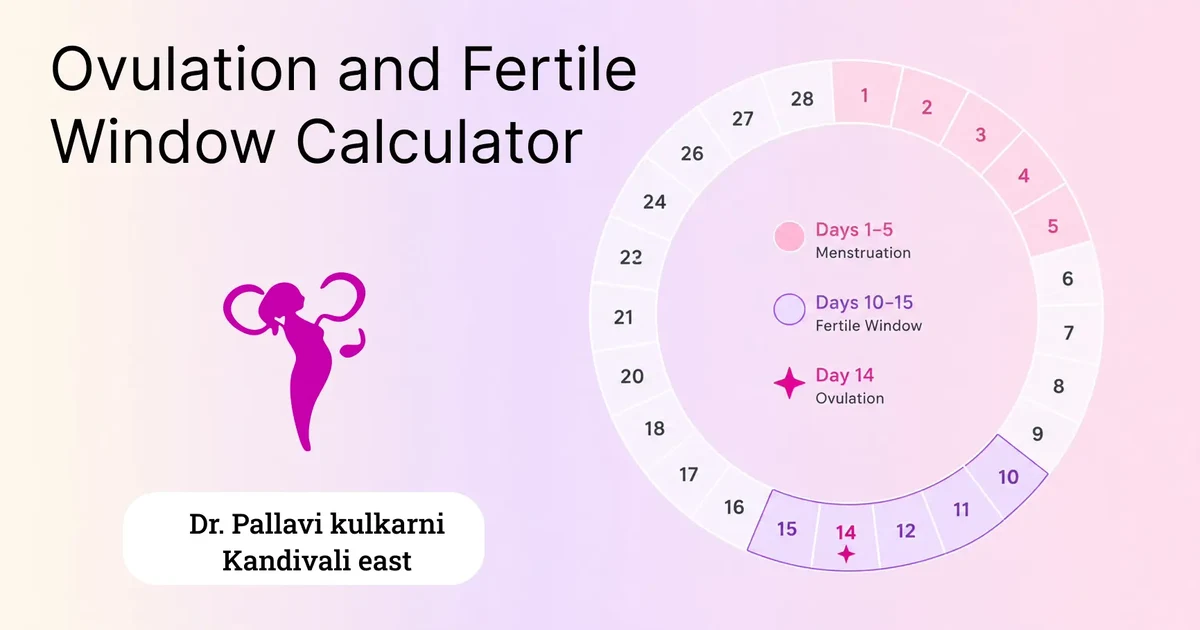
Ovulation usually happens about 14 days before the next expected period, not 14 days after the last one. This is why the calculator works back from your projected next-period date rather than forward from your last period.
In a 28-day cycle, that puts ovulation around day 14. In a 35-day cycle, around day 21. In a 24-day cycle, around day 10.
The fertile window is ~6 days
The fertile window is the 5 days before ovulation plus the day of ovulation - about 6 days in total, per ACOG and WomensHealth.gov. Sperm can survive in the female reproductive tract for up to 5 days, while the egg lives only around 12 to 24 hours after ovulation.
The most fertile days are typically the 1 to 2 days before ovulation and the day of ovulation itself.
When the estimate is less reliable
A calculator works best for regular cycles. Estimates may be off if you have:
- Irregular, delayed or absent periods
- PCOS / PMOS (now the official name)
- Thyroid imbalance
- Breastfeeding or recent delivery
- Recently stopped hormonal contraception
- Perimenopause
If trying to conceive in any of these situations, ultrasound follicle tracking and hormone tests give a far more reliable picture.
Frequently asked questions
About ovulation, the fertile window, and when an estimate is less reliable.
How is ovulation calculated?
Ovulation is usually estimated as happening about 14 days before the next expected period. This calculator first estimates your next period date using your average cycle length, then counts back 14 days to estimate ovulation. It is an estimate, not a guarantee - actual ovulation can vary from cycle to cycle and can be affected by stress, illness, travel, PCOS / PMOS, thyroid imbalance and many other factors.
What is the fertile window?
The fertile window is the time in your menstrual cycle when pregnancy is most likely. It usually includes the 5 days before ovulation and the day of ovulation itself - about 6 days in total. The reason it covers several days is that sperm can survive inside the female reproductive tract for up to 5 days (ACOG), while the egg lives only around 12 to 24 hours after ovulation. The most fertile days are typically the 1 to 2 days before ovulation and the day of ovulation.
How do I calculate ovulation day and fertile window?
Whether you call it an ovulation calculator, fertile window calculator or ovulation day and fertile window calculator, the method is the same. Start with the first day of your last period and your average cycle length, work out when your next period is expected (last period date + cycle length), then count back 14 days from that next-period date. That is your estimated ovulation day. Your fertile window is the 5 days before ovulation through the day of ovulation - about 6 days in total. The most fertile 2 to 3 days are the day before and the day of ovulation. Worked example: if your last period started on 1 May and your cycle is 28 days, your next period is around 29 May, ovulation is around 15 May, and your fertile window is roughly 10 May to 15 May.
How accurate is an online ovulation calculator? Are there better tools?
A calculator is reasonably useful when cycles are regular, but it is just one tool. Other ways women track ovulation, in increasing order of accuracy: a cycle-tracking app (uses similar maths to this calculator), basal body temperature (BBT) charting (small rise after ovulation), cervical mucus observation (becomes egg-white-clear and stretchy near ovulation), ovulation predictor kits (OPKs - urine LH strips, predict ovulation 12 to 36 hours ahead), wearable fertility monitors (continuous BBT plus other signals), and at the most accurate end - ultrasound follicle tracking plus an LH blood test, done at a clinic over a few visits in one cycle. None of the at-home methods can confirm that ovulation actually happened, only predict that it may. If you have been trying for several months without success, or your cycles are irregular, an ultrasound follicle tracking cycle gives a far more reliable picture than any calculator or app.
Is this calculator accurate for irregular periods?
It may be less accurate if your periods are irregular. In irregular cycles, ovulation can happen earlier, later, or sometimes not at all. If your cycles are repeatedly irregular, delayed or absent, a gynaecologist can help identify the reason - common causes include PCOS / PMOS, thyroid imbalance, significant stress, weight change, or perimenopause. Ultrasound follicle tracking and hormone tests give a far more reliable picture than a calculator in these situations.
Can I use this calculator to avoid pregnancy?
No. This calculator should not be used as contraception or to identify safe days. Ovulation timing can vary, and pregnancy can still happen if the actual timing is different from the estimate. If you want to avoid pregnancy, please speak to a doctor about reliable contraception options - the natural / rhythm method has a real-world failure rate of around 13 to 24 per 100 women per year, much higher than modern contraceptive methods.
Does PCOS / PMOS affect ovulation?
Yes. PCOS / PMOS can make ovulation delayed, irregular or absent in some cycles. If you have PCOS / PMOS and are trying to conceive, medical guidance can help track ovulation more accurately - through ultrasound follicle monitoring, hormone tests, and where appropriate, ovulation-induction medication. See our PCOS-is-now-PMOS guide for the full clinical picture.
When should I see a gynaecologist about my periods or fertility?
Consider consulting a gynaecologist if any of these apply, whether or not you are trying to conceive: periods that are repeatedly irregular, very painful or very heavy; bleeding between periods or after intercourse; periods that last more than 7 days; periods absent for around 3 months or more when you are not pregnant; unusual vaginal discharge, itching, pelvic pain or pain during sex; a known PCOS / PMOS, thyroid imbalance or hormonal issue that has not been reviewed recently; or an annual gynaecological check-up that is overdue. For specifically trying-to-conceive evaluation timing: under 35, after roughly 12 months of trying without success; over 35, after roughly 6 months; sooner if there is a known reason (PCOS / PMOS, thyroid issue, previous pelvic surgery, previous miscarriages, or known male-factor concerns).
What Our Patients Say
Compassionate and Highly Recommended Gynecologist in Kandivali East
Dr. Pallavi Kulkarni is a trusted Gynecologist in Kandivali East, known for compassionate care, clear communication, and a patient-first approach. Women often feel comfortable, well-informed, and reassured throughout their consultation, treatment, and pregnancy journey.
Trying to conceive? Let us help you plan.
Dr. Pallavi Kulkarni is a female gynaecologist and fertility specialist in Kandivali East with consultations in English, Hindi and Marathi. If you have been trying for several months without success, or your cycles are unpredictable, an early consultation can save months of guesswork.
Book a consultation