
Yoga for Women’s Health: The Best Poses for Periods, PCOS, Fertility and Menopause
By Dr. Pallavi Kulkarni, MBBS, DGO, DNB (OB-GYN), DFP, MRCOG (UK), Fellowship in IVF · ·
Quick answer: Yoga supports women’s gynaecological health through three mechanisms: better pelvic blood flow, a shift from stress mode to rest mode in the nervous system, and gradual rebalancing of reproductive hormones. Research supports yoga for period pain, PCOS (recently renamed PMOS), endometriosis, fertility, menopause and pelvic floor health. Most measurable change happens over 8 weeks to 6 months of consistent practice. Yoga complements medical care, it does not replace it.
You have probably landed on this page after another rough day with your cycle. Or after a doctor said the words “PCOS” or “endometriosis” and you started looking for things you can do at home. Or maybe you are trying for a baby and the stress is starting to feel heavier than the journey itself.
Whatever brought you here, I am glad you are reading.
In my clinic in Kandivali East, women ask me the same question almost every week. “Doctor, will yoga help my period pain?” “Are there yoga poses for PCOS?” “I am doing IVF, should I be doing yoga too?” The honest answer is that yes, for several women’s health conditions, yoga has real research behind it. Not magic, not a replacement for treatment, but a tool that genuinely helps when used the right way.
So I sat down with the medical research and put this guide together. It is everything I would tell you across the table in my consulting room, written in plain language, with the specific poses, the conditions they help with, and the safety notes you need to know. This is a long read. Bookmark it. Come back to the section that matters to you today.
“Yoga is one of the few practices that addresses physical, hormonal, and emotional health in the same session. The catch is consistency. Eight weeks of regular practice is when most women feel a real shift. Six months is when we start measuring it in their blood work.”
- Dr. Pallavi Kulkarni, MBBS, DGO, DNB (OB-GYN), DFP, MRCOG (UK), Fellowship in IVF
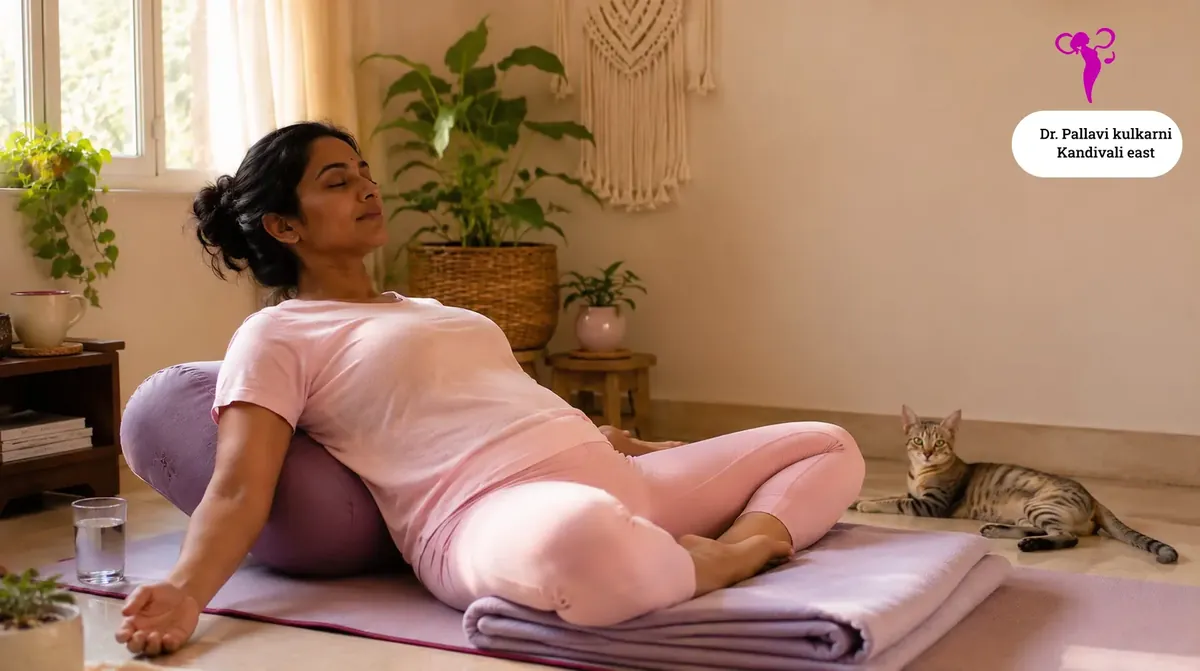
Why yoga works for women’s health: the science in plain words
Yoga is not just stretching. It is a combination of three things working together: physical postures (asanas), breathing techniques (pranayama), and deep relaxation or meditation. When women practise yoga consistently, three changes happen in the body that explain most of its benefits for gynaecological health.
Blood flow to the pelvis improves. Many yoga poses gently massage the abdominal organs and open the hip area. Better circulation in the pelvis means healthier ovaries, a calmer uterus, and less congestion that contributes to period pain.
The nervous system shifts from stress mode to rest mode. Modern life keeps most of us in a constant low-level fight-or-flight state. This raises cortisol, disturbs hormones, and worsens almost every gynaecological condition. Yoga, especially with slow breathing, switches on the parasympathetic nervous system, which is your body’s rest and repair mode.
Hormones rebalance over time. Studies on women practising yoga regularly have shown measurable changes in prolactin, FSH, LH, TSH, and cortisol levels. These are the same hormones your gynaecologist tests in blood reports.
The catch is that these changes happen gradually, with consistent practice, not after one class. Most studies measuring real benefits use programmes of eight weeks to six months. If you are starting today, give your body that kind of timeline.
Understanding your cycle before you begin
Your menstrual cycle is not the same energy every day. Ayurveda figured this out centuries ago, and modern research is catching up. Your hormones change in four distinct phases, and your yoga practice should change with them.
| Phase | Days | What is happening | Yoga focus |
|---|---|---|---|
| Menstruation | Day 1 to 5 | Bleeding, low energy | Restorative, gentle poses |
| Follicular | Day 1 to 13 | Estrogen rising, energy rising | Dynamic flows, standing poses |
| Ovulation | Around day 14 | Peak fertility, highest energy | More vigorous practice, inversions |
| Luteal | Day 15 to 28 | Progesterone rising, PMS possible | Calming, hip openers, twists |
If your cycle is irregular (which is common with PCOS or thyroid issues), you may not always know which phase you are in. That is okay. The general principle still applies: when energy feels low, go gentle. When energy feels high, you can practise more vigorously. Our free period cycle calculator can help you estimate the next phase if your cycles are reasonably regular.
Yoga for period pain (dysmenorrhea)
Painful periods affect somewhere between 45 and 95 percent of women who menstruate. In my clinic I see women, including teenage girls dealing with severe period pain, who miss work, miss college, or curl up with painkillers every month. If this is you, please know that yoga has some of the strongest research support for menstrual pain of any complementary therapy.
A 2023 review of 10 studies found that 39 different yoga poses, 5 breathing techniques, and Yoga Nidra all contributed to real relief from period pain. The mechanism is not mysterious. Yoga improves blood flow to the pelvic region, which reduces the cramping caused by tissue oxygen shortage. It also releases beta-endorphins, your body’s own painkillers, which are several times stronger than the pills you might be taking.
A well-known study by Rakhshaee in 2011 tested just three poses, Cobra (Bhujangasana), Cat (Marjariasana), and Fish (Matsyasana), and found significant reduction in pain intensity and duration compared to women who did not do yoga. A later 2016 study by Yang and colleagues used a 12-week programme that combined Surya Namaskar with these same poses, plus relaxation, and again the pain reduction was statistically significant.
Best yoga poses for period pain
| Pose (Sanskrit) | Common name | What it does |
|---|---|---|
| Balasana | Child’s Pose | Releases lower back, calms nervous system |
| Marjariasana-Bitilasana | Cat-Cow | Gently massages abdominal organs |
| Supta Baddha Konasana | Reclining Butterfly | Opens hips, relieves pelvic tension |
| Supta Matsyendrasana | Supine Twist | Releases back, reduces bloating |
| Viparita Karani | Legs-Up-the-Wall | Improves circulation, reduces fatigue |
| Ananda Balasana | Happy Baby | Opens hips, releases sacral area |
| Bhujangasana | Cobra | Strengthens pelvic region, relieves back pain |
How to use these: Start one week before your period is expected, and continue through the first two or three days of bleeding. Practise for 10 to 20 minutes daily, with slow deep breathing. A warm pad on your belly or lower back before or after practice makes the relief even better.
If you have severe period pain that gets worse year on year, please come for an evaluation. Conditions like endometriosis and adenomyosis hide behind “just bad periods” and need proper diagnosis. Yoga helps, but it is not a substitute for finding out what is causing the pain.
Yoga for PMS (premenstrual syndrome)
That week before your period when you cry at advertisements, fight with your husband over nothing, feel bloated, and cannot focus at work? That is PMS. It is real, it is physiological, and you are not imagining it.
An 8-week study published in 2024 followed 34 women between 18 and 40 who attended two weekly 90-minute hatha yoga sessions and did 15 minutes of daily home practice. Their PMS symptom scores dropped significantly, while the women who did not do yoga showed no change. They also lost some body weight and improved hip mobility, but the mood and physical symptom improvements were the most striking finding.
A larger study in Taiwan followed women for three months and found that yoga reduced not just the mood symptoms (depression, anger, irritability) but also the physical symptoms and the impact PMS was having on work, relationships, and daily life. This is what we call a meaningful clinical change. It is the difference between still functioning during that pre-period week and being knocked out by it.
For PMS, your practice in the second half of your cycle (the luteal phase) should be calming and grounding. Forward folds settle the nervous system. Supported backbends gently lift mood. Twists relieve bloating. Legs-Up-the-Wall (Viparita Karani) is wonderful for the fatigue and anxiety that often peak in the days before bleeding starts.
A breathing technique called Nadi Shodhana, or alternate nostril breathing, deserves a special mention here. Five to ten minutes of this practice each evening in your PMS week can shift your emotional state surprisingly quickly. It is simple: thumb closes right nostril, breathe in left, switch fingers to close left, breathe out right. Reverse. Repeat.
Yoga for PCOS (recently renamed PMOS)
PCOS, recently renamed PMOS (Polyendocrine Metabolic Ovarian Syndrome) by the May 2026 Lancet consensus, is the most common hormonal disorder I see in young women in Mumbai. ICMR research and Indian population studies put PCOS prevalence among reproductive-age women in the 4 to 22 per cent range depending on diagnostic criteria, with rates at the higher end seen using Rotterdam criteria. The symptoms vary from irregular periods to weight gain to acne to facial hair to fertility problems, and most women feel overwhelmed by the diagnosis.
Here is the good news. PCOS responds very well to consistent yoga practice, and the research backs this up clearly.
A 2022 case study followed a woman through an integrated yoga and naturopathy programme. After three months her periods had become regular. After six months her ovarian morphology on ultrasound showed normal appearance, not the classic polycystic look. Her weight and BMI also reduced. While a single case is not proof for everyone, this pattern, gradual normalisation of cycles with consistent practice, is something I have seen in my own patients.
A 2021 randomised controlled trial by Mohseni and colleagues found that yoga significantly improved both body measurements and PCOS symptoms in women who were undergoing fertility treatment. The mechanism makes sense. Yoga improves insulin sensitivity (a core problem in PCOS), reduces stress hormones, enhances pelvic blood flow, and supports gradual weight loss in women who need it.
“PCOS responds to consistency more than intensity. The women in my clinic who turn it around tend to be the ones doing 30 to 45 minutes, five days a week, for three months straight. Not the ones doing two-hour sessions at the weekend.”
- Dr. Pallavi Kulkarni, MBBS, DGO, DNB (OB-GYN), DFP, MRCOG (UK), Fellowship in IVF
Best yoga poses for PCOS
| Pose (Sanskrit) | Common name | PCOS benefit |
|---|---|---|
| Bhujangasana | Cobra Pose | Stimulates ovarian function |
| Setu Bandhasana | Bridge Pose | Improves pelvic circulation |
| Baddha Konasana | Butterfly Pose | Supports reproductive organs |
| Malasana | Garland Pose (deep squat) | Enhances blood flow to pelvis |
| Dhanurasana | Bow Pose | Stimulates endocrine glands |
| Paschimottanasana | Seated Forward Fold | Reduces stress, calms mind |
| Viparita Karani | Legs-Up-the-Wall | Improves lymphatic drainage |
| Surya Namaskar | Sun Salutation | Whole body, weight management |
How to use these: Aim for 30 to 45 minutes of practice, 5 to 6 days per week. PCOS responds to consistency more than intensity. Combine the poses above with Surya Namaskar rounds for the cardiovascular benefit, and end with at least 10 minutes of deep breathing or Yoga Nidra to lower cortisol. Give it three months before you judge whether it is working.
Yoga is not a replacement for the medical management of PCOS. If your doctor has put you on metformin, on hormonal medication, or has recommended specific investigations, please continue. Yoga works alongside these, not instead of them. Underlying contributors like thyroid issues, hormonal imbalance, and common Indian nutrient deficiencies (iron, vitamin D, B12) also need separate attention.
If your PCOS has been “managed” for years without much change, a fresh evaluation can identify the gaps in your current plan. Consult Dr. Pallavi Kulkarni at Aarogya Women’s Clinic, Kandivali East, for a structured PCOS workup that combines medical care with lifestyle support.
Yoga for endometriosis and chronic pelvic pain
Endometriosis is a condition where tissue similar to the uterine lining grows outside the uterus, causing intense pain, painful periods, and sometimes infertility. About one in ten women of reproductive age has it, and many wait years for a diagnosis. Chronic pelvic pain that lasts six months or longer affects many women regardless of endometriosis status.
For both conditions, gentle yoga has been studied and found helpful.
A Brazilian study followed 15 women with painful endometriosis who practised yoga for eight weeks. All 15 reported improvement in their pelvic pain. What was interesting in the interviews was how women described the change. They said the breathing techniques helped them become aware of their body, and that awareness itself made the pain easier to manage. Several women reduced their use of pain medication and psychiatric medication during the study period.
A randomised controlled trial on chronic pelvic pain compared NSAIDs alone with NSAIDs plus yoga over eight weeks. The yoga group had statistically significant reduction in pain scores and improvement in physical, psychological, social, and environmental quality of life domains. The conclusion was clear: yoga can be used as an add-on treatment that reduces dependence on painkillers and their side effects.
For endometriosis and chronic pelvic pain, gentler styles work best. Hatha, Yin, and restorative yoga are appropriate. Avoid intense vinyasa flows or anything that creates strain in the abdomen. Key poses are Reclining Bound Angle (Supta Baddha Konasana), Supine Spinal Twist, Happy Baby (Ananda Balasana), and Garland Pose (Malasana). The principle is simple: open without straining, breathe deeply, and never push through pain. ACOG’s guidance on dysmenorrhea and endometriosis recognises complementary practices as part of a balanced management plan.
Yoga for fertility
Of all the questions I get asked, fertility is probably the one with the most emotional weight behind it. Couples trying to conceive often describe the journey itself as more stressful than the medical procedures. And that stress is not just a feeling. It directly affects fertility outcomes through hormones, ovulation patterns, sperm quality, and even how a woman’s body responds to IVF. This is where yoga shines.
A 2018 systematic review of complementary therapies in IVF found consistent reductions in stress and anxiety across age groups and across different types of fertility challenges. For women undergoing IVF specifically, mind-body programmes that include yoga reduce anxiety and depression scores significantly compared to women who do not do these practices. A 6-week yoga programme for 128 women undergoing IVF reduced their stress and anxiety scores on a validated scale used in infertility research.
The bigger question is whether yoga affects actual pregnancy rates, not just feelings. The early evidence is encouraging. One study found that women who did yoga during their IVF cycles had higher implantation rates and pregnancy rates than the control group. Domar and colleagues in 2011 showed that women who completed a mind-body programme before their first IVF cycle had higher pregnancy rates than women who did not.
The biological reasons are still being studied, but the leading hypotheses are:
- Yoga reduces oxidative stress, which damages eggs and sperm
- Lower stress hormones improve ovulation regularity
- Better pelvic blood flow improves uterine receptivity to an embryo
- The emotional resilience makes it easier to stay with treatment cycles
For fertility, the practice that helps is gentle and restorative, not hot yoga or power yoga. Hip openers like Baddha Konasana and Supta Baddha Konasana improve pelvic circulation. Legs-Up-the-Wall after a difficult day is calming and circulation-friendly. Slow breathing practices and Yoga Nidra are particularly valuable. If you have been trying to conceive for many months without success, or you want a structured approach to getting pregnant faster, please pair this practice with a clinical evaluation.
If you are in active IVF treatment, talk to your fertility doctor about modifying your practice during the stimulation and post-transfer phases. Generally, gentle yoga is safe and helpful throughout, but inversions and intense abdominal work are avoided after embryo transfer.
A few important honest words: yoga is a support, not a cure. Fertility problems often have medical causes that need medical treatment. If you have been trying to conceive for over a year (or six months if you are over 35), please see a fertility specialist for an evaluation. Combining medical evaluation with stress-reducing practices like yoga gives you the best chance.
Yoga for menopause and perimenopause
Perimenopause, the years leading up to menopause, can start as early as the late thirties for some women and typically lasts several years. Hormone levels fluctuate unpredictably, causing hot flashes, disturbed sleep, mood swings, brain fog, weight changes, vaginal dryness, and changes in libido. For many Indian women, this transition coincides with caring for aging parents and adult children, which adds its own load.
The research on yoga for menopause is mixed for hot flashes specifically but very positive for everything else.
A pilot study of Integral Yoga for hot flashes split 54 women into three groups: yoga, health education, and waitlist control. Yoga did not show clear superiority for reducing hot flash frequency, although there were trends toward improvement. The 2023 guidelines from the North American Menopause Society reflect this: the evidence for yoga directly reducing hot flashes is limited.
But here is what yoga does help with during menopause, and the evidence is strong:
- Sleep quality improves significantly
- Anxiety and depressive symptoms reduce
- Overall quality of life improves across physical, psychological, social, and environmental measures
- Bone density is supported through weight-bearing standing poses, which matters because osteoporosis risk rises after menopause
For perimenopausal and menopausal women, a balanced practice works best. Include weight-bearing standing poses like the Warrior series (Virabhadrasana I and II) and Triangle Pose (Trikonasana) for bones. Add cooling forward folds and gentle twists for the nervous system. Practice Sheetali pranayama (rolled tongue breathing) when hot flashes feel overwhelming. End with restorative poses or Yoga Nidra for sleep support.
Yoga is one of the safest non-hormonal approaches to managing this transition. If your symptoms are severe, please discuss hormone therapy or non-hormonal medical options with your gynaecologist as well. The two approaches work well together.
Yoga for pelvic floor health (urinary incontinence, prolapse)
This is a topic women in India almost never bring up. They will live with it for years, leak urine when they cough or laugh, feel something dragging in the pelvis, avoid going out, and never tell their doctor or family. Please know that pelvic floor dysfunction is common, especially after childbirth and during menopause, and it is treatable.
A major randomised trial published in the Annals of Internal Medicine in 2024 compared 12 weeks of therapeutic pelvic floor yoga with a general physical conditioning programme in 240 women between 45 and 90 years old, all with daily urinary incontinence. Both programmes worked well, reducing incontinence episodes by approximately 60 percent. The yoga group averaged 2.3 fewer leakage episodes per day. This is a substantial real-life improvement.
A pilot study on women with urgency urinary incontinence showed that after 8 weeks of gentle yoga, urgency symptoms were significantly better, quality of life improved, depression scores dropped, and sleep improved. There was even a measurable reduction in an inflammatory marker called TNF-alpha in the blood.
Best yoga poses for pelvic floor health
- Malasana (Garland Pose, deep squat) for pelvic floor opening and strength
- Utkatasana (Chair Pose) for engaging the pelvic floor against gravity
- Setu Bandhasana (Bridge Pose) for pelvic floor and core integration
- Trikonasana (Triangle Pose) for side body and pelvic awareness
- Mula Bandha (root lock) integrated throughout practice
Mula Bandha is essentially the yogic version of Kegel exercises, but with breath awareness added. As you breathe in, gently lift the muscles of the pelvic floor (the same ones you use to stop urine flow midstream). Hold gently for a few breaths, then release. Done consistently, this strengthens the pelvic floor without you needing to set aside separate time for it.
The American College of Obstetricians and Gynecologists recommends pelvic floor muscle training as a first-line treatment for stress urinary incontinence and as an auxiliary treatment for pelvic organ prolapse. Yoga is one of the most accessible ways to do this training. If your symptoms are significant, please also consult a physiotherapist who specialises in women’s pelvic health.
If you have been silently dealing with leakage, pelvic heaviness, or post-childbirth changes, please talk to us. Dr. Pallavi Kulkarni offers pelvic floor evaluations in confidence at Aarogya Women’s Clinic, Kandivali East. You should not have to live around it.
Yoga Nidra: the most underrated practice for women’s hormones
If I had to pick one practice that benefits women’s gynaecological health more than any other relative to the effort it takes, it would be Yoga Nidra. The name means “yogic sleep,” and it is essentially a guided deep relaxation done lying down. You do nothing except listen to a voice guiding you through body awareness, breath awareness, and visualisation. It takes 20 to 30 minutes.
The research on Yoga Nidra and women’s hormones is striking.
A controlled trial by Rani and colleagues compared 100 women with menstrual irregularities, randomly allocated to a Yoga Nidra group alongside their prescribed medication or to a medication-only control group. After six months, the Yoga Nidra group showed statistically significant reductions in prolactin, FSH, TSH, and LH. These are the same hormones a gynaecologist would order in a blood test to investigate menstrual problems. A measurable hormone shift from a relaxation practice is remarkable.
Another study showed significant improvements in anxiety, depression, well-being, and general health in women practising Yoga Nidra for irregular periods. The mechanisms involve reduced adrenal cortisol output, normalisation of thyroid function, and a calming effect on the entire hypothalamic-pituitary axis (the master controller of your hormones). For women with diagnosed hormonal imbalance or borderline thyroid issues, this is genuinely worth trying alongside medical management.
“I tell my Kandivali patients with irregular cycles to try three Yoga Nidra sessions a week, in the luteal phase and during their period. Most of them are sceptical at first. By month three, several show normalised TSH on repeat blood tests without changing anything else. The mind-body connection is not a metaphor in gynaecology, it is biology.”
- Dr. Pallavi Kulkarni, MBBS, DGO, DNB (OB-GYN), DFP, MRCOG (UK), Fellowship in IVF
You do not need to be flexible. You do not need to be fit. You do not even need to stay awake. Yoga Nidra can be practised lying in bed before sleep. Guided recordings are freely available on YouTube and meditation apps. For gynaecological health, 3 to 5 sessions per week is enough to see benefit, ideally in your luteal phase and during menstruation.
Safety: what to avoid and when
Yoga is one of the safest forms of exercise studied, but there are situations where modifications matter.
During your period
Traditional yoga avoids inversions (poses where hips are above the heart, like Headstand and Shoulderstand) during menstruation. The reasoning is to not interfere with the natural downward flow. The scientific evidence for this is limited, but the principle is sensible. If a pose feels uncomfortable during your period, skip it. Stick to gentle, restorative practices, and skip strenuous classes for the first two days.
During pregnancy
Prenatal yoga is well-studied and safe when modified correctly. After the first trimester, avoid lying flat on your back for long periods. Avoid deep twists, strong abdominal work, and any pose that compresses the belly. A systematic review of yoga in pregnancy found no adverse effects in the studies that tracked them. Please join a proper prenatal yoga class or work with a teacher trained in prenatal modifications, especially after your second trimester begins. For more on antenatal care in this phase, see our pages on pregnancy care and high-risk pregnancy care.
Conditions that need medical clearance first
Please check with your gynaecologist before starting yoga if you have:
- Recent pelvic or abdominal surgery
- Severe osteoporosis (avoid forward folds, deep twists)
- Uncontrolled high blood pressure (avoid inversions)
- Certain eye conditions like advanced glaucoma (avoid inversions)
- Severe endometriosis with active pain (gentle only)
- Pelvic organ prolapse (avoid deep squatting and intense core work without guidance)
If you have any of these, tell your yoga teacher. A good teacher will modify safely. A teacher who insists you push through pain or who does not understand modifications is not the right teacher for you.
A simple weekly schedule to start with
You do not need to start by doing two hours every day. That is the surest way to give up by week three. Here is a realistic schedule for a beginner who wants to use yoga for gynaecological health.
| Day | Focus | Practice |
|---|---|---|
| Monday | Gentle flow | 20 min hatha yoga + 10 min pranayama |
| Tuesday | Pelvic health | 15 min pelvic floor poses + Yoga Nidra |
| Wednesday | Restorative | 30 min restorative yoga + meditation |
| Thursday | Active practice | 25 min vinyasa or Surya Namaskar |
| Friday | Hip openers | 20 min hip-opening sequence + breathing |
| Saturday | Yoga Nidra | 30 min deep relaxation |
| Sunday | Rest or gentle | Light stretching or full rest |
Adjust this according to your cycle. During your period, swap whatever is scheduled with gentle or restorative practice. In your luteal week when PMS hits, lean toward calming sessions.
Tips to actually keep this going
- Start with 10 minutes a day. Increase only when it feels natural.
- Have a fixed spot at home. Same corner, mat ready, props nearby. The fewer decisions you have to make, the more likely you will practise.
- Use props generously. Pillows, bolsters, folded blankets, books for blocks. Yoga is not gymnastics. Props are not cheating.
- Listen to your body, not Instagram. The version of a pose you see online is often by a professional yogi. Your version is allowed to look different.
- Find a teacher if you can. A certified yoga therapist or instructor with training in women’s health will give you personalised guidance that no article (including this one) can match.
- Track your symptoms. Keep a simple journal of your cycle, symptoms, and yoga days. After three months, look back. Patterns become visible.
A final, honest word from Dr. Pallavi
Women’s bodies are wonderfully complex. The same body that bleeds every month, that can grow a baby, that goes through perimenopause, deserves a practice that respects all of that complexity. Yoga, done thoughtfully, can be that practice.
What I want you to take from this guide is not a list of poses to memorise. It is the larger idea that you can do something for your own health beyond appointments and prescriptions. Yoga is one of the few practices that addresses physical, hormonal, and emotional health together. It is accessible, it costs almost nothing once you have a mat, and the research support is solid for many of the conditions women in my clinic struggle with.
Start small. Be consistent. Be honest with yourself about what your body is asking for on any given day. And please, do not use yoga as a reason to delay medical care. If something feels wrong, come for an evaluation.
If you are in Mumbai and would like to discuss your specific gynaecological concerns and how to integrate yoga with appropriate medical care, you can book an appointment at Aarogya Women’s Clinic in Kandivali East. Our clinic in Thakur Village welcomes women from across the western suburbs, including Kandivali East, Kandivali West, Borivali, Malad, Goregaon, Jogeshwari, and Andheri. Your health is worth the time.
Book a consultation with Dr. Pallavi Kulkarni, MBBS, DGO, DNB (OB-GYN), DFP, MRCOG (UK), Fellowship in IVF, at Aarogya Women’s Clinic, Kandivali East. Call +91 91366 33062 or WhatsApp us.
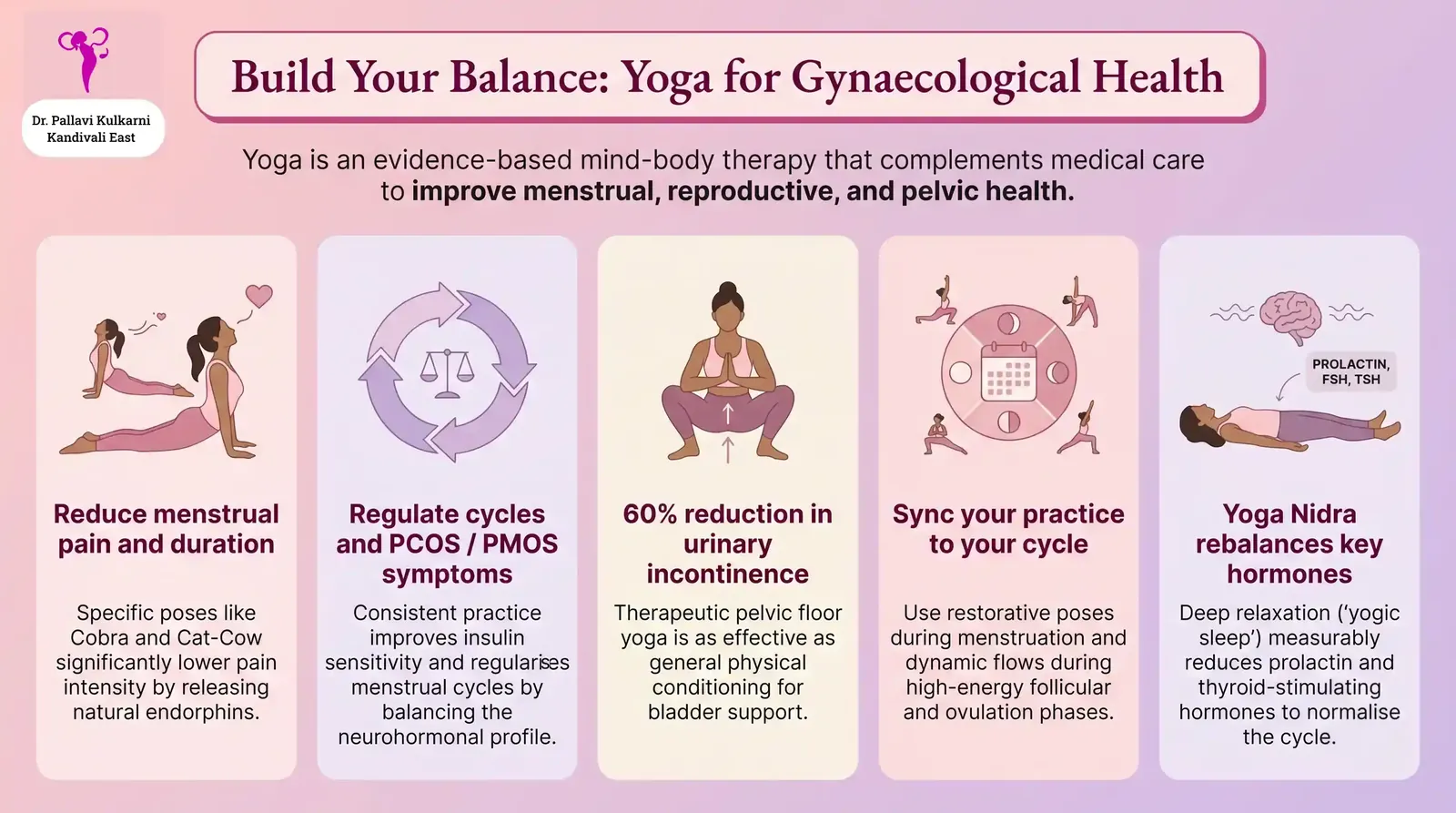
Key takeaways at a glance
A one-page summary of the five evidence-based ways yoga supports women’s gynaecological health, from menstrual pain to Yoga Nidra’s hormone effects.
Related reads on our blog
- → PCOS is now PMOS: what the rename means for diagnosis and treatment
- → Hormonal imbalance in women: signs, causes and what to do
- → Painful periods in teenagers: a Mumbai gynaecologist’s guide
- → Nutrient deficiencies in Indian women: iron, vitamin D, B12, folate
- → How to get pregnant fast: a Mumbai gynaecologist’s honest guide
- → Thyroid disorders in women: symptoms, fertility, treatment, diet
Medically reviewed by Dr. Pallavi Kulkarni, MBBS, DGO, DNB (OB-GYN), DFP, MRCOG (UK), Fellowship in IVF, May 2026. This article is for educational purposes and does not replace personal medical advice. For diagnosis and treatment, please consult a qualified gynaecologist.
Frequently Asked Questions
Can yoga cure PCOS?
No. PCOS (recently renamed PMOS) is a hormonal disorder with multiple factors, and there is no cure for it. But yoga, combined with appropriate medical care and lifestyle changes, can significantly improve symptoms, regularise periods, support weight management, and reduce the long-term risks associated with PCOS.
How long before I see results from yoga?
For period pain, some women feel relief within one to two cycles. For PCOS and fertility, give it at least three months of consistent practice. For menopause symptoms, expect changes over six to eight weeks. Hormonal shifts measured in studies usually require two to six months of regular practice.
Can I do yoga during my period?
Yes, gentle and restorative yoga is helpful during your period. Avoid intense flows and inversions on heavier bleeding days. Listen to your energy. Many women find that gentle yoga actually reduces cramping.
Is yoga safe during pregnancy?
Yes, with modifications. Join a proper prenatal yoga class and tell your teacher you are pregnant from the first session. Avoid lying flat on your back after the first trimester, avoid deep twists and strong abdominal work, and avoid hot yoga. Walk away from any class that does not feel safe.
Can yoga help me get pregnant?
Yoga supports fertility by reducing stress, improving pelvic blood flow, and supporting hormonal balance. Studies on IVF patients have shown improvements in pregnancy rates with yoga and mind-body programmes. It is not a fertility treatment by itself, but it is a valuable support alongside medical evaluation and treatment.
Is hot yoga safe for women’s health conditions?
Generally no, especially during your period, during pregnancy, during fertility treatment, and during perimenopause when hot flashes are an issue. The heat stress is not helpful for any of these conditions. Stick to regular temperature yoga.
Should I learn yoga from YouTube or join a class?
For absolute beginners or anyone with a medical condition, a real-world class with a qualified teacher is much better. The teacher can correct alignment, modify for your body, and prevent injury. Once you have learned the basics safely, home practice with reliable online resources is fine for daily maintenance.
Are there any yoga poses I should never do if I have endometriosis?
Avoid poses that compress the lower abdomen or create pelvic strain. This usually means intense abdominal work, strong vinyasa flows, and any pose that flares your pain. Stick to gentle, restorative, and Yin styles. If a pose hurts, that is your answer.
Can yoga replace my medication?
No. Please continue your prescribed medication. Yoga complements medical treatment. Stopping medication without consulting your doctor can be harmful, especially for conditions like PCOS, thyroid disorders, hypertension, and during pregnancy or fertility treatment.
What Our Patients Say
Experienced Gynecologist in Kandivali East with a Patient-Centered Approach
Dr. Pallavi Kulkarni is a highly regarded Gynecologist in Kandivali East, praised for her calm, compassionate, and patient-centered care. Her supportive approach helps women feel heard, respected, and confident about their treatment decisions.