
Hormonal Imbalance in Women: Signs, Causes, Tests and How to Fix It
By Dr. Pallavi Kulkarni, MBBS, DGO, DNB (OB-GYN), DFP, MRCOG (UK), Fellowship in IVF - Gynecologist, Aarogya Women’s Clinic, Kandivali East · ·
I was reading this NDTV article recently - “How A Silent Stress Hormone Crisis Is Disrupting Women’s Health In India” - and it described exactly what I have been seeing at our clinic for the past few years. Women coming in with fatigue, weight gain, irregular periods, and mood changes, all tied to hormonal imbalance that nobody caught early enough. It made me want to write down everything I tell my patients, in one place.
If you have been Googling “hormonal imbalance symptoms in women” and finding yourself in every list, you are not imagining things. Something is off, and your body has been trying to tell you for a while.
Most women who walk into our clinic with hormonal concerns have been dealing with vague symptoms for months, sometimes years, before anyone runs the right tests. Fatigue that sleep does not fix. Weight that shows up around the belly and will not leave. Skin that was clear at 22 but broke out again at 30. Periods that come whenever they feel like it.
The good news is that hormonal imbalance is not a mystery. It is measurable. It is identifiable. And in most cases, it is fixable, often without aggressive treatment.
What is hormonal imbalance?
Your body runs on hormones. They control your menstrual cycle, metabolism, mood, sleep, appetite, skin, hair, and fertility. When even one hormone is out of range, the ripple effects show up everywhere.
The hormones that matter most for women are estrogen, progesterone, testosterone, thyroid hormones (T3, T4, TSH), insulin, cortisol, and prolactin. They work together like an orchestra. If one instrument is off-key, the whole piece sounds wrong.
According to the Endocrine Society, even small shifts in hormone levels can cause noticeable symptoms. The challenge is that many women dismiss these symptoms as “just stress” or “just getting older.” They are not. They are signals worth investigating.
A hormonal imbalance is not a disease in itself. It is a sign that something underneath needs attention, whether that is your thyroid, your ovaries, your adrenal glands, or simply the way you have been living for the last two years.
Early signs most women miss
- Periods arriving earlier or later than usual, or skipping months entirely
- Weight gain concentrated around the midsection that does not respond to diet or exercise
- Acne appearing after age 25, especially along the jawline and chin
- Hair thinning on the scalp while growing in unwanted places like the chin or upper lip
- Persistent fatigue even after a full night of sleep
- Mood swings, irritability, or anxiety that feels out of character
- Difficulty sleeping or waking up between 2 and 4 AM regularly
- Low libido that does not match your relationship or life circumstances
- Bloating that seems constant rather than cycle-related
- Brain fog, forgetfulness, or trouble concentrating at work
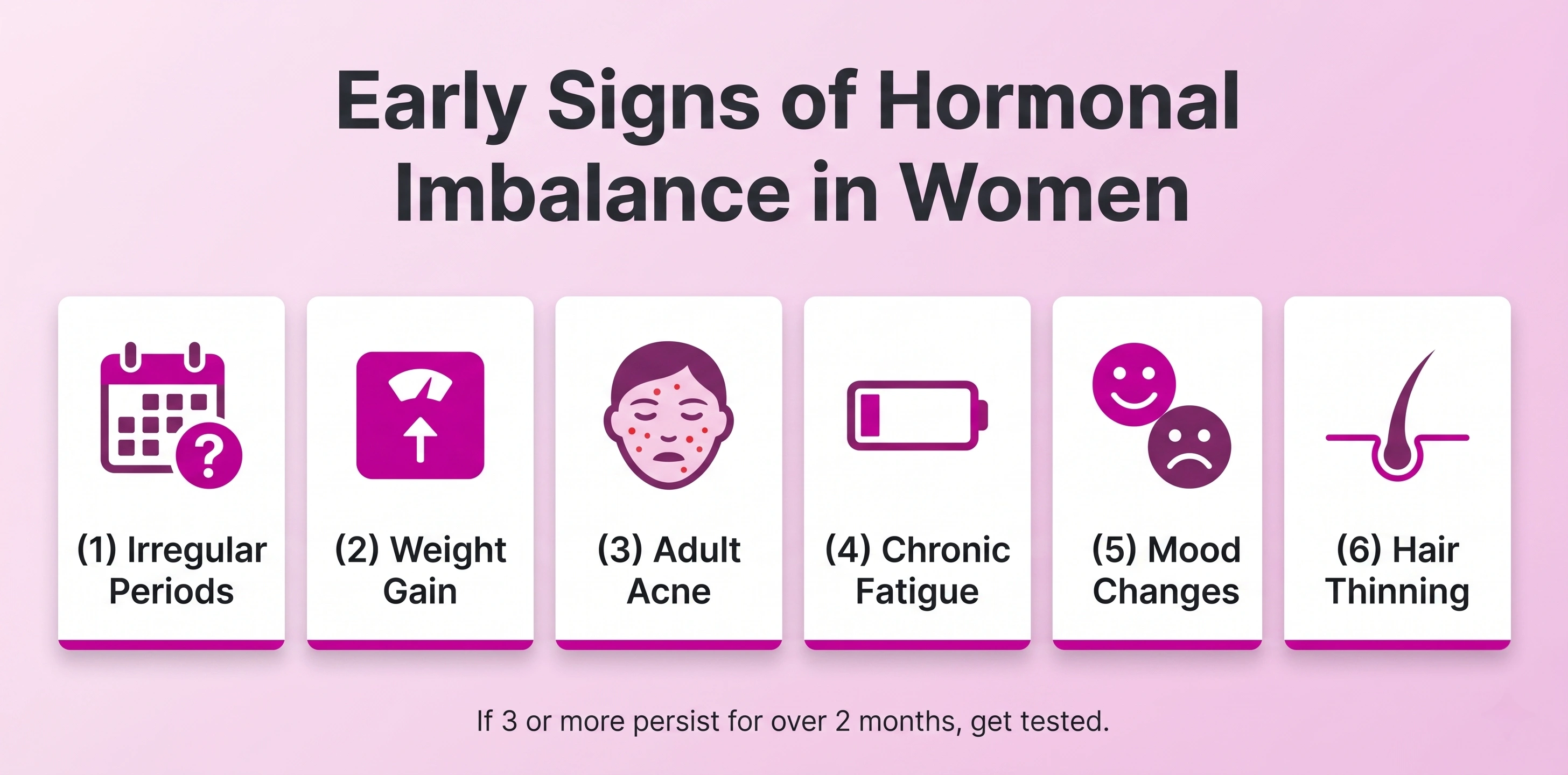
If 3 or 4 of these signs have been showing up together for more than 2 months, it is worth getting checked. A single consultation can tell you whether something is off.
The 5 signs we see most often
Out of everything on that list, these five show up in our clinic more than any others. If you recognise yourself here, you are not alone.
| Sign | What it looks like | When to worry |
|---|---|---|
| Irregular periods | Cycles shorter than 21 days or longer than 35 | Persists for 3+ months |
| Unexplained weight gain | Concentrated around the abdomen | No change in diet or activity |
| Adult acne | New breakouts after age 25 | Not responding to skincare |
| Chronic fatigue | 8 hours of sleep doesn’t help | Lasts more than 2 months |
| Mood changes | Irritability, anxiety, or low mood | Feels new or out of character |
Source: Clinical presentation patterns observed in Indian women, consistent with ICMR and FOGSI diagnostic guidelines
How do I know if I have a hormone imbalance?
The honest answer is: you cannot be sure without blood work. Symptoms overlap between thyroid problems, PCOS, vitamin deficiencies, insulin resistance, and even depression. What looks like a hormonal issue could be thyroid. What feels like burnout could be low progesterone. What seems like laziness could be insulin resistance.
That is why guessing does not work. The only way to know what is actually going on is to test. And testing is not complicated. A single blood draw on the right day of your cycle can check most of the hormones that matter.
What helps is tracking your symptoms before your appointment. When do they get worse? Are they tied to your cycle? Do they come with your period or mid-cycle? Have they changed in the last 6 to 12 months?
“Track your symptoms for 2 full cycles. Write it down. When you come to us with that diary, we can get to the problem much faster than starting from scratch.”
- Dr. Pallavi Kulkarni
Can I check hormonal imbalance at home?
There are home hormone test kits available online, and they are getting more popular. Here is what I tell patients about them: they can give you a rough idea, but they are not reliable enough to base treatment on.
The problem is timing. Hormones fluctuate throughout the day and across your cycle. A single sample taken at a random time may not tell you much. FSH and LH need to be tested on day 2 or 3 of your cycle. Progesterone needs to be tested around day 21. Cortisol is highest in the morning. If you miss the window, the number is meaningless.
Home kits also cannot give you the clinical context. A slightly elevated testosterone looks different in a woman with acne and irregular periods than in a woman with none of those symptoms. Numbers need interpretation.
Get a proper hormone panel done at a reliable lab. It costs about the same as most home kits, and you get results a doctor can actually work with.
Which tests actually matter?
When women ask about the “7 hormone test” or “complete hormone panel,” this is what we are usually ordering. Each test has a specific purpose and a specific timing window.
| Test | What it checks | When to test |
|---|---|---|
| TSH | Thyroid function | Any day |
| Prolactin | Pituitary hormone, affects periods and fertility | Any day |
| FSH | Ovarian function and egg reserve | Day 2–3 of cycle |
| LH | Ovulation trigger | Day 2–3 of cycle |
| Estradiol (E2) | Main estrogen level | Day 2–3 of cycle |
| Progesterone | Confirms ovulation | Day 21 of cycle |
| Testosterone | Often raised in PCOS | Any day |
| AMH (optional) | Ovarian reserve | Any day |
Timing guidelines per ACOG and Endocrine Society recommendations
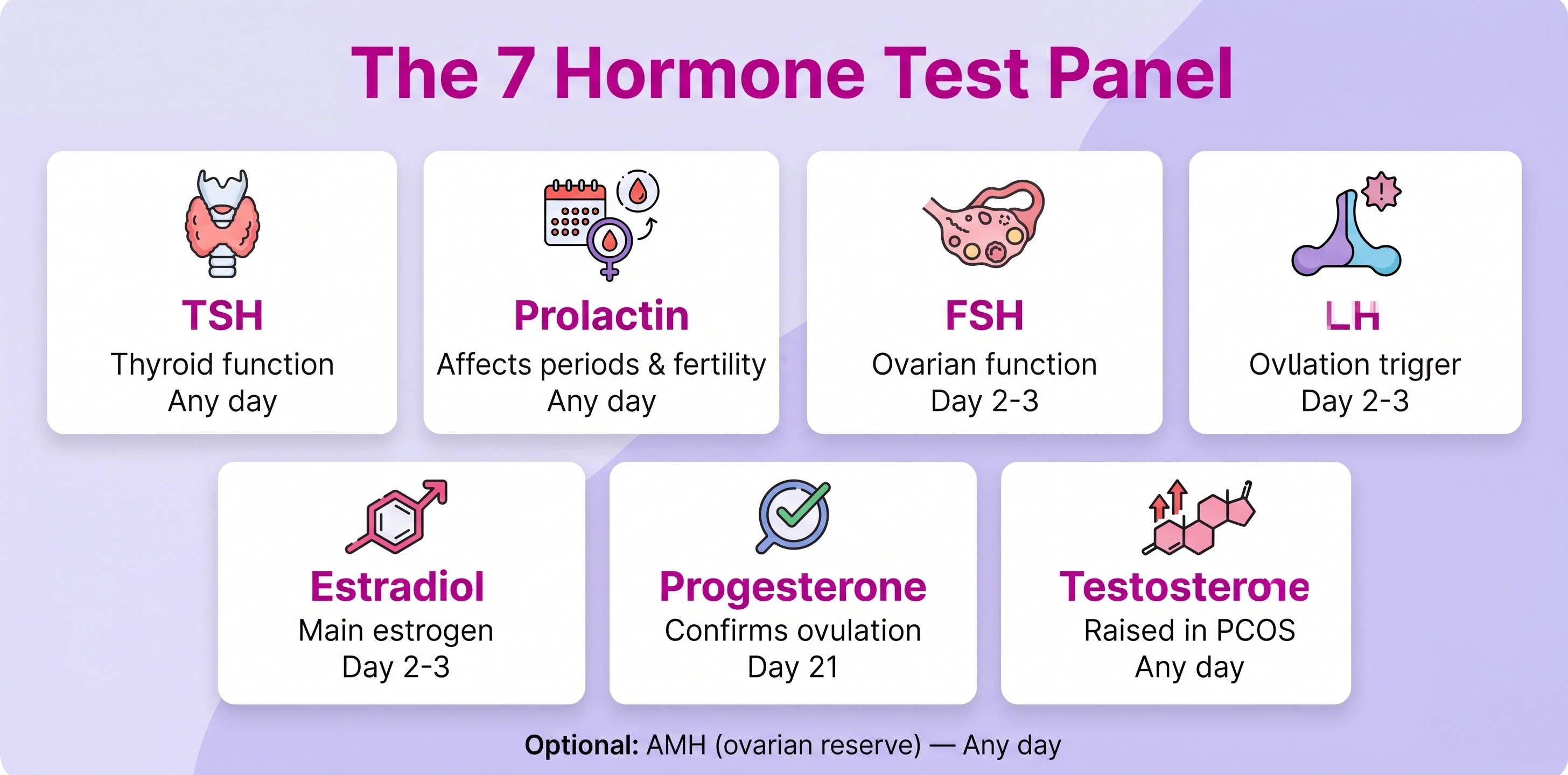
Not sure which tests you need? A 30-minute consultation can help us figure out the right panel for your specific symptoms.
What causes hormonal imbalance?
There is no single cause. Hormonal imbalance in women usually comes from one or more of these:
PCOS
PCOS is the single biggest cause of hormonal imbalance in Indian women. It raises testosterone, disrupts ovulation, affects insulin, and can cause weight gain, acne, hair growth, and irregular periods all at once. PCOS affects up to 20 percent of Indian women of reproductive age according to WHO and ICMR studies.
Thyroid disorders
Both hypothyroidism (underactive) and hyperthyroidism (overactive) throw off the rest of your hormones. Thyroid problems are extremely common in Indian women. A multi-city epidemiological study published in the Indian Journal of Endocrinology and Metabolism found subclinical hypothyroidism in about 8 to 11 percent of Indian women, and an estimated 42 million people in India have some form of thyroid disease. Fatigue, weight changes, hair loss, and period irregularity are the classic signs. A simple TSH test catches it. For a full guide to symptoms, testing, treatment, and an Indian-kitchen-friendly thyroid diet, see our thyroid disorders in women page.
Insulin resistance
When your cells stop responding properly to insulin, your body produces more of it. High insulin raises testosterone and worsens PCOS. It also drives weight gain around the midsection and makes it very difficult to lose.
Perimenopause
Perimenopause, which can start earlier than women expect, sometimes as early as the late thirties, causes estrogen and progesterone to fluctuate unpredictably. Hot flashes, mood changes, sleep disruption, and irregular periods are classic signs. When perimenopausal heavy bleeding does not respond to medical management, conservative options such as Mirena are typically tried before considering surgery.
Lifestyle factors
Poor sleep, chronic stress, crash diets, excessive exercise, and nutritional deficiencies (especially vitamin D, B12, and iron) can all disrupt hormonal balance. These are often the easiest to fix and the most commonly ignored.
Post-pill changes
Coming off birth control pills can temporarily disrupt your natural hormone cycle. Most women regulate within three to six months, but some take longer, especially if an underlying condition like PCOS was masked by the pill.
Does stress actually cause hormonal imbalance?
Yes, and it is not just a vague wellness claim. There is solid science behind it.
When you are stressed, your body produces cortisol. Short-term, that is fine. Long-term, chronically elevated cortisol interferes with the production of estrogen, progesterone, and thyroid hormones. It can delay or stop ovulation. It raises blood sugar. It disrupts sleep. And it makes every other hormonal problem worse.
In Mumbai, this is not theoretical. The women I see are commuting two hours a day in trains or traffic. Working demanding jobs. Managing households. Skipping meals or eating at their desks. Sleeping six hours and calling it enough. Running on chai and willpower.
That is not a lifestyle that supports hormonal health. And no supplement is going to fix what a consistently exhausting routine is breaking.
I am not saying quit your job and move to the hills. I am saying that when we treat hormonal imbalance, we have to talk about the life you are living, not just the pills you are taking. Small, consistent changes to sleep, meals, and stress management often do more than medication alone.
“Chronic psychological stress has been associated with menstrual irregularity and anovulation in multiple population-based studies.”
- World Health Organization
PCOS and hormonal imbalance
PCOS deserves its own section because it is behind so many hormonal complaints that women bring to us. Irregular periods, stubborn weight, acne that will not clear, thinning hair on the head, extra hair on the face, difficulty getting pregnant. All of these can trace back to PCOS.
Roughly 1 in 5 women of reproductive age in India has some form of PCOS. A systematic review in Cureus found pooled prevalence of 11 to 22 percent depending on diagnostic criteria used. Many of them do not know it. They have been told their periods are “just irregular” or that their weight gain is “just diet.” It is not.
PCOS is a hormonal and metabolic condition. It raises androgens (male hormones like testosterone), disrupts ovulation, and is closely tied to insulin resistance. The treatment is not one-size-fits-all. Some women need medication. Some respond well to weight management and lifestyle changes alone. Some need both. Even a modest weight loss of 2 to 5 percent of body weight can restore ovulatory cycles in many women with PCOS. Once cycles become regular again, our Ovulation and Fertile Window Calculator can give a baseline estimate of the likely fertile window. For those who need medication, a landmark trial published in the New England Journal of Medicine found that letrozole achieved ovulation rates significantly higher than clomiphene, with live birth rates of 27.5 percent per cycle.
The important thing is to get diagnosed properly. An ultrasound alone is not enough. We look at symptoms, blood work, and ultrasound together before confirming PCOS. If you have been told you have PCOS based only on an ultrasound, get a second opinion with proper blood tests.
Women dealing with adolescent gynecology concerns, especially teenage girls with acne and irregular cycles, are often seeing the early signs of PCOS before anyone thinks to test for it.
Watch: PCOS Explained
How hormonal imbalance affects fertility
If your hormones are off, getting pregnant becomes harder. Not impossible, but harder. Here is why.
Ovulation depends on a precise sequence of hormonal signals. FSH tells your ovary to develop a follicle. LH triggers the release of the egg. Progesterone prepares the uterine lining. If any of these hormones are too high or too low at the wrong time, ovulation may not happen at all, or the lining may not be ready to support a pregnancy.
Thyroid problems, high prolactin, PCOS, and even chronic stress can each independently disrupt this sequence. Many women who have been trying to conceive for 6 to 12 months without success discover that a treatable hormonal issue was the barrier all along.
The reassuring part is that most hormonal causes of infertility are treatable. Women with conditions like thyroid disorders, PCOS, or diabetes who do conceive may need high-risk pregnancy care to ensure a safe outcome. Thyroid medication corrects cycle irregularity within weeks. Ovulation induction with letrozole or clomiphene restores ovulation in 60 to 80 percent of women with PCOS. Insulin-sensitising drugs like metformin help when insulin resistance is involved. And lifestyle changes alone, better sleep, regular meals, consistent exercise, resolve a significant number of mild cases without any medication at all. Fertility treatment does not always mean IVF. In fact, most couples we see never need it.
“Women older than 35 years should receive an expedited evaluation after 6 months of failed attempts to become pregnant.”
- ACOG's guidance on evaluating infertility
If your hormones are affecting your ability to conceive, the earlier you act, the more options you have. Most couples we see do not need IVF.
The 4 happy hormones
You have probably seen this term on Instagram. It refers to dopamine, serotonin, oxytocin, and endorphins. Here is what they actually do and why they matter for hormonal health.
Dopamine
The reward hormone. It drives motivation, focus, and the feeling of satisfaction when you accomplish something. Low dopamine shows up as lack of motivation, difficulty concentrating, and cravings for sugar or junk food. Exercise, completing tasks, and adequate sleep support dopamine production.
Serotonin
The mood stabiliser. About 90% of serotonin is produced in the gut, which is why digestive health and diet affect your mood more than most people realise. Low serotonin is linked to anxiety, depression, sleep problems, and irritability. Sunlight, regular meals with protein, and physical activity all support it.
Oxytocin
The bonding hormone. Released during physical touch, breastfeeding, and positive social interactions. It reduces stress and anxiety. Women with strong social connections and physical affection in their lives tend to have more stable cortisol levels.
Endorphins
Natural painkillers. Released during exercise, laughter, and certain foods. They reduce perception of pain and create a sense of well-being. The “runner’s high” is an endorphin effect. Even a 20-minute walk can trigger endorphin release.
These four hormones are not separate from the hormones we test in blood work. They are part of the same system. When your thyroid, estrogen, and cortisol are off, your happy hormones suffer too. Fixing the underlying imbalance often improves mood, energy, and motivation as a side effect.
How to actually fix hormonal imbalance
There is no magic pill. But there is a clear process that works for most women when followed consistently.

Step 1: Get tested
You cannot fix what you have not identified. Start with the hormone panel above, a thyroid check, fasting insulin, and basic blood counts. Without data, everything is guesswork.
Step 2: Fix the foundations
Sleep 7 to 8 hours. Eat three proper meals a day with protein, fibre, and healthy fats. Cut back on refined sugar and processed food. Move your body for 30 minutes daily, even walking counts. These are not optional add-ons. They are the base layer of treatment.
Step 3: Targeted treatment
Depending on what the tests show, treatment might include thyroid medication, metformin for insulin resistance, hormonal support for PCOS, vitamin D and B12 supplementation, or progesterone support. Each case is different.
Step 4: Follow up and adjust
Hormones do not rebalance overnight. We retest at 3 months, adjust if needed, and monitor progress. Most women start feeling better around month 2 to 3, with full rebalancing by month 6.
“Hormones take 3 to 6 months to rebalance with consistent effort. We tell every patient this upfront because the dropout happens around week 6, when people feel like nothing is changing. It is. You just can’t feel it yet.”
- Dr. Pallavi Kulkarni
Can you reset hormones in 7 days?
No. This is one of the most common myths circulated on social media and wellness blogs, and it causes real harm.
Your hormonal system is not a phone you can restart. Thyroid medication takes 4 to 6 weeks to reach stable levels. Insulin sensitivity changes over months. Ovulatory cycles need 2 to 3 months to regulate. Cortisol patterns shift gradually with sustained lifestyle changes.
Anyone promising a 7-day hormone reset, a 14-day detox, or a weekend cleanse that “fixes” your hormones is selling you something, not giving you medical advice. The biology simply does not work that fast.
What about a 14-day hormone reset?
Same answer. Two weeks of clean eating and early bedtimes will make you feel better, sure. But it has not “reset” your hormones in any measurable way. If you have PCOS, a thyroid disorder, or insulin resistance, those conditions are still there on day 15.
What actually works is consistency over months. Not perfection. Not extremes. Just steady, sustainable habits combined with the right medical support when needed.
Drinks that support hormonal health
Women often ask about specific drinks or teas that help with hormonal balance. Here is what is actually supported by evidence and common sense.
Water. Sounds boring, but dehydration affects cortisol levels and overall metabolic function. Most women in Mumbai are not drinking enough, especially in summer.
Green tea. Contains compounds that may support insulin sensitivity. One to two cups a day is reasonable. It is not a cure, but it is a decent swap for your third cup of milky chai.
Spearmint tea. Some studies suggest it may help reduce androgens in women with PCOS. Two cups a day for at least a month to see any effect. Worth trying as a complement to treatment, not as a replacement.
Haldi doodh (turmeric milk). Anti-inflammatory. Useful as part of a broader anti-inflammatory diet. Your grandmother was right about this one.
What to reduce: Excess caffeine (more than 2 cups of coffee per day), sugary packaged juices, alcohol. All of these can worsen hormonal symptoms, especially sleep disruption and cortisol elevation.
No single drink will fix a hormonal imbalance. But the right daily habits, including what you drink, add up over time.
Hormonal imbalance in teenagers
Hormonal fluctuation is normal in the first 2 to 3 years after a girl starts her period. The system is still calibrating. Irregular cycles, some acne, and mood swings during this time are expected and usually resolve on their own.
But if a teenager has very heavy periods, severe pain that keeps her home from school, cycles that are consistently longer than 45 days, or significant acne and hair growth, those are signs that something beyond normal puberty adjustment is happening.
PCOS can start showing signs in the teenage years. Early identification means earlier management, which can prevent years of frustration. We see many young women in their twenties who had symptoms since they were 14 or 15 but were told “it will settle.” Sometimes it does. Sometimes it does not, and waiting costs time.
If your daughter has persistent symptoms, bring her in. The consultation is gentle and age-appropriate. We explain everything to both the parent and the child. Our adolescent gynecology clinic is set up for exactly this. We also cover irregular periods in teenagers and painful periods in detail.
When to see a doctor
- Your periods have been irregular for more than 3 months
- You have gained weight without any change in diet or exercise
- Acne appeared or worsened after age 25
- You feel exhausted no matter how much you sleep
- Your mood has changed noticeably and does not improve
- You have been trying to get pregnant for 6 months or more without success
- Hair is thinning or growing in unusual places
- You are experiencing symptoms of perimenopause before 45
- Multiple symptoms from the list above are showing up together
You do not need to have a dramatic health crisis to deserve an evaluation. If things feel off, they probably are. Trust your body. If you are unsure, this guide on when to consult a gynaecologist can help you decide.
Consult Dr. Pallavi Kulkarni at Aarogya Women’s Clinic in Thakur Village, Kandivali East. Call us at +91 91366 33062, WhatsApp us, or just walk in.
Women from Kandivali East including Thakur Village, Kandivali West, Malad East, Malad West, Borivali East, Borivali West, Goregaon East and Goregaon West visit us for hormonal health evaluation and gynaecological care.
Related reads on our blog
- → Irregular Periods in Women: How Many Days Late Is Normal?
- → Irregular Periods in Teenage Girls
- → Painful Periods in Teenagers
- → Why Am I Not Getting Pregnant? A Fertility Doctor Answers
- → Fertility Testing Explained: AMH, FSH, and Scans
- → When to Visit a Gynecologist: 10 Signs You Must Know
- → Menopause Clinic in Kandivali East
Medically reviewed by Dr. Pallavi Kulkarni, MBBS, DGO, DNB (OB-GYN), DFP, MRCOG (UK), Fellowship in IVF, April 2026. This article is for educational purposes and does not replace personal medical advice. For diagnosis and treatment, please consult a qualified gynaecologist.
Do you have any questions?
Request An AppointmentQuestions I get asked
What are the first signs of hormonal imbalance in women?
Irregular periods, unexplained weight gain, acne after 25, fatigue that does not resolve, and mood changes. If two or more persist together for over 3 months, get tested.
What is the 7 hormone test for women in India?
A blood panel covering TSH, prolactin, FSH, LH, estradiol, progesterone, and testosterone. Sometimes AMH is added. Standard workup for suspected hormonal imbalance. Available at most pathology labs across Mumbai.
Can hormonal imbalance in women be cured permanently?
Depends on the cause. Thyroid issues respond well to medication. Stress-related imbalance often reverses with lifestyle changes. PCOS is managed lifelong, not cured, but kept in check with the right approach.
Does hormonal imbalance go away on its own without treatment?
Short-term imbalance from acute stress or illness sometimes resolves. PCOS, thyroid disorders, and insulin resistance do not resolve without intervention.
What foods help fix hormonal imbalance in women?
Regular meals with protein, fibre, healthy fats, limited sugar. Standard home-cooked Indian food works well when eaten on time without skipping meals.
Is hormonal imbalance dangerous if left untreated?
Not immediately. But ignored over years, it can affect fertility, metabolic health, heart health, and mental health.
Can stress cause hormonal imbalance in women?
Yes. Chronically high cortisol from stress can delay ovulation, worsen PCOS, interfere with thyroid function, and reduce fertility.
How long does it take to fix a hormonal imbalance?
Hormones take 3 to 6 months to rebalance with consistent lifestyle changes and treatment. Anyone promising a 7-day reset is not giving medical advice.
What doctor should I see for hormonal imbalance in Mumbai?
A gynecologist with experience in hormonal conditions like PCOS, thyroid disorders, and fertility issues. Look for someone who orders proper blood work and explains things clearly.
What Our Patients Say
Experienced Gynecologist in Kandivali East with a Patient-Centered Approach
Dr. Pallavi Kulkarni is a highly regarded Gynecologist in Kandivali East, praised for her calm, compassionate, and patient-centered care. Her supportive approach helps women feel heard, respected, and confident about their treatment decisions.