
Contraceptive Options for Women in India: A Simple, Honest Guide
By Dr. Pallavi Kulkarni, MBBS, DGO, DNB (OB-GYN), DFP, MRCOG (UK), Fellowship in IVF ·
Deciding how to prevent pregnancy is a big decision, and yet most of us are never really taught about it. We hear bits and pieces from a friend, from a cousin, from a WhatsApp forward, from a late-night Reddit thread, or from an aunty who “knows someone.” A lot of that information is either wrong or half true, and it leaves many women confused and a little scared.
So let us slow down and talk about it properly. There is no single “best” method. A pill that a friend loves might not suit you at all, and that is completely normal. This guide walks you through every option available in India today, in plain language, so you can understand your choices, ask your doctor better questions, and stop worrying about the myths.
“In my Kandivali East OPD, I meet many women who went straight to the permanent operation because nobody told them that safe, reversible options existed. A ten-minute conversation about your age, your plans, and your health usually opens up three or four good choices you did not know you had.”
- Dr. Pallavi Kulkarni, MBBS, DGO, DNB (OB-GYN), DFP, MRCOG (UK), Fellowship in IVF
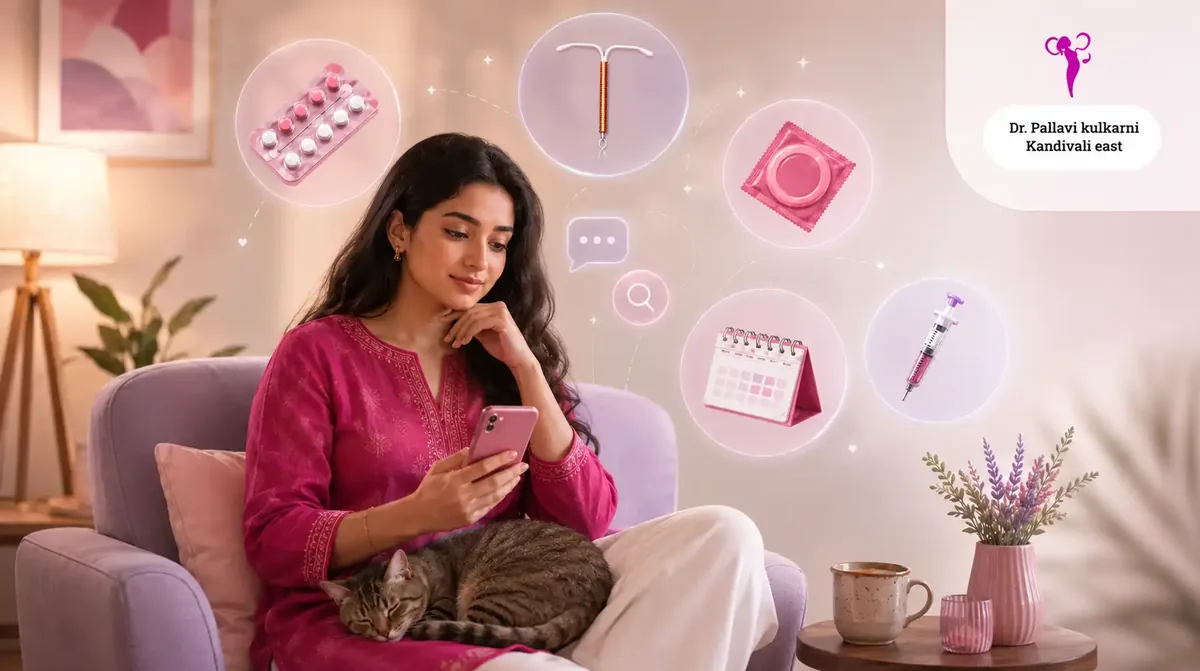
First, how do women in India actually prevent pregnancy?
India has come a long way. According to the National Family Health Survey (NFHS-5), the share of married women using some form of contraception has risen from 54% to about 67%, and use of modern methods now sits at roughly 56%. That is real progress.
But here is the catch. A very large share of that is female sterilisation, the permanent operation. Around 38 in every 100 married women have had it done, while barely any men choose the male operation, just about 0.3 in 100. Reversible methods like pills, the injection, and the copper-T are used far less than they could be.
Why does this matter to you? Because it means many women reach for the permanent option without ever knowing that there are safe, effective, reversible methods that let you plan your family on your own terms. You have more choices than you think. Let us go through them.
A quick note before we begin. This blog is here to give you information, not to replace a doctor. A proper check-up with a gynaecologist will always give you advice that fits you personally.
The condom broke last night. How do I avoid getting pregnant?
If you are reading this in a panic because the condom broke, or you missed your pills, or it just happened, take a breath. You have options, but time matters, so here is exactly what to do.
- Under 72 hours (3 days): take an emergency pill. i-Pill, Unwanted-72, or Ezy Pill, available at almost any chemist without a prescription for about ₹75 to ₹110. The sooner you take it, the better it works, so do not wait for a “good time.”
- Up to 5 days (120 hours): consider a copper-T. Fitted by a doctor, the copper-T is the most effective emergency contraception there is, more than 99% effective (ACOG), and it then keeps protecting you for years. Many women never hear about this, but it is a genuinely good choice if you were already thinking about long-term contraception.
- Do not rely on home remedies. Papaya, pineapple, lemon, ajwain, hot drinks, jumping, squats, heavy exercise, or washing and douching afterwards will not reliably prevent pregnancy after sex. These are old beliefs with no science behind them, so do not rely on food or home tricks.
Afterwards, watch your period. If it is more than a week late after taking an emergency pill, or if you feel pregnancy symptoms like nausea or breast tenderness, take a home pregnancy test or see a doctor. One more thing worth knowing: an emergency pill protects you only for that one incident. It does not cover you for the rest of the month, so use condoms or start a regular method until your next period.
Not sure of your window, or which option is safer for you? Call +91 91366 33062 or message us on WhatsApp. It stays confidential.
The methods, one by one
We have grouped these the way real life works: things you use in the moment, things you take regularly, things you can forget about for years, the emergency backup, and the permanent options. Read the ones that matter to you.
The effectiveness figures given for each method below are typical-use estimates, meaning how well the method works in real life rather than under perfect use, from the US CDC and the WHO.
1. Condoms: the only method that also protects against infection
Condoms are the most familiar method, and for good reason. A male condom is worn on the man and simply stops the sperm from reaching the egg. No hormones, no prescription.
Here is the one thing that makes condoms special. They are the only contraceptive that also protects both partners from sexually transmitted infections, including HIV. No pill, no injection, no copper-T can do that. If there is any chance of infection, condoms are not optional. They are important.
How well do they work? Used perfectly and every single time, they are about 98% effective. In real life, with the occasional slip or “just this once without it,” the number drops to around 87%. That gap is exactly why some couples pair condoms with another method.
Where to get them and cost. Condoms need no prescription. The government’s Nirodh brand is given free at health centres and by ASHA workers. In a chemist shop, a pack costs roughly ₹25 to ₹300 depending on the brand.
One myth worth killing right now. Using two condoms at once does not give extra protection. It actually causes friction and makes them more likely to tear. One at a time, correctly, every time. That is the rule.
2. Birth control pills (goli): taken daily, fully reversible
Oral contraceptive pills are small tablets you take every day. Most contain two hormones (these are called combined pills) that stop your ovaries from releasing an egg. Common brands in India include Mala-N, which is free at government centres, along with Mala-D, Femilon, Yasmin, and Diane-35 at chemist shops.
Used correctly, pills are very effective. In real life, allowing for the days women forget to take them, they are around 91 to 93% effective. The key word is daily. The pill only works if you take it at about the same time every day, so it suits women who can build it into a routine.
There are also some nice bonuses. Many women find their periods become lighter, more regular, and less painful on the pill. Pills can help with acne, and long-term use is linked to a lower risk of ovarian and uterine cancers.
Now the myths, because there are big ones:
- “Pills make you fat.” Modern low-dose pills have not been shown to cause real, lasting weight gain. Some women hold a little water in the first month or two, and that settles down.
- “Pills cause infertility.” This is simply false. Once you stop the pill, your fertility comes back quickly, usually within one to three cycles.
- “You must take a break from pills to rest your body.” There is no medical reason to do this. Random breaks just put you at risk of an unplanned pregnancy.
One thing you genuinely must tell your doctor about. If you are taking medicines for tuberculosis (especially rifampicin), certain epilepsy medicines, or the herbal remedy St. John’s wort, these can make the pill weaker. TB is common in India, so this matters. If that is you, do not rely on the pill alone; your doctor may suggest a backup method or a different option like the copper-T or the injection, which these medicines do not affect.
There is also a non-hormonal pill developed in India called Chhaya (Centchroman). It has no estrogen, is taken twice a week for the first three months and then once a week, and is free at government centres. It suits women who want a pill but prefer to avoid daily dosing or estrogen. If your periods or hormones are already irregular, for example with PCOS or a thyroid problem, mention that before you start, because it changes which pill is safest for you.
Cost. Mala-N and Chhaya are free at government health centres. Branded pills at a chemist range from about ₹35 to ₹400 per monthly pack.
3. The emergency pill (i-Pill, Unwanted-72): does it cause an abortion?
Sometimes the condom breaks. Sometimes you missed your pills. Sometimes it just happened. That is what emergency contraception is for.
You have probably seen the ads for i-Pill, Unwanted-72, or Ezy Pill. You can buy them at any chemist without a prescription for about ₹75 to ₹110. The government also gives Ezy Pill free through health centres and ASHA workers. A few important facts:
- Take it as soon as you can. The emergency pill works best the sooner you take it, ideally within 72 hours (3 days) of unprotected sex.
- It is not an abortion pill. This is the biggest myth, and it stops many women from using it. The emergency pill works by delaying the release of the egg so that fertilisation does not happen. If you are already pregnant, it does nothing and does not harm an existing pregnancy.
- Side effects are usually mild. Emergency pills are safe, but they can cause short-lived nausea, tiredness, a headache, mild breast tenderness, or a slightly upset stomach, usually passing within a day or two. The most common effect is a change in your next period: it may come a few days early or late, and may be heavier or lighter than usual. That is normal. If you vomit within 2 hours of taking the pill, take another dose.
- It is a backup, not a routine. Emergency pills are less reliable than regular methods and are not meant to be used again and again. There is no fixed number that will harm you, and they do not cause infertility, but using them repeatedly is hard on your cycle and simply less effective than a regular method.
One thing many women do not know: the copper-T is actually the most effective emergency contraceptive of all. Fitted within five days, it is more than 99% effective and then keeps protecting you for years. So if you were already thinking about long-term contraception, an emergency visit can solve two problems at once.
“Every week someone tells me she was too scared to take an emergency pill because she thought it was an abortion. It is not. It simply delays the egg from being released, so a pregnancy never starts. Taken early, it is safe and it works.”
- Dr. Pallavi Kulkarni, MBBS, DGO, DNB (OB-GYN), DFP, MRCOG (UK), Fellowship in IVF
4. The copper-T (copper IUD): fit it and forget it for years
The copper-T is a small device shaped like the letter T that a doctor or trained nurse places inside your uterus in a quick five to ten minute procedure. It slowly releases copper, which stops sperm from reaching or fertilising an egg. No hormones at all.
This is one of the most effective methods there is, over 99%, in the same league as the permanent operation. The difference is that it is completely reversible. The moment you have it removed, your fertility returns.
Depending on the type, a copper-T lasts 5 or 10 years (the common Cu-T 380A lasts 10 years). You do not have to remember anything daily or monthly. For a busy woman, that peace of mind is worth a lot.
What to expect. In the first three to four months, some women notice heavier periods and more cramping. This usually settles down. If you already have very heavy or painful periods, tell your doctor, because a different method might suit you better.
Two big myths to drop. First, “the copper-T causes infertility.” It does not; your fertility comes straight back after removal. Second, “it is only for women who already have children.” Also untrue: the copper-T is safe and suitable even if you have never had a baby.
Cost. At a government facility, the copper-T (device, insertion, and follow-up) is completely free. In a private clinic, expect roughly ₹200 to ₹3,600 all in.
Still not sure whether a copper-T, a pill, or the injection fits your body and your plans? A short consultation sorts it out, with no pressure to decide on the spot.
5. The hormonal IUD (Mirena): lighter periods, long protection
This is a cousin of the copper-T, but instead of copper it releases a tiny, steady dose of a hormone right where it is needed. In India it is known by the brand Mirena, and it lasts about 5 years.
It is extremely effective, over 99%. Its standout benefit is that it makes periods much lighter, and many women eventually get very light periods or none at all. For women who struggle with heavy, painful periods, doctors sometimes recommend it for that reason alone, and not only for contraception.
In the first three to six months you might get some spotting or irregular bleeding as your body adjusts. That usually calms down.
Cost and access. The hormonal IUD is not part of the free government programme, so it is a private option. Including insertion, it usually costs around ₹6,000 to ₹9,000. It is an investment, but spread over five years it is quite reasonable.
6. The contraceptive injection (Antara): why did my periods stop?
If remembering a daily pill is not for you, the injection might appeal. One injection protects you for three months (12 weeks). In India it is available free under the government programme as Antara. Used on time, it is about 94 to 96% effective in real life.
Be prepared for period changes, because this is the number one reason women stop it. In the early months your periods may become irregular or spotty. Over time, many women stop getting periods altogether while on the injection. This is normal and not harmful, but it surprises women who are not warned about it.
That leads to a common fear: “my periods stopped, so blood must be collecting inside me.” This is not true. There is no blood building up. The injection simply keeps the lining of the uterus thin, so there is little or nothing to shed. It is harmless.
One honest point. After you stop the injection, your fertility can take a bit longer to return than with other methods, on average around four to six months, sometimes longer. Most women conceive within a year of stopping, but if you are planning to try for a baby very soon, mention this to your doctor.
There is also newer international information that long-term use of this injection may be linked to a small increased risk of a usually non-cancerous brain tumour called meningioma (Roland and colleagues, BMJ 2024). The overall risk stays very low, and this is mostly relevant for women who use it for several years. It is simply worth an honest chat with your doctor, especially if you plan to use it long term. Because of these trade-offs, a good counselling session before your first injection makes a real difference.
“When periods stop on the injection, women often panic that blood is collecting inside them. It is not. The injection just keeps the lining of the uterus thin, so there is nothing to shed. Once I explain that, most women relax completely.”
- Dr. Pallavi Kulkarni, MBBS, DGO, DNB (OB-GYN), DFP, MRCOG (UK), Fellowship in IVF
7. The contraceptive implant: a tiny rod under the skin
The implant is a small, matchstick-sized flexible rod that a doctor places just under the skin of your upper arm. It slowly releases a hormone and protects you for about three years. It is one of the most effective methods available, over 99%.
The honest situation in India: the implant is not part of the government’s free programme, and availability through private clinics is still limited and varies from city to city. If you are interested, ask your gynaecologist whether it is available and reliably stocked near you, rather than trying to arrange it yourself. In private clinics, the device plus insertion may cost roughly ₹8,000 to ₹15,000.
8. Natural methods: do “safe days” and pulling out actually work?
Many couples try to avoid pregnancy by counting “safe days” or by withdrawal (pulling out). These cost nothing and use no devices, which is why they are popular. But you should know the real numbers. In typical use, withdrawal fails for about 22 out of every 100 women in a year, and calendar or rhythm methods for around 24 out of 100 (CDC). That is roughly one in four.
These methods are especially unreliable if your periods are irregular, which is common after childbirth, around menopause, and in conditions like PCOS. If avoiding pregnancy really matters to you right now, these are not the methods to lean on. If you do want to use fertility awareness properly, it needs careful training and very consistent effort, and it is worth learning from a professional rather than a WhatsApp chart. Tools like our ovulation and fertile-window calculator and period cycle calculator can help you understand your cycle, but treat them as learning aids, not as contraception.
While we are here, let us settle the home-remedy question for good. Eating papaya or pineapple, drinking lemon or ajwain water, doing yoga or heavy exercise, jumping, or washing yourself out after sex: none of these reliably prevents pregnancy. They are popular online and in family chats, but there is no real evidence behind any of them. For a non-hormonal option that actually works, the copper-T and condoms are your best friends.
9. Breastfeeding as contraception (LAM): only with all three conditions
New mothers are often told that you cannot get pregnant while breastfeeding. There is truth in it, but only under strict conditions. This method is called LAM, and it works only when all three of these are true at the same time:
- Your periods have not returned since delivery
- You are fully or almost fully breastfeeding, with no other food, water, or formula for the baby
- Your baby is less than 6 months old
When all three hold together, breastfeeding gives more than 98% protection (WHO). But the moment even one of them changes, for example your baby starts other foods, or your period returns, or the baby turns six months, the protection drops fast and you need to start another method right away.
The dangerous myth here is thinking breastfeeding alone always protects you. Many women have conceived their second baby very soon after the first because of exactly this misunderstanding. If you are a new mother, please plan your next method before you actually need it, ideally during your pregnancy check-ups.
10. Permanent methods (sterilisation): should I get the operation, or should he?
When your family is complete and you are sure you do not want any more children, sterilisation is a safe, permanent, over 99% effective choice.
Female sterilisation (the operation) blocks the fallopian tubes. It is done free at government hospitals and costs roughly ₹15,000 to ₹50,000 privately. Recovery is usually a few days to a couple of weeks.
Male sterilisation (vasectomy, or NSV) is the man’s version. Here is something most people in India do not realise: the male operation is actually simpler, safer, cheaper, and quicker than the female one, with no hospital stay needed. And yet barely any men choose it, while lakhs of women undergo the bigger surgery every year.
Let us bust the myth head on. A vasectomy does not reduce a man’s strength, masculinity, or performance in any way. It does not affect testosterone or the ability to be intimate. It simply stops sperm from being present. Family planning does not have to fall only on the woman, and this is worth discussing openly with your husband.
Two honest points about sterilisation for everyone. First, treat it as permanent. Reversal surgery exists, but it is complex, expensive, and does not always work, so choose it only when you are truly done having children. Second, and this is important, the decision must be yours, made with full information and without pressure. You have every right to ask questions and to say no.
“The male operation is smaller, safer, and quicker than the female one, yet I have counselled far more women for sterilisation than men. Family planning does not have to fall only on the wife, and it helps when couples decide this together.”
- Dr. Pallavi Kulkarni, MBBS, DGO, DNB (OB-GYN), DFP, MRCOG (UK), Fellowship in IVF
Quick comparison: all methods at a glance
Table 1: Contraceptive methods compared
| Method | How effective (real life) | How long it lasts | Reversible? | Cost (private) | Free from government? |
|---|---|---|---|---|---|
| Male condom | About 87% | Each time | Yes, at once | ₹25 to ₹300 per pack | Yes (Nirodh) |
| Daily pill (Mala-N, etc.) | About 91 to 93% | Daily | Yes, in 1 to 3 cycles | ₹35 to ₹400 per month | Yes (Mala-N) |
| Non-hormonal pill (Chhaya) | About 98 to 99% | Weekly | Yes | Free at govt | Yes |
| Emergency pill (i-Pill, etc.) | About 75 to 89% | Each time | Not applicable | ₹75 to ₹110 | Yes (Ezy Pill) |
| Copper-T (copper IUD) | Over 99% | 5 to 10 years | Yes, at once | ₹200 to ₹3,600 | Yes |
| Hormonal IUD (Mirena) | Over 99% | 5 years | Yes, at once | ₹6,000 to ₹9,000 | No |
| Injection (Antara) | About 94 to 96% | 3 months | Yes, after a few months | Free at govt | Yes (Antara) |
| Implant | Over 99% | 3 years | Yes, at once | ₹8,000 to ₹15,000 | No |
| Female sterilisation | Over 99% | Permanent | No | ₹15,000 to ₹50,000 | Yes |
| Vasectomy (NSV) | Over 99% | Permanent | No | ₹5,000 to ₹60,000 | Yes |
Effectiveness figures are typical-use estimates from the US Centers for Disease Control and Prevention and the World Health Organization. India cost and access notes follow the National Family Planning Programme. Costs are indicative and vary by brand, city, and clinic.
Which method is right for you? Guidance by life stage
Because the best method really does depend on where you are in life, here is a simple way to think about it.
Newly married and want to wait before your first baby? Reversible methods are your friends: condoms, pills, or the copper-T all let you delay easily and come off whenever you are ready. If you also want infection protection, keep condoms in the picture.
Spacing out children by a few years? Doctors often suggest waiting around two to three years between births for the health of both mother and baby. The copper-T (up to 10 years) and the hormonal IUD (5 years) are excellent here because you fit them and forget them. The injection and pills work well too.
Just delivered or breastfeeding? You have safe choices. A copper-T can even be placed right after delivery (this is called PPIUCD, often done within 48 hours before you leave the hospital). Progestin-only methods like the mini-pill, injection, and hormonal IUD are safe while breastfeeding and do not reduce your milk. Combined pills with estrogen are usually avoided for the first few weeks to months. The best time to plan all this is actually before delivery, so ask during your antenatal check-ups.
Family complete? You can choose a long-acting reversible method like the copper-T if you want the option of changing your mind, or a permanent method (female or male sterilisation) if you are certain. Women under 30 especially should know that reversible options give the same protection without closing the door forever.
If you are approaching your 40s or perimenopause, your needs shift again; our menopause clinic page explains what changes and why some methods suit this stage better than others.
Which method is safest if you have PCOS, migraine, high BP, diabetes, or thyroid issues?
Some health conditions change which methods are safe for you, so this is the one part of the guide where you really should not self-select. Doctors match a method to your health using the WHO Medical Eligibility Criteria for Contraceptive Use. As a rough guide:
- PCOS: most methods are fine, and certain combined pills can actually help with acne, irregular periods, and unwanted hair. More in our PCOS guide.
- Migraine with aura: combined estrogen pills are usually avoided. Progestin-only methods, the copper-T, and the hormonal IUD are safer choices.
- High blood pressure: if it is uncontrolled, combined estrogen pills are avoided. The copper-T and progestin-only methods are generally safe.
- Diabetes: it depends on how long you have had it and whether there are complications. Many methods are fine, but this needs a proper review.
- Thyroid problems: most methods are safe; the main thing is to get your thyroid well controlled.
- Smoker over 35: combined estrogen pills are best avoided. The copper-T, progestin-only methods, and condoms are safer.
The copper-T is safe in almost every one of these situations, which is one reason doctors reach for it so often. Please treat this as a starting point for a conversation, not a final answer, and have a quick consultation so a method is matched to your specific health.
When to see a doctor quickly
Whatever method you use, some signs should never be ignored. Please see a doctor soon if you notice:
- A severe headache, blurred vision, chest pain, or pain and swelling in one leg while on hormonal methods
- Severe lower tummy pain, fever, or foul-smelling discharge after a copper-T or hormonal IUD is fitted
- Very heavy bleeding, soaking a pad every hour
- A missed period or a positive pregnancy test after sterilisation, which must be checked at once
- Your period being more than a week late after taking an emergency pill
These are not meant to scare you. They are simply the “call the doctor” signals, the same way you would for any other health matter.
The most useful thing you can do is talk it through with a doctor who listens. Dr. Pallavi Kulkarni offers unhurried, confidential contraception counselling at Aarogya Women’s Clinic, Kandivali East. Call +91 91366 33062 or WhatsApp us.
A final, gentle word
Choosing contraception is not about picking the perfect method that a magazine or a neighbour recommends. It is about finding what fits your body, your life, and your plans right now, knowing you can always change it later.
Women from Kandivali East including Thakur Village, Kandivali West, Borivali East, Borivali West, Malad East, Malad West, Goregaon East, and Goregaon West consult Dr. Pallavi Kulkarni, a gynaecologist in Kandivali East, for honest contraception advice at Aarogya Women’s Clinic. Bring your questions, even the ones that feel silly. There are no silly questions when it comes to your own health.
If you would like personal guidance on which method suits you best, book a consultation with Dr. Pallavi Kulkarni. You can also read more about her credentials and approach. You will get clear answers, no judgement, and a plan made just for you.
Related reads on our blog
- → PCOS Is Now Called PMOS: What the Name Change Means for Women in India
- → Irregular Periods in Women: How Many Days Late Is Normal?
- → Hormonal Imbalance in Women: Signs, Tests and Fixes
- → White Discharge in Women: Causes, Is It Normal, and When to See a Doctor
- → Adolescent Gynecology Clinic in Kandivali East
- → Menopause Clinic in Kandivali East
- → Pregnancy Care in Kandivali East
Medically reviewed by Dr. Pallavi Kulkarni, MBBS, DGO, DNB (OB-GYN), DFP, MRCOG (UK), Fellowship in IVF, July 2026. This article is for educational purposes and does not replace personal medical advice. For diagnosis and treatment, please consult a qualified gynaecologist.
Have a question about contraception?
Request An AppointmentFrequently Asked Questions
Which is the best contraceptive method for women in India?
There is no single best method for everyone. The right choice depends on your age, whether you have children, your health, your plans, and your daily routine. The copper-T and hormonal IUD are among the most effective reversible options, condoms are best if you also need protection from infection, and pills suit women who can keep a daily routine. A gynaecologist can help you match a method to your life.
How can I avoid pregnancy after unprotected sex?
You have two reliable options. If it has been less than 72 hours, take an emergency contraceptive pill like i-Pill, Unwanted-72, or Ezy Pill, available at any chemist without a prescription. If it has been up to 5 days, a copper-T fitted by a doctor is the most effective choice and also gives you years of protection. The sooner you act, the better it works.
Can I prevent pregnancy naturally after unprotected sex?
Not reliably. Once sex has happened, there is no safe natural trick that will prevent pregnancy. Your only dependable options are the emergency pill within 72 hours or a copper-T within 5 days. Natural methods like tracking safe days only help before sex, not after.
Can food, papaya, lemon, ajwain, or home remedies prevent pregnancy?
No. Eating papaya or pineapple, drinking lemon or ajwain water, exercising, jumping, or washing yourself out after sex does not prevent pregnancy. These are myths with no science behind them. Use an emergency pill or see a doctor instead.
Does the emergency pill (i-Pill) cause an abortion?
No. The emergency pill works by delaying the release of the egg, so pregnancy does not start in the first place. If you are already pregnant, it does not work and does not harm the pregnancy. It is not an abortion pill.
What are the side effects of emergency contraceptive pills, and can they delay my period?
Yes, a delayed or early period is the most common effect, and it is normal. Other short-lived effects can include nausea, tiredness, headache, and mild breast tenderness, usually settling within a day or two. If you vomit within 2 hours of taking the pill, take another dose.
How many times can I take i-Pill or Unwanted-72?
There is no fixed number that will harm you, and it does not cause infertility. But emergency pills are less effective than regular methods and can upset your cycle, so they are meant only for occasional emergencies. If you need them often, see a doctor to choose a regular method.
What should I do if my period is late after taking the emergency pill?
If your period is more than a week late, take a home pregnancy test or see a doctor. A small delay of a few days is common and usually nothing to worry about.
Do birth control pills cause weight gain or infertility?
No to both. Modern low-dose pills are not linked to real long-term weight gain, and any water retention is small and temporary. Fertility returns quickly after stopping, usually within one to three cycles. Pills do not cause infertility.
Is the copper-T only for women who already have children?
No. The copper-T is safe and suitable even for women who have never had a baby, and it does not affect your future fertility.
My periods stopped on the contraceptive injection. Is that dangerous?
No. The injection keeps the lining of the uterus thin, so there is little or nothing to shed. There is no blood collecting inside you. It is a normal and harmless effect, and your periods return after you stop.
Can I get pregnant while breastfeeding?
Yes, you can. Breastfeeding only protects you when all three conditions are met together: no periods yet, exclusive breastfeeding, and a baby under six months. Once any one of these changes, you need another method.
Do antibiotics make my birth control pill stop working?
Most common antibiotics do not affect the pill. The main ones to worry about are rifampicin and rifabutin, used to treat tuberculosis, and some epilepsy medicines. If you take these, use a backup method and talk to your doctor.
Which contraception is best after delivery or while breastfeeding?
Progestin-only methods are the safe choice while breastfeeding: the mini-pill, the injection (Antara), the implant, and the hormonal IUD. The copper-T is also excellent and can even be placed right after delivery. All of these are safe for your milk. Combined pills with estrogen are usually avoided for the first few weeks to months. Plan this during your pregnancy check-ups, before the baby arrives.
Which birth control is best for women above 35 or 40?
It depends on your health, especially whether you smoke or have high blood pressure. Combined estrogen pills are often avoided for women over 35 who smoke. Very good choices at this age include the copper-T, the hormonal IUD (which also helps with the heavier periods common in your 40s), the mini-pill, and condoms. A quick check-up will point you to the safest fit.
Which contraception is best if I have PCOS, migraine, high blood pressure, diabetes, or thyroid problems?
This is exactly where you should not self-select from a blog. Some conditions change which methods are safe. For example, migraine with aura and uncontrolled high blood pressure usually rule out combined estrogen pills, while methods like the copper-T are safe in almost every situation. For PCOS, certain pills can actually help with symptoms. Please see a gynaecologist who can match a method to your specific condition.
Which contraception has no hormones?
The main hormone-free options in India are the copper-T (Cu-T, up to 10 years of protection), condoms, the non-hormonal pill Chhaya, and fertility awareness methods. The copper-T and condoms are the most reliable non-hormonal choices.
Does a vasectomy make a man weak or affect his sex life?
No. A vasectomy does not affect a man’s strength, hormones, masculinity, or performance. It simply prevents sperm from being present. It is safer, simpler, and cheaper than the female operation.
What Our Patients Say
Experienced Gynecologist in Kandivali East with a Patient-Centered Approach
Dr. Pallavi Kulkarni is a highly regarded Gynecologist in Kandivali East, praised for her calm, compassionate, and patient-centered care. Her supportive approach helps women feel heard, respected, and confident about their treatment decisions.