
HPV Vaccination in Mumbai: What Every Parent Should Know
By Dr. Pallavi Kulkarni, MBBS, DGO, DNB (OB-GYN), DFP, MRCOG (UK), Fellowship in IVF ·
Many parents first hear about the HPV vaccine, often called the cervical cancer vaccine, from a school circular, a WhatsApp forward or a paediatrician’s reminder. The questions that follow are almost always the same. Isn’t my daughter too young for this? Is it safe? Why does one doctor say one dose and another say two?
Each of these has a clear answer. This guide takes them in the order most parents ask, so you can decide calmly and on time. It is written for families looking for the HPV vaccine in Mumbai, and it covers both the free government route and private vaccination.
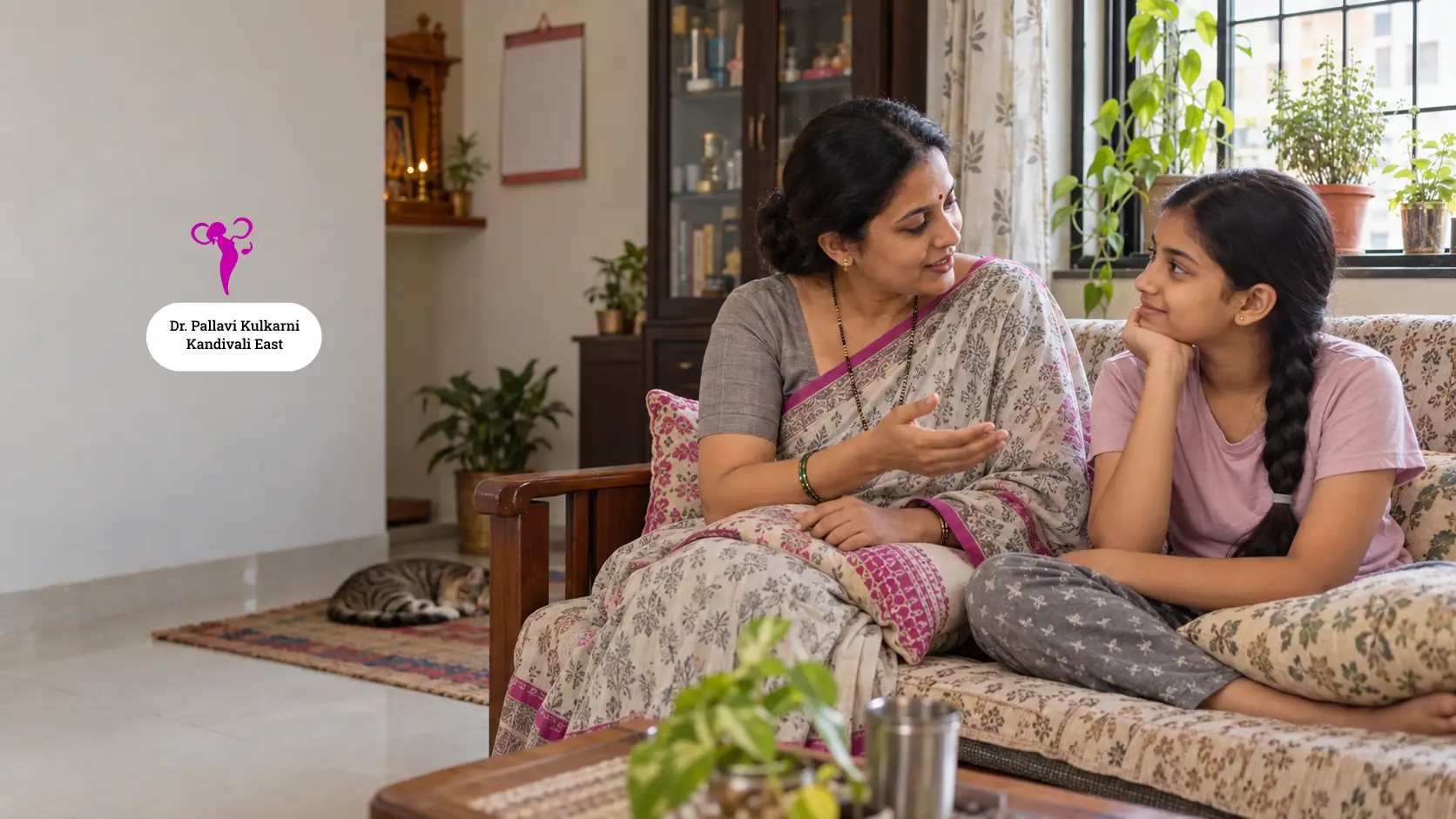
HPV vaccine at a glance
If you are scanning rather than reading, start here. Each row is explained in more detail below.
| Topic | What to know |
|---|---|
| Best age | 9 to 14 years. Protection is strongest and fewer doses are needed. |
| Free option | One dose of Gardasil 4 for girls aged 14 (completed 14, not yet 15) who have not had any HPV vaccine before, at government health facilities. |
| Private option | Usually two doses, six months apart, if started at 9 to 14. Three doses (at 0, 2 and 6 months) if started at 15 or later, or if immunity is weak. |
| Boys | Can be vaccinated privately. The free programme covers girls only. |
| Safety | Mild, short-lived side effects are common. No link with infertility has been found. |
| Older teens and adults | Catch-up is recommended up to 26. From 27 to 45 it is considered after discussion with a doctor. |
| Private cost | Approximately ₹2,000 per dose for Cervavac, ₹4,000 for Gardasil 4 and ₹11,000 for Gardasil 9. |
| Before the vaccine | No Pap test, HPV test or internal examination. |
| Later in life | Vaccinated girls still need regular cervical screening as adults. |
What is HPV, and what does the vaccine do?
Human papillomavirus (HPV) is a very common group of viruses. Most people meet it at some point in adult life, usually without knowing, and the body clears most infections on its own within a year or two.
The concern is the small share of infections that persist. A few high-risk HPV types can slowly change cells in the cervix, and according to the World Health Organization it usually takes 15 to 20 years for those abnormal cells to turn into cancer in a woman with a normal immune system. The same virus is linked to cancers of the vulva, vagina, anus, penis and throat. Other, low-risk types cause genital warts.
The vaccine trains the immune system to block the HPV types it covers before they can settle in. It is preventive only. It cannot clear an infection that is already there or treat abnormal cells, which is why giving it early matters so much.
Depending on the HPV types they cover, HPV vaccines protect against cervical, vaginal and vulvar cancers in females, anal cancer, certain head and neck cancers such as cancers of the throat and the back of the mouth, and genital warts in both males and females.
Why does cervical cancer matter for Indian families?
Cervical cancer is the second most common cancer in Indian women, after breast cancer. The GLOBOCAN 2024 estimates for India put it at 79,360 new cases and 36,319 deaths in a single year.
Yet it is one of the few cancers we know how to prevent. Vaccination in adolescence, screening in adulthood and early treatment of precancerous changes, used together, can make it rare. The vaccine is the step parents control, and it is taken years before any risk begins.
What is the right age for the HPV vaccine?
The ideal window is 9 to 14 years. At this age the immune response is strongest, fewer doses are needed, and protection is in place long before any possible exposure.
Parents sometimes worry that vaccinating early sends a message about sex. It does not. Babies get the hepatitis B vaccine long before they could ever catch hepatitis B, and the HPV vaccine follows the same logic. You do not need to have a conversation about sex to give it. “This vaccine protects you from a cancer later in life” is an honest and complete explanation for a ten-year-old.
If your child is already 15 or older, it is not too late. Teenagers and young adults still benefit, though they usually need three doses. Catch-up vaccination is recommended up to age 26 for anyone who missed it earlier. Between 27 and 45 it can still be considered after discussion with a doctor, though the expected benefit is generally lower, as the US Centers for Disease Control and Prevention also advises. Above 45, HPV vaccines are generally not licensed or routinely recommended. The Adolescent Health Academy of the Indian Academy of Pediatrics (IAP) recommends catch-up vaccination, planned around age, health history and the vaccine used.
“Parents often tell me their daughter is too young for this vaccine. That is exactly why now is the right time. It works best years before it could ever be needed. When I explain it to a twelve-year-old, I say it helps prevent a cancer later in life, and that is usually all she needs to hear.”
- Dr. Pallavi Kulkarni, MBBS, DGO, DNB (OB-GYN), DFP, MRCOG (UK), Fellowship in IVF
How many doses does my child need? The HPV vaccine schedule in India
It depends on which route you take. The free government programme and private clinics follow different, equally valid guidance, which is why parents hear different numbers.
Government programme and private clinic, side by side
| Question | Free government programme | Private clinic |
|---|---|---|
| Who | Girls aged 14 who have not had any HPV vaccine before | Girls and boys from age 9, plus catch-up for older teens and young adults |
| Vaccine | Gardasil 4 (covers four HPV types) | Gardasil 4, Cervavac or Gardasil 9 |
| Doses | One | Usually two if started at 9 to 14, six months apart. Three if started at 15 or later, or if immunity is weak (at 0, 2 and 6 months) |
| Cost | Free | Approximately ₹2,000 (Cervavac), ₹4,000 (Gardasil 4) or ₹11,000 (Gardasil 9) per dose |
| Where | Government health facilities, including Ayushman Arogya Mandirs, community health centres, district hospitals and government medical colleges | A gynaecologist or paediatrician, such as Aarogya Women’s Clinic, Kandivali East |
Sources: Ministry of Health and Family Welfare, Indian Academy of Pediatrics, World Health Organization.
Why one dose there and two or three here?
The World Health Organization allows either one or two doses for girls aged 9 to 14, and for girls and young women aged 15 to 20. It describes the single dose as an alternative, off-label schedule (one that differs from the vaccine’s licensed instructions) with protection comparable to two doses. People with weakened immunity should have at least two doses, and three where possible.
Some of the strongest evidence for one dose comes from India. A multicentre study of Indian girls published in The Lancet Oncology found that, about ten years after vaccination, one dose of a quadrivalent vaccine protected against persistent HPV 16 and 18 infection as well as two or three doses did. India’s public programme uses the single dose to reach as many girls as possible.
Private clinics usually follow IAP guidance and the vaccine’s licensed schedule, which calls for two or three doses. Whichever route you choose, follow the schedule your doctor writes down. If a dose is delayed, the IAP guidance is clear that the course does not start again from the beginning. It simply continues from where it stopped.
Protection lasts a long time. The WHO position paper on HPV vaccines reports antibody levels staying high for at least 12 years with the quadrivalent vaccine, and says there is no evidence so far that a booster dose is needed, although the data continue to be reviewed.
Is the HPV vaccine free in Mumbai?
Yes, for girls aged 14. India launched its national HPV vaccination programme on 28 February 2026, and eligible girls receive a single dose of Gardasil 4 free of cost at government health facilities. It is voluntary, and a parent’s consent is required. After the initial three-month campaign, the vaccine continues to be offered on routine immunisation days.
The programme is for girls who have completed 14 years of age but not yet 15, as Maharashtra’s campaign defines it. During the launch campaign, girls who turned 15 within 90 days were also included. Girls who have already had any HPV vaccine are not eligible, and the programme guidance also excludes pregnancy, a known allergy to yeast or an earlier allergic reaction to a vaccine.
To get it, you can register on the U-WIN portal, ask a health worker to register your daughter, or walk in for registration on the spot, as the government backgrounder describes. The vaccination certificate can be downloaded from U-WIN afterwards. Session days and timings vary by centre, so call ahead before you travel.
In Mumbai, the BMC’s drive was planned to begin with students in BMC-run schools, followed by private and government-aided schools, with the vaccine also offered at the city’s civic health centres, maternity homes, general hospitals and medical colleges. Now that the three-month campaign is over, ask your daughter’s school or the nearest civic health centre when the next session is.
For any child outside the programme, including boys, girls younger than 14 and teenagers older than the programme age, vaccination is available privately. A private clinic should tell you the full cost of the course before the first dose.
Not sure which route suits your child, or whether an earlier dose counts? A short consultation can confirm eligibility, help you choose a vaccine and set a clear schedule.
Should boys get the HPV vaccine too?
Yes, it is worth discussing. HPV causes genital warts and cancers of the throat, anus and penis in men, and boys can pass the virus on. Vaccinating them protects their own health and lowers the spread of HPV in the community.
The free national programme currently covers only girls. Boys can be vaccinated privately with a vaccine licensed for their age, and the IAP Adolescent Health Academy calls for gender-neutral vaccination. The same 9 to 14 window is best. In India, Cervavac, for example, is licensed for boys and men from 9 to 26. At Aarogya Women’s Clinic we vaccinate boys as well as girls.
Dr. Pallavi Kulkarni explains why she recommends the vaccine for boys as well as girls in a short video on early HPV vaccination.
Which HPV vaccines are available in India?
Which is better: Gardasil 4, Cervavac or Gardasil 9? All three protect against HPV 16 and 18, the types behind most cervical cancers. Gardasil 4 and Cervavac cover four HPV types; Gardasil 9 covers nine, so its protection is broader, but it costs more. For most children any of the three is a sound choice, and the right one depends on age, sex, earlier doses and budget.
All three are approved by India’s national drug regulator, the Central Drugs Standard Control Organisation (CDSCO).
HPV vaccines used in India
| Vaccine | Type | HPV types covered | Approximate cost per dose |
|---|---|---|---|
| Gardasil 4 | Quadrivalent (four types) | 6, 11, 16, 18 | ₹4,000 |
| Cervavac (made in India) | Quadrivalent (four types) | 6, 11, 16, 18 | ₹2,000 |
| Gardasil 9 | Nine-valent (nine types) | 6, 11, 16, 18, 31, 33, 45, 52, 58 | ₹11,000 |
Types 16 and 18 cause the large majority of cervical cancers, and types 6 and 11 cause most genital warts. Gardasil 9 adds five more cancer-causing types, so it gives broader cover at a higher price.
A quadrivalent vaccine is still a sound choice. It is the vaccine the national programme uses. The right option depends on your child’s age, sex, health history, any earlier doses and your budget.
These are approximate prices and they change from time to time. Before you book, confirm:
- the current price per dose and the total number of doses
- any consultation charge
- whether the same brand will be in stock for the later doses
Is the HPV vaccine safe?
Yes. HPV vaccines have been used internationally for many years and have a strong safety record. The World Health Organization’s 2026 safety review found no new safety concerns after looking at large, high-quality studies.
Most side effects are mild and settle within a day or two:
- soreness, redness or swelling where the injection was given
- mild fever, headache or tiredness
- nausea, dizziness or aching muscles
A serious allergic reaction is very rare.
Some teenagers feel faint around any injection, usually from nerves rather than the vaccine itself. That is why the dose is given seated.
Does the HPV vaccine affect fertility?
No. This is the worry parents raise most often, and the evidence does not support it. The WHO vaccine safety committee reviewed the research and found no evidence that HPV vaccination causes infertility or premature ovarian insufficiency (periods stopping before 40), and a study in Pediatrics looking specifically at premature ovarian insufficiency after adolescent vaccination found no raised risk either.
Can the vaccine give my child HPV?
No. The vaccine contains no live virus and cannot cause HPV infection or cancer.
When should the HPV vaccine wait?
Tell the doctor before the injection if your child:
- had a severe allergic reaction to an earlier HPV dose or any vaccine, or is allergic to yeast
- is moderately or severely unwell on the day (a mild cold is usually fine, but let the doctor decide)
- has a condition, or takes medicines, that weaken immunity, as three doses may be needed
- is an older teenager or young woman who could be pregnant, as the vaccine is postponed during pregnancy
If a dose was given before a pregnancy was known, there is no cause for alarm. The World Health Organization notes that no specific safety concerns for pregnancy have been found in trials, and the remaining dose is simply delayed until after the pregnancy. Speak to your doctor about when to complete the course.
Does my daughter need a Pap test or internal examination first?
No. This is a common and very understandable worry, so it is worth saying plainly: no HPV test, Pap smear or internal examination is needed before the vaccine. The visit is a conversation about health history, allergies and earlier vaccines, followed by the injection in the upper arm.
Later in life she will still need regular cervical screening, because the vaccine does not cover every cancer-causing HPV type. Vaccination and adult screening work as a pair. Our guide to women’s health after 30 sets out the screening schedule Dr. Pallavi follows.
“Many mothers are relieved when they see what an HPV vaccine visit actually involves: a conversation and an injection in the arm, nothing more. No examination. For a lot of girls it quietly becomes the visit that makes the next gynaecologist appointment, years later, much easier.”
- Dr. Pallavi Kulkarni, MBBS, DGO, DNB (OB-GYN), DFP, MRCOG (UK), Fellowship in IVF
How do I prepare my child for the vaccination appointment?
- Carry your child’s vaccination card and the record of any earlier HPV dose.
- Note down allergies, regular medicines and any long-term health conditions.
- Make sure your child has eaten and had water beforehand.
- Ask whether any other vaccine is due. The HPV vaccine can be given on the same day as other vaccines, in a different arm.
- Keep the explanation simple and positive: this is a vaccine that prevents a cancer later in life.
- For a two-dose or three-dose course, save the next date in your phone and on the card.
What should I do next, based on my child’s age?
- Daughter aged 14, never vaccinated: check the free single-dose government programme through U-WIN or a nearby government health facility.
- Daughter or son aged 9 to 14: book a private two-dose course.
- Child aged 15 or older: ask about catch-up vaccination, usually three doses.
- Child with weak immunity, or one who has already had a dose: bring all records so the schedule can be planned around them.
HPV vaccination at Aarogya Women’s Clinic, Kandivali East
You do not need to memorise HPV types or dose intervals. You only need to start the conversation around age 9 and complete the course your doctor advises.
Dr. Pallavi Kulkarni offers HPV vaccination and counselling for children, girls and boys alike, and for adults up to 45, at Aarogya Women’s Clinic in Thakur Village, Kandivali East. All three vaccines available in India are offered, so you can choose the one that suits your family. A short consultation confirms eligibility, checks any earlier doses and sets a clear schedule. For many girls it is also a comfortable first visit to a gynaecologist, with no examination involved. Our adolescent gynaecology clinic page covers the other reasons teenagers see us, from painful periods to puberty counselling.
Families come to us from Thakur Village, Thakur Complex, Lokhandwala Township and Ashok Nagar in Kandivali East, and from Kandivali West, Borivali, Malad and Goregaon. If you are looking for a gynaecologist in Kandivali East for your daughter’s vaccination, you are welcome to call or message us.
Address: Aarogya Women’s Clinic, Shop no. 48, EMP-53, Evershine Halley, Thakur Village, Kandivali East, Mumbai 400101, next to Achija Restaurant.
Book an HPV vaccination consultation for your daughter at Aarogya Women’s Clinic, Kandivali East. We will check eligibility, any earlier doses and the right schedule.
Clinic hours: Monday to Saturday, 10:00 AM to 9:00 PM. Closed Sundays. Call +91 91366 33062 or +91 93245 97166.
References
- Ministry of Health and Family Welfare, via Press Information Bureau. Rajya Sabha reply on the national HPV vaccination campaign, 17 March 2026. https://www.pib.gov.in/PressReleasePage.aspx?PRID=2241079&lang=2®=3
- Press Information Bureau. Backgrounder: nationwide HPV vaccination programme, 28 February 2026. https://www.pib.gov.in/PressReleasePage.aspx?PRID=2234009®=3&lang=2
- Adolescent Health Academy, Indian Academy of Pediatrics. HPV vaccination in adolescents: white paper, February 2025. https://aha.iapindia.org/pdf/HPV-Adolescent-White-Paper-25-Feb-2025.pdf
- World Health Organization. Cervical cancer fact sheet. https://www.who.int/news-room/fact-sheets/detail/cervical-cancer
- World Health Organization. WHO updates recommendations on HPV vaccination schedule, December 2022. https://www.who.int/news/item/20-12-2022-WHO-updates-recommendations-on-HPV-vaccination-schedule
- World Health Organization. Weekly Epidemiological Record, vol. 101, no. 34, 2026. https://www.who.int/publications/journals/weekly-epidemiological-record/wer101-34
- World Health Organization, Global Advisory Committee on Vaccine Safety. Human papillomavirus vaccines and infertility. https://www.who.int/groups/global-advisory-committee-on-vaccine-safety/topics/human-papillomavirus-vaccines/infertility
- Naleway AL et al. Primary Ovarian Insufficiency and Adolescent Vaccination. Pediatrics, 2018. https://pubmed.ncbi.nlm.nih.gov/30131438/
- International Agency for Research on Cancer. GLOBOCAN 2024: India fact sheet. https://gco.iarc.who.int/media/globocan/factsheets/populations/356-india-fact-sheet.pdf
- Central Drugs Standard Control Organisation. Approved vaccines. https://cdsco.gov.in/opencms/opencms/en/biologicals/Vaccines
- Ministry of Health and Family Welfare. U-WIN vaccination portal. https://uwin.mohfw.gov.in/home
- Basu P et al. Vaccine efficacy against persistent HPV 16/18 infection at 10 years after one, two, and three doses of quadrivalent HPV vaccine in girls in India: a multicentre, prospective, cohort study. The Lancet Oncology, 2021. PMID 34634254. https://pubmed.ncbi.nlm.nih.gov/34634254/
- World Health Organization. Human papillomavirus vaccines: WHO position paper, December 2022. Weekly Epidemiological Record, vol. 97, no. 50. https://iris.who.int/server/api/core/bitstreams/182d51d2-6d08-4963-a643-43d4bc843189/content
- Central Drugs Standard Control Organisation. Quadrivalent HPV vaccine (Cervavac) summary of product characteristics. https://cdsco.gov.in/opencms/resources/UploadCDSCOWeb/2018/UploadSmPC/qHPV%20-%20SmPC%202022.pdf
- US Centers for Disease Control and Prevention. HPV vaccine recommendations. https://www.cdc.gov/hpv/hcp/vaccination-considerations/index.html
- All India Radio News. Maharashtra government launches statewide HPV vaccination campaign for girls, March 2026. https://www.newsonair.gov.in/maharashtra-govt-launches-statewide-hpv-vaccination-campaign-for-girls
- Free Press Journal. Mumbai launches HPV drive for 1.3 lakh adolescent girls in phased rollout, 28 February 2026. https://www.freepressjournal.in/mumbai/mumbai-launches-massive-hpv-drive-13-lakh-adolescent-girls-to-get-cervical-cancer-vaccine-in-phased-rollout
This page is reviewed periodically by Dr. Pallavi Kulkarni. Last reviewed . Programme eligibility, vaccine availability and prices may change, so please confirm with your doctor or a government vaccination centre.
Related reads on our blog
- → Adolescent Gynecology Clinic in Kandivali East
- → Puberty Counselling for Girls
- → Irregular Periods in Teenage Girls
- → Painful Periods in Teenagers
- → Common Women’s Health Problems After 30
- → When to See a Gynecologist by Age and Life Stage
Medically reviewed by Dr. Pallavi Kulkarni, MBBS, DGO, DNB (OB-GYN), DFP, MRCOG (UK), Fellowship in IVF, October 2026. This article is for educational purposes and does not replace personal medical advice. For diagnosis and treatment, please consult a qualified gynaecologist.
Do you have any questions?
Request An AppointmentFrequently asked questions about the HPV vaccine
What is the best age for the HPV vaccine in India?
Between 9 and 14 years. Protection is strongest at this age and fewer doses are needed. Under the national programme, girls aged 14 get one dose free.
Is the HPV vaccine free in Mumbai?
Yes, for girls aged 14 who have not had any HPV vaccine before. They can get one dose of Gardasil 4 free at government health facilities, after registering on the U-WIN portal, through a health worker or on the spot. Other children, including boys, can be vaccinated at private clinics for a fee.
How many doses of the HPV vaccine are needed?
One dose under the government programme. In private practice, usually two doses (0 and 6 months) if started at 9 to 14, and three doses (0, 2 and 6 months) if started at 15 or later, or if the child’s immunity is weak.
Can boys get the HPV vaccine in India?
Yes. Boys can be vaccinated at private clinics with a vaccine licensed for their age, ideally between 9 and 14. The free programme currently covers girls only.
How much does the HPV vaccine cost in Mumbai?
It is free for girls aged 14 under the national programme. Privately, the approximate cost per dose is ₹2,000 for Cervavac, ₹4,000 for Gardasil 4 and ₹11,000 for Gardasil 9. Prices change, so confirm before you book.
Can adults get the HPV vaccine?
Yes. Catch-up vaccination is recommended up to age 26 for anyone who missed it earlier. Between 27 and 45 it can still be considered after discussion with a doctor, though the expected benefit is generally lower. Above 45, HPV vaccines are generally not licensed or routinely recommended.
Does the HPV vaccine cause infertility?
No. The WHO vaccine safety committee found no evidence that HPV vaccination causes infertility or premature ovarian insufficiency, and a study of premature ovarian insufficiency after adolescent vaccination found no raised risk either.
Which HPV vaccine is better: Gardasil 4, Cervavac or Gardasil 9?
All three protect against HPV 16 and 18, the types behind most cervical cancers. Gardasil 4 and Cervavac cover four HPV types and Gardasil 9 covers nine, so its protection is broader, but it costs more. For most children any of the three is a sound choice.
Is the HPV vaccine safe?
Yes. HPV vaccines have a strong safety record, and a 2026 WHO safety review found no new safety concerns. Side effects such as a sore arm, mild fever or headache are common and settle in a day or two. A serious allergic reaction is very rare.
How long does HPV vaccine protection last? Is a booster needed?
Protection is long-lasting. WHO reports antibody levels staying high for at least 12 years with the quadrivalent vaccine, and there is no evidence so far that a booster dose is needed.
Can the HPV vaccine be given with other vaccines?
Yes. WHO says HPV vaccines can be given on the same day as other vaccines, using a separate syringe and a different injection site.
What happens if we miss a dose of the HPV vaccine?
The most important point is that you do not need to restart the vaccination schedule, even if the dose is delayed by several months or years. The course continues from where it stopped, so contact your doctor to schedule the remaining dose as soon as you can.
Is a Pap smear or internal examination needed before the HPV vaccine?
No. No test or internal examination is needed before HPV vaccination. The visit is a conversation about health history and the injection in the upper arm. Keep in mind that the vaccine prevents new HPV infections; it does not treat an existing infection or cervical abnormalities. Women who are due for cervical cancer screening should still have it according to their age and national guidelines, whether or not they have been vaccinated. Vaccination does not replace a Pap smear or HPV test.
Will my vaccinated daughter still need cervical screening?
Yes. The vaccine prevents most, but not all, cervical cancers, so she should follow cervical screening advice as an adult.
HPV vaccine kis umar mein lagwana chahiye, aur kya yeh free hai?
Sabse achhi umar 9 se 14 saal hai, kyunki is umar mein protection sabse strong hota hai aur kam doses lagte hain. Sarkari programme mein 14 saal ki ladkiyon ko ek dose free milta hai. Baaki bachche, ladke bhi, private clinic mein vaccine lagwa sakte hain.
What Our Patients Say
Experienced Gynecologist in Kandivali East with a Patient-Centered Approach
Dr. Pallavi Kulkarni is a highly regarded Gynecologist in Kandivali East, praised for her calm, compassionate, and patient-centered care. Her supportive approach helps women feel heard, respected, and confident about their treatment decisions.