
Fertility Testing: What Gets Tested, When to Do It, and What the Numbers Mean
Fertility testing helps understand your egg reserve, ovulation, and chances of pregnancy using tests like AMH, FSH, and ultrasound. If you have been trying to conceive without success, or you are just wondering where you stand, a basic fertility workup can replace the guesswork with actual information.
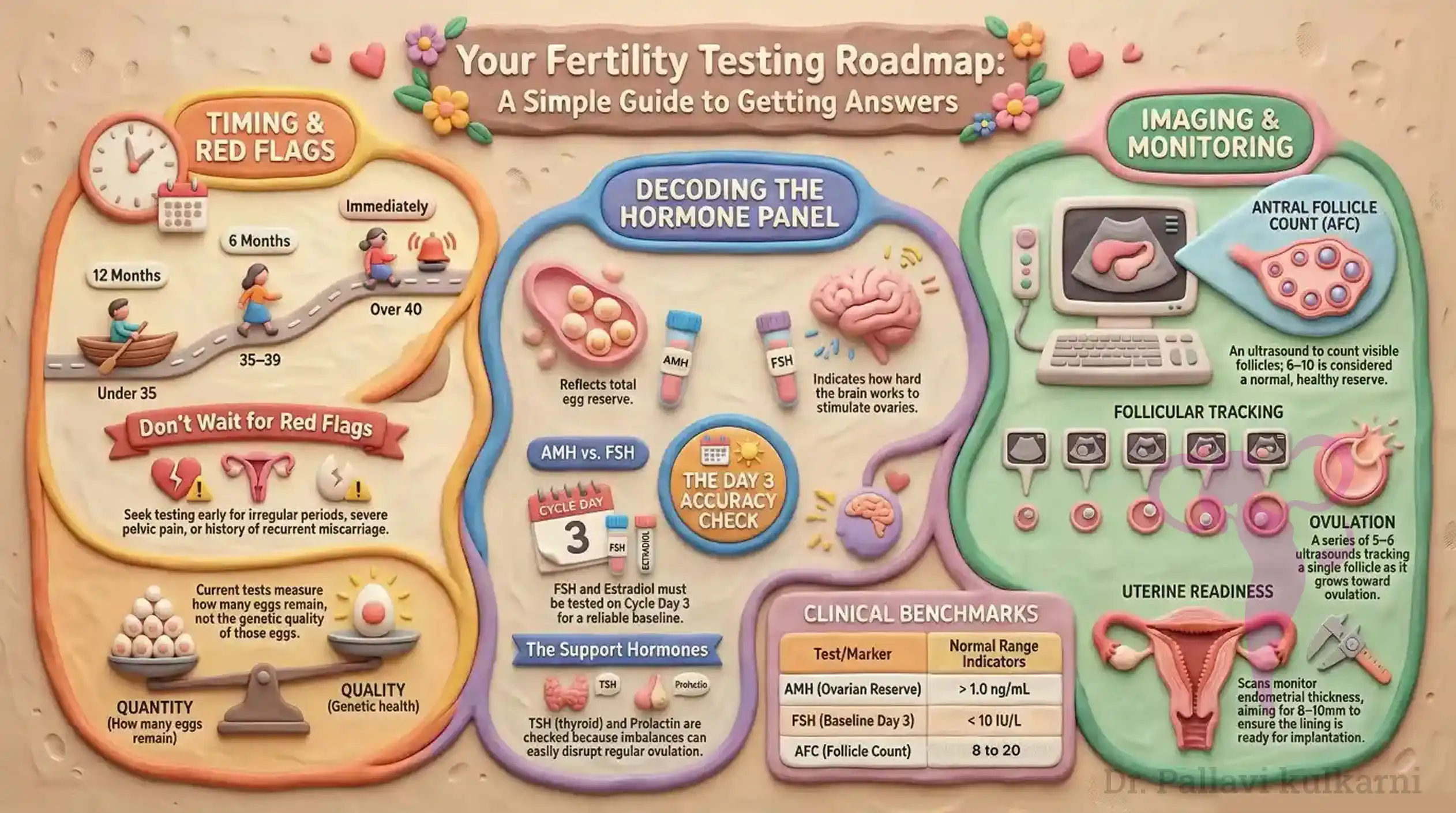
When to get tested
General rule of thumb:
- Under 35: after 12 months of trying without success.
- 35 to 39: after 6 months.
- 40 and over: right away.
Some things warrant testing earlier regardless of age: irregular or absent periods, very painful periods, pain during sex (which can point to endometriosis), signs like facial hair or persistent acne that suggest excess androgens (often PCOS-related), or a history of recurrent miscarriage or pelvic infections. PCOS is particularly common in Indian women, by the way. Some studies put the prevalence at 20% or higher. If you are seeing those signs, don’t brush them off.
If any of those apply, don’t wait. Just book the appointment. You can start with your regular gynaecologist — you don’t need to go straight to a fertility specialist.
Wondering if it is time to get tested? A basic fertility evaluation can give you clarity and help you plan your next steps.
The blood work
Fertility blood tests measure the hormones running your cycle.
AMH (Anti-Mullerian Hormone)
AMH is produced by developing follicles and reflects how many eggs you have left. Not how good they are, just how many. It can be drawn on any day of your cycle, which makes it the easiest to schedule. Most clinics lean on this number when estimating how you would respond to IVF meds.
FSH (Follicle-Stimulating Hormone)
FSH has to be drawn on Day 3 of your cycle. FSH tells the ovaries to start growing follicles. When it is high, it usually means the ovaries are not responding well, so the brain keeps cranking up the signal. High FSH is the brain yelling because nobody is picking up.
Estradiol (E2)
Estradiol is always read alongside FSH. High estradiol on Day 3 can push FSH down artificially, making the numbers look better than they are. You need both.
LH (Luteinizing Hormone)
LH triggers ovulation — it is what those ovulation predictor kits detect. If your doctor suspects PCOS, they will look at your LH-to-FSH ratio, which tends to run high.
TSH (Thyroid-Stimulating Hormone)
Get this checked. An underactive thyroid messes with your cycle and raises miscarriage risk, and it is ridiculously common in India. A lot of women find out only when they start investigating fertility. The good news is it is easy to treat once you know.
Prolactin
Prolactin drives milk production. If it is elevated and you are not pregnant or breastfeeding, it can suppress ovulation. Worth checking if your cycles are off.
AMH vs. FSH
AMH measures egg quantity, any day. FSH measures how hard the brain is working to get the ovaries going, Day 3 only. Clinics use AMH for IVF planning; they use FSH for choosing medication doses.
What trips people up: a low AMH with a normal FSH does not mean you cannot conceive. It means your reserve is lower than expected and you should not sit on it. The numbers help you plan. They are not the verdict.
Imaging
A pelvic ultrasound checks the uterus and ovaries for fibroids, polyps, or cysts. Baseline scan, done early in the cycle. Most gynaecologists in India will order this first, and it is available at pretty much any diagnostic centre.
The antral follicle count (AFC) happens between Days 2 and 5. The tech counts small follicles visible on each ovary. Under 6 is low reserve, 6 to 10 is normal, over 12 is high (and sometimes suggests PCOS). Basically a real-time version of your AMH.
An HSG (hysterosalpingography) checks whether your fallopian tubes are open. They inject dye through the cervix and take an X-ray. Uncomfortable, sometimes properly painful, but it is over in about 15 minutes. Most fertility doctors in India want this done early on. Some clinics offer a saline sonogram instead, which hurts less, but HSG is still more common here.
Diagnostic laparoscopy is surgery. Not routine. Reserved for suspected endometriosis when nothing else has given a clear answer.
Follicular monitoring
If your doctor wants to track ovulation directly, expect a series of transvaginal ultrasounds across your cycle. Usually 5 or 6, starting around Day 9 or 10. This gets prescribed a lot in India, sometimes even before other tests, because it is cheap and you get real-time information.
They are watching one follicle become dominant, grow, and release. They are also checking that your uterine lining is thickening properly for implantation.
The scan takes 10 to 20 minutes and feels about like a pelvic exam. Pressure and awkwardness, mostly. If it actually hurts, say something, because that is not normal. And if you are not comfortable with a transvaginal scan, tell your doctor. An abdominal ultrasound can work in some cases, though it is less detailed.
Need help understanding your fertility test results? Dr. Pallavi Kulkarni can walk you through the numbers and what they mean for you.
Common worries
“My AMH is low, so my eggs must be bad.”
AMH and FSH tell you how many, not how good. Egg quality is mostly about age, and there is no blood test for it. Low reserve means move faster, not give up.
“Will the scans hurt?”
Usually no. Some pressure. Honestly not the hard part of this process.
“What is this going to cost?”
At most private labs, AMH runs ₹1,200 to ₹2,500, FSH ₹500 to ₹1,000. A full initial workup — bloodwork plus imaging — usually lands between ₹5,000 and ₹15,000. Depends on the city and whether you are going to a standalone lab like Thyrocare or SRL versus doing everything at a fertility clinic. Metro cities are pricier. Government hospitals do some of this for free or nearly free, but the waits are long. Ask for a breakdown of charges upfront. Those bundled “fertility packages” at private clinics sometimes include tests you do not need yet.
“Should I go to a fertility clinic or a regular gynaecologist?”
Start with your gynaecologist. Get the basic workup done. If the results point toward IUI or IVF, that is when a fertility specialist makes sense. Going straight to an IVF clinic can mean getting pushed toward expensive treatments before anyone has tried the simpler stuff. I have heard this complaint more times than I can count.
Get your partner tested too
I am putting this near the end but it should really happen at the beginning. A semen analysis costs ₹500 to ₹1,500 at most labs. They are checking volume (1.5 mL or more), concentration (15 million per mL or more), and motility. Running months of testing on one partner before even checking the other is a waste of time, and it happens all the time.
There is still a tendency in India to assume the issue is with the woman, so men’s testing gets delayed or just never happens. Push for it. Male factor is involved in something like 40% of fertility problems. That is not a small number to be ignoring.
Using the results
Best question to ask your doctor after getting results: “What specifically changes about our approach?” Not whether your numbers are good or bad. That depends on your age, your goals, and how much time you are willing to give it. A 35 year old with an AMH of 1.0 is in a very different situation than a 28 year old with the same number, even though the lab report looks identical.
One thing worth knowing: fertility treatment in India costs a fraction of what it does in the US or UK, so IUI and IVF are more accessible than a lot of people realise. But cheaper does not mean cheap. An IVF cycle still runs ₹1.5 to ₹2.5 lakh, and you may need more than one.
The whole point of testing is to stop guessing.
Ready to get your fertility evaluated? Dr. Pallavi Kulkarni at Aarogya Women’s Clinic, Kandivali East can guide you through the right tests and what the results mean for your situation.
Women from Kandivali West, Borivali East, Borivali West, Malad East, Malad West, Goregaon East, and Thakur Village visit Aarogya Women’s Clinic for fertility evaluation and gynecological care.